. 2018 Jan 8;8(1):86.
doi: 10.1038/s41598-017-18216-x.

An assay for the identification of Plasmodium simium infection for diagnosis of zoonotic malaria in the Brazilian Atlantic Forest

Affiliations

An assay for the identification of Plasmodium simium infection for diagnosis of zoonotic malaria in the Brazilian Atlantic Forest

Denise Anete Madureira de Alvarenga et al. Sci Rep. .

Erratum in

Abstract

Zoonotic malaria poses a unique problem for malaria control. Autochthonous cases of human malaria in the Atlantic Forest have recently been attributed to Plasmodium simium, a parasite that commonly infects non-human primates in this Brazilian biome. However, due to its close similarity at both the morphological and molecular level to Plasmodium vivax, the diagnosis of P. simium in this region remains problematic. Therefore, a diagnostic assay able to accurately identify P. simium is important for malaria surveillance. Based on mitochondrial genome sequences, primers were designed to amplify a region containing a SNP specific to P. simium. This region can then be digested with the restriction enzyme HpyCH4III, which results in digestion of P. simium sequences, but not of any other malaria parasite. Fifty-two human and monkey blood samples from different regions and infected with different Plasmodium species were used to validate this protocol. This easy and inexpensive tool can be used for the diagnosis of P. simium in non-human primates and human infections from the Atlantic Forest region to monitor zoonotic malaria transmission in Brazil.


Conflict of interest statement

The authors declare that they have no competing interests.

Figures
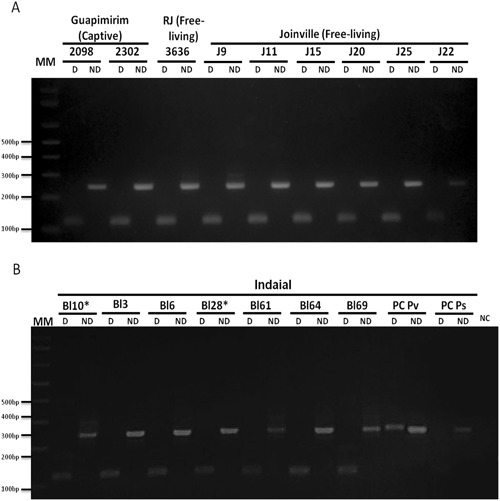
Figure 1
Figure 1
Differential Diagnosis of Plasmodium simium infection by nested/PCR followed by a digestion with HpyCH4III restriction enzyme of 16 non-human primate samples: (A) 2 captive NHP from Rio de Janeiro/RJ (Sapajus xanthosternos 2098; Cacajao melanocephalus 2302), one free-living Alouatta g. clamitans from Rio de Janeiro State (3636) and 6 free-living Alouatta g. clamitans from Joinville/SC, Brazil (J9, J11, J15, J20, J22, J25); (B) 7 Alouatta g. clamitans from CEPESBI, Indaial, SC, Brazil (Bl3, Bl6, Bl10, Bl28, Bl61, Bl64, Bl69), *Captive NHPs, all the other were free-living. More details about each sample see Additional file 1. 3% agarose gel stained with ethidium bromide. MM:1 kb Plus Ladder (ThermoFischer). Reactions were performed simultaneously in the same thermocycler and splited in different gels. PC Pv: Positive Control for P. vivax, PC P!s: positive control for P. simium. NC: Negative Control (without DNA).
Figure 2
Figure 2
Differential diagnosis of Plasmodium simium infection by nested/PCR followed by a digestion with HpyCH4III restriction enzyme of 9 infected human samples from Atlantic Forest in Rio de Janeiro/RJ (H2 – H9) and one from Amazon endemic region (H1) according to Additional file 1. 3% agarose gel stained with ethidium bromide. MM:1 kb Plus Ladder (ThermoFischer, Calrsbad, CA, USA). Reactions were performed simultaneously in the same thermocycler and splited in different gels.D: Digested; ND: Non Digested. PC Pv: Positive Control for P. vivax, PC Ps: positive control for P. simium. NC: Negative Control (without DNA).
Figure 3
Figure 3
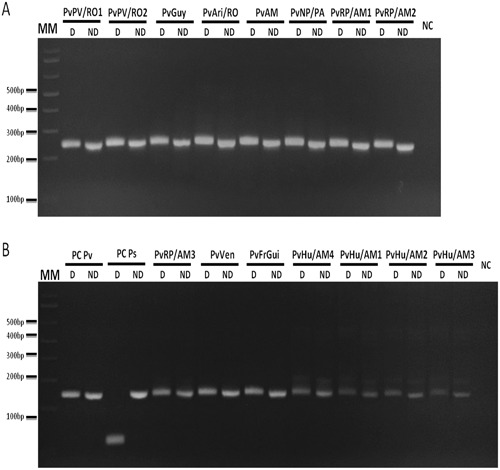
Nested/PCR-RFLP of P. vivax DNA samples. 15 DNA samples from P. vivax infected individuals from different parts of Amazon: Porto Velho/Rondônia State, Brazil (PvPV/RO1 and 2), Guyana (PvGuy), Ariquemes/Rondônia State, Brazil (PvAri/RO), Venezuela (PvVen), French Guiana (PvFrGui), Novo progresso/Pará State, Brazil (PvNP/PA), Rio Pardo/Amazonas State, Brazil (PvRP/AM1, 2 and 3), Humaita/Amazonas State, Brazil (PvHu/Am1, 2, 3 and 4) and unknown city in Amazonas State, Brazil (PvAM) were used for Nested PCR amplification followed by digestion with HpyCH4III restriction enzyme. 3% Agarose gel stained with ethidium bromide. Name tags above gels indicated the patients according to Additional file 2. Reactions were performed simultaneously in the same thermocycler and splited in different gels. MM: 1 kb Plus Ladder. D: Digested (8 μL of digestion); ND: Non Digested (the equivalent amount of PCR product used in the digestion, 6.5 μL of samples and 5 μL of controls); PC Pv: positive control of P. vivax (pool of samples from infected patient from Amazonia); PC Ps: positive control of P. simium (Alouatta g. clamitans infected with P. simium previously sequenced); NC: negative Control.
Figure 4
Figure 4
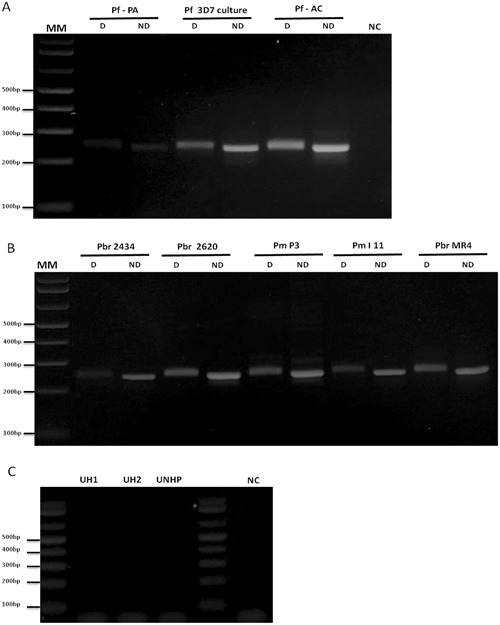
Nested/PCR-RFLP of (A) Plasmodium falciparum samples, two patients from Pará State (Pf – PA) and Acre State (Pf – AC) and Pf 3D7 culture (diluted 1:100); (B) Plasmodium brasilianum/Plasmodium malariae, two NHPs (Pbr 2434 and Pbr 2620), two patients (Pm P3 and Pm l11) and Plasmodium brasilianum from MR4 (diluted 1:100 in water); (C) Negative controls of PCR: two uninfected humans (UH - 1 and 2), one uninfected NHP (UNHP), and negative control of PCR (NC - without DNA). Reactions were performed simultaneously in the same thermocycler and splited in different agarose gels. 3% Agarose gelstained with ethidium bromide. MM: 1 kb Plus Ladder. D: Digested; ND: Non Digested.
Figure 5
Figure 5
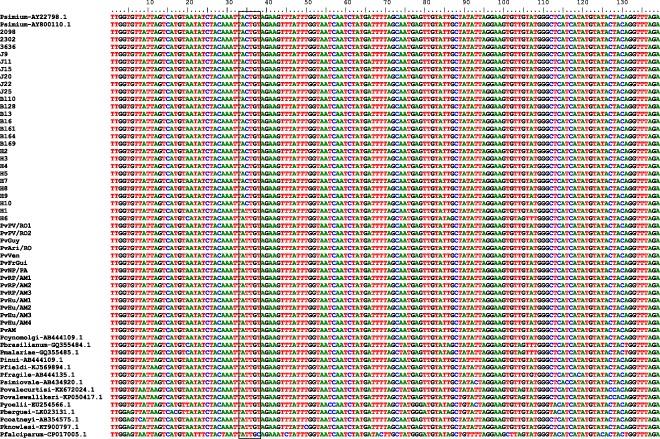
Alignment of partial mitochondrial sequences of Plasmodium simium isolated from captive (2098, 2302, 3636, BL10 and BL28) and free living NHPs (BL3, BL6, BL61, BL64, BL69, J9, J11, J15, J20, J22 and J25) from Atlantic forest; humans (H2, H3, H4, H5, H7, H8, H9 and H10) infected with P. simium at Atlantic Forest; human samples obtained in Atlantic Forest infected with P. vivax (H1 and H6); P. vivax isolated from human from Brazilian Amazonia: (PvPV/RO1 and PvPV/RO2 (Porto Velho, Rondonia), PvGuy (Guyana), PvAri/RO (Ariquimedes, Rondônia), PvVen (Venezuela), PvFrGui (French Guiana), PvNP/PA (Novo Progresso, Pará), PvRP/AM1- PvRPAM3 (Rio Pardo, Amazonia), PvHu/AM1 - PvHu/AM4 (Humaita, Amazonia) and PvAM (Amazonia State). These sequences were identified herein. Genbank sequences from P. simium (two sequences), P. cynomolgi, P. inui, P.fieldi, P. fragile, P. coatneyi, P. simiovale, P. berguei, P. falciparum, P. ovale curtisi, P. ovale wallikeri, P. yoelii and P. knowlesi (accession number at genbank included in the name of sequence). Box delimited the site of HpyCH4III restriction enzyme (ACNGT), including SNP T>C at position 3535,.
Figure 6
Figure 6
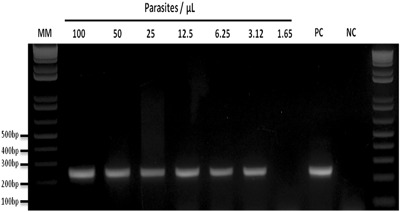
Detection limit of the Nested-PCR for a differential diagnosis of Plasmodium simium. P. simium human DNA sample were serially diluted 2-fold with a starting parasitemia of 100 parasites/µL to 1.65 parasites/µL. 2% Agarose gel stained with ethidium bromide. MM:1 kb Plus Ladder, PC: positive control, NC: negative control (without DNA).

References

    1. Cox-Singh J. Zoonotic malaria: Plasmodium knowlesi, an emerging pathogen. Curr Opin Infect Dis. 2012;25:530–536. doi: 10.1097/QCO.0b013e3283558780. - DOI - PubMed
    1. Singh B, et al. A large focus of naturally acquired Plasmodium knowlesi infections in human beings. Lancet. 2004;363:1017–1024. doi: 10.1016/S0140-6736(04)15836-4. - DOI - PubMed
    1. Antinori S, Galimberti L, Milazzo L, Corbellino M. Plasmodium knowlesi: the emerging zoonotic malaria parasite. Acta Trop. 2013;125:191–201. doi: 10.1016/j.actatropica.2012.10.008. - DOI - PubMed
    1. Yusof R, et al. High proportion of knowlesi malaria in recent malaria cases in Malaysia. Malar J. 2014;13:168. doi: 10.1186/1475-2875-13-168. - DOI - PMC - PubMed
    1. Deane LM, Deane MP, Ferreira, Neto J. Studies on transmission of simian malaria and on the natural infection of man with Plasmodium simium in Brazil. Bull World Health Organ. 1966;35:805–808. - PMC - PubMed

Publication types