Review
. 2017 Dec 22:11:730.
doi: 10.3389/fnins.2017.00730. eCollection 2017.

Deciphering the Neural Control of Sympathetic Nerve Activity: Status Report and Directions for Future Research

Affiliations
Review

Deciphering the Neural Control of Sympathetic Nerve Activity: Status Report and Directions for Future Research

Susan M Barman et al. Front Neurosci. .

Abstract

Sympathetic nerve activity (SNA) contributes appreciably to the control of physiological function, such that pathological alterations in SNA can lead to a variety of diseases. The goal of this review is to discuss the characteristics of SNA, briefly review the methodology that has been used to assess SNA and its control, and to describe the essential role of neurophysiological studies in conscious animals to provide additional insights into the regulation of SNA. Studies in both humans and animals have shown that SNA is rhythmic or organized into bursts whose frequency varies depending on experimental conditions and the species. These rhythms are generated by brainstem neurons, and conveyed to sympathetic preganglionic neurons through several pathways, including those emanating from the rostral ventrolateral medulla. Although rhythmic SNA is present in decerebrate animals (indicating that neurons in the brainstem and spinal cord are adequate to generate this activity), there is considerable evidence that a variety of supratentorial structures including the insular and prefrontal cortices, amygdala, and hypothalamic subnuclei provide inputs to the brainstem regions that regulate SNA. It is also known that the characteristics of SNA are altered during stress and particular behaviors such as the defense response and exercise. While it is a certainty that supratentorial structures contribute to changes in SNA during these behaviors, the neural underpinnings of the responses are yet to be established. Understanding how SNA is modified during affective responses and particular behaviors will require neurophysiological studies in awake, behaving animals, including those that entail recording activity from neurons that generate SNA. Recent studies have shown that responses of neurons in the central nervous system to most sensory inputs are context-specific. Future neurophysiological studies in conscious animals should also ascertain whether this general rule also applies to sensory signals that modify SNA.

Keywords: baroreceptor reflex; central command; exercise pressor response; sympathetic nerve activity; vestibulosympathetic reflex.


Figures
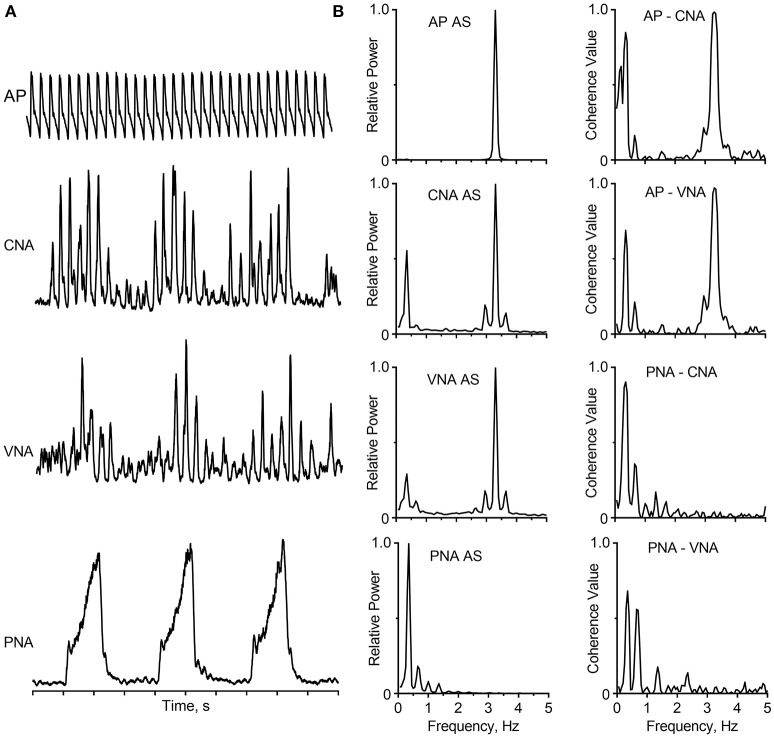
Figure 1
Figure 1
Cardiac-related and respiratory activity recorded from two branches of the left stellate ganglion in a barbiturate-anesthetized, paralyzed, and artificially-ventilated cat. (A) Traces (top to bottom) show the arterial pressure (AP), cardiac nerve activity (CNA), vertebral nerve activity (VNA), integrated phrenic nerve activity (PNA), and time base (1 s/division). The capacity-coupled preamplifier bandpass setting was 30–3,000 Hz (CNA, VNA) or 10–1,000 Hz (PNA). Signals were passed through a 50/60 Hz noise eliminator (Hum Bug; Quest Scientific) and a moving averager (CWE, Model MA-821RSP) with a 50-ms (CNA, VNA) or 100-ms (PNA) time constant. (B) Autospectra (left) and coherence functions (right) for these signals. Spectra are based on 35 20-s windows with 50% overlap, and they have a frequency resolution of 0.05 Hz per bin. Data showing cardiac- and respiratory-related rhythms appear in CNA and VNA have been published (Barman and Kenney, ; Barman, 2016); this figure has been created de novo but does not contain any original data.
Figure 2
Figure 2
Neural pathways that regulate blood pressure. The minimal “textbook” pathway that produces baroreceptor reflexes is denoted using black-filled symbols and thick arrows, and consists of neurons in the nucleus tractus solitarius (NTS) that receive baroreceptor inputs, interneurons in the reticular formation of the caudal ventrolateral medulla (CVLM), bulbospinal neurons in the rostral ventrolateral medulla (RVLM), and sympathetic preganglionic neurons located in the intermediolateral cell column (IML) of the thoracic and upper lumbar spinal cord. However, many other neural structures and pathways participate in regulating sympathetic nervous system effects on the control of blood pressure, which are indicated using gray-filled symbols and thin arrows. The medullary raphe nuclei act in concert with the RVLM in adjusting sympathetic nervous system outflow to the cardiovascular system (Barman and Gebber, 2000). Both the RVLM and raphe nuclei receive substantial inputs through particular regions of the reticular formation (RF), including the lateral tegmental field (LTF) (Barman and Gebber, 1987, 1989). In addition to baroreceptor inputs, a variety of other visceral inputs including those from chemoreceptors contribute to regulating sympathetic nervous system activity (Thorén et al., ; Guyenet, 2000), as do somatic signals relayed from the spinal cord (Wilson and Hand, ; Boscan et al., 2002) and vestibular system (Yates et al., 2014). Somatic signals are conveyed to the RVLM through the CVLM and other regions of the reticular formation (Masuda et al., ; Steinbacher and Yates, 1996a,b), the parabrachial nucleus and periaqueductal gray (Balaban, ; Andrew, 2010), the caudal portions of the vestibular nuclei (Holstein et al., 2011a), and regions of the cerebellum (uvula, fastigial nucleus) (Nisimaru, ; Yates et al., 2014). Cerebellar influences on the control of blood pressure are mediated in part through connections with parabrachial neurons that project to NTS (Bradley et al., 1991). Several midbrain regions participate in regulating blood pressure by providing inputs to NTS and RVLM, including the periaqueductal gray (Lovick, 1993), parabrachial nucleus (Saper and Loewy, ; Hamilton et al., ; Mraovitch et al., ; Felder and Mifflin, ; Herbert et al., ; Mifflin and Felder, ; Paton et al., ; Krukoff et al., 1993), and mesencephalic locomotor region (MLR) (Degtyarenko and Kaufman, 2005). The MLR regulates locomotion in some species, and projections from the MLR to NTS likely change the set point of the baroreceptor reflex during locomotion (Degtyarenko and Kaufman, 2005). Hypothalamic nuclei (Ross et al., ; Berk and Finkelstein, ; Kannan and Yamashita, ; van der Kooy et al., ; Jordan et al., ; Mifflin et al., ; Wible et al., ; Mifflin and Felder, ; Markgraf et al., ; Allen and Cechetto, ; Cechetto and Chen, ; Martin and Haywood, ; Ebihara et al., ; Martin Haywood and Haywood, ; Kawano and Masuko, ; Badoer, ; Coote et al., ; Fontes et al., ; Cravo et al., ; Horiuchi et al., ; Kawabe et al., ; Bowman et al., ; Sapru, 2013) provide inputs to NTS and/or the RVLM, as do the amygdala (Kapp et al., ; Schwaber et al., ; van der Kooy et al., ; Saha, ; Saha et al., ; Bowman et al., 2013), and prefrontal and insular cortices (Shipley, ; van der Kooy et al., ; Cechetto and Chen, , ; Verberne and Owens, ; Owens and Verberne, ; Gabbott et al., ; Sévoz-Couche et al., 2006). Inputs from the telencephalon to the RVLM and NTS are both direct and indirect through relays in the hypothalamus, periaqueductal gray, and parabrachial nucleus (Saper and Loewy, ; Cechetto and Chen, , ; Krukoff et al., ; Hardy, 1994).

References

    1. Abdel-Rahman A. R., Russ R., Strickland J. A., Wooles W. R. (1987). Acute effects of ethanol on baroreceptor reflex control of heart rate and on pressor and depressor responsiveness in rats. Can. J. Physiol. Pharmacol. 65, 834–841. 10.1139/y87-134 - DOI - PubMed
    1. Acharya U. R., Joseph K. P., Kannathal N., Lim C. M., Suri J. S. (2006). Heart rate variability: a review. Med. Bio. Eng. Comput. 44, 1031–1051. 10.1007/s11517-006-0119-0 - DOI - PubMed
    1. Adrian E. D., Bronk D. W., Phillips G. (1932). Discharges in mammalian sympathetic nerves. J. Physiol. 74, 155–133. 10.1113/jphysiol.1932.sp002832 - DOI - PMC - PubMed
    1. Allen G. V., Cechetto D. F. (1992). Functional and anatomical organization of cardiovascular pressor and depressor sites in the lateral hypothalamic area: I. Descending projections. J. Comp. Neurol. 315, 313–332. 10.1002/cne.903150307 - DOI - PubMed
    1. Almeida F. R., Perry J. C., Futuro-Neto H. A., Almeida V. R., Sebastião R. M., Andersen M. L., et al. (2014). Cardiovascular function alterations induced by acute paradoxical sleep deprivation in rats. Clin. Exp. Hypertens. 36, 567–571. 10.3109/10641963.2014.881843 - DOI - PubMed
