. 2017 Nov 26;8(65):108292-108302.
doi: 10.18632/oncotarget.22660. eCollection 2017 Dec 12.

Secretory leukocyte protease inhibitor (SLPI) as a potential target for inhibiting metastasis of triple-negative breast cancers

Affiliations

Secretory leukocyte protease inhibitor (SLPI) as a potential target for inhibiting metastasis of triple-negative breast cancers

Sergey V Kozin et al. Oncotarget. .

Abstract

SLPI has been implicated in the progression and metastasis of certain cancers. However, the effects of SLPI seem to be tumor-specific and the mechanisms remain poorly defined. Here, we demonstrate that highly metastatic, triple-negative breast cancer (TNBC) 4T1 cells secreted more SLPI compared to their non-metastatic counterparts. Furthermore, SLPI secretion directly correlated with spontaneous lung metastasis from 4T1 tumors orthotopically implanted in mice. Consistent with our experimental results, we also found that higher SLPI expression levels correlate with worse clinical outcome in basal/TNBC patients. Using high-throughput screening we identified a novel compound, C74, which significantly inhibits SLPI secretion. C74 administration in our mouse model slows the growth of primary 4T1 tumors and inhibits their dissemination to the lung. We also discovered that SLPI physically interacts with the retinoblastoma tumor suppressor protein (Rb) and releases FoxM1 from the Rb-FoxM1 complex, which may activate FoxM1 target genes involved in breast cancer metastasis.

Keywords: FoxM1; SLPI; anti-metastatic compound; triple-negative breast cancer.


Figures
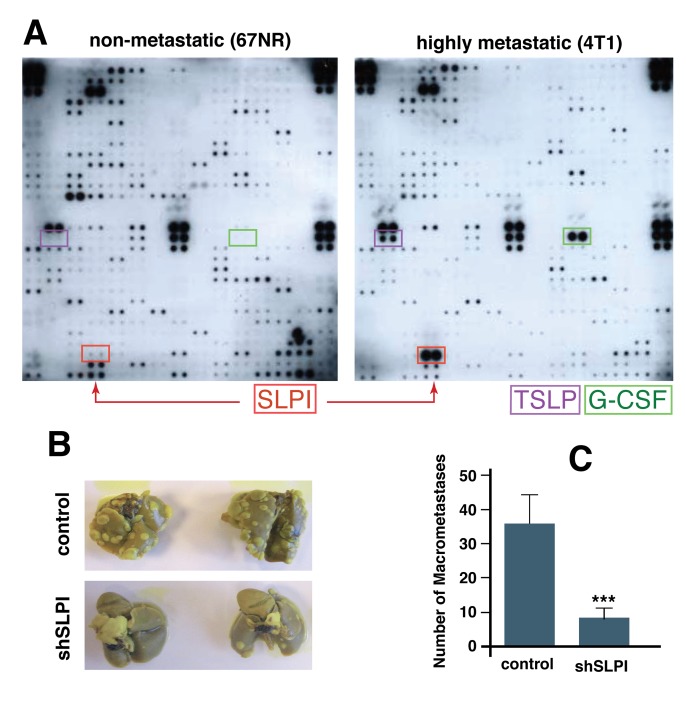
Figure 1
Figure 1. SLPI is upregulated in highly metastatic cancer cells and promotes spontaneous lung metastasis in mice
A. Comparison of secreted proteins in non-metastatic (67NR) and highly metastatic (4T1) cell conditioned media using a protein array that detects 350 mouse proteins. Arrows indicate secreted proteins markedly increased in highly metastatic cells including SLPI. B. Down-regulation of SLPI using shRNA in 4T1 cells inhibits lung metastases. The mice were implanted with control or SLPI-shRNA 4T1 tumors orthotopically and the lungs were examined for metastases (whitish nodules) 21 days after primary tumor resection. Lungs from mice pre-implanted with SLPI-shRNA tumors clearly exhibited fewer metastases (shSLPI). C. The number of macrometastases (colonies at least 0.5 mm in diameter) per mouse was significantly less in the mice bearing the SLPI-shRNA tumors (n = 7 for each group, *p = 0.004).
Figure 2
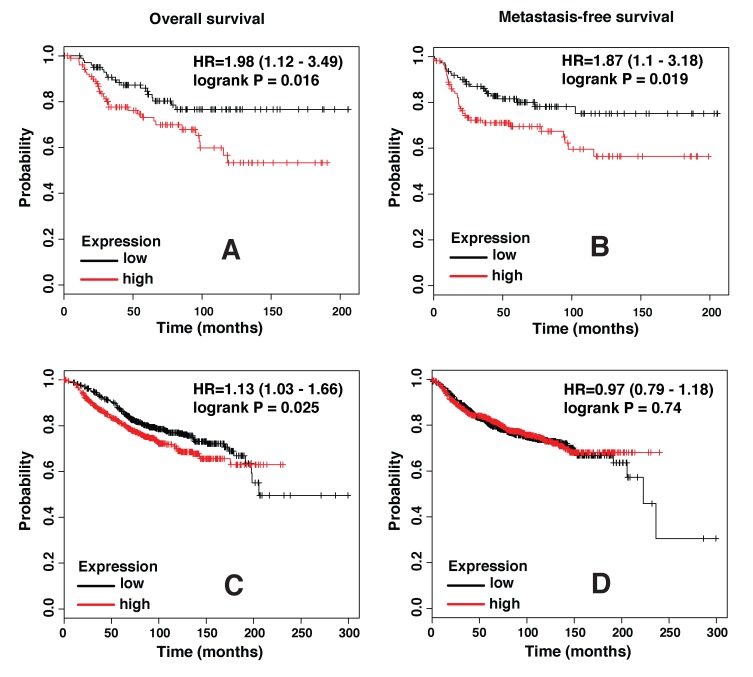
Figure 2. SLPI expression levels strongly correlate with poor outcome in triple negative/basal-like subtype of breast cancer
A. Plots show overall survival (n = 204), and B. distant metastasis-free survival (n = 229) in basal breast cancer patients with low (black trace) or high (red trace) levels of SLPI expression based on the median value. C. Overall survival (n = 1117) and D. distant metastasis-free survival (n = 1609) in all subgroups of breast cancer patients with low or high SLPI expression. HR, hazard ratio.
Figure 3
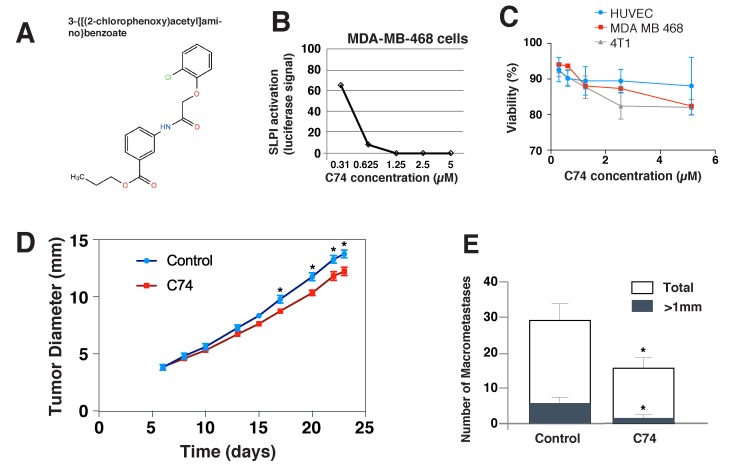
Figure 3. In vitro effects of the anti-SLPI compound C74 and its effects on the metastasis and primary tumors in vivo
A. The molecular structure of the selected compound C74. B. C74 inhibition of SLPI expression by MDA-MB-468 cells. Cells were treated with C74 (0.31 to 5 µM) for 24 hours, and SLPI expression was quantified using luciferase activity driven by the SLPI promoter. C. Viability of HUVEC, MDA-MB-468 and 4T1 cancer cells treated with C74 for 24 hours evaluated using a MTT assay. D., E. Anti-SLPI compound C74 suppressed tumor growth and metastasis of 4T1 TNBC in mice. (D) 4T1 cells were injected in the mammary fat pad of female BALB/c mice and the mice were treated with C74 (25 mg/kg) daily for 12 days (from day 6 to day 17) via intraperitoneal injection. Error bars represent SEM; n = 8 mice/group, * P < 0.05. (E) Quantification of the numbers of large (>1 mm, black bar) and total lung metastases (white bar) observed after harvesting lungs on day 23. Error bars represent SEM; n = 8 mice/group, * P < 0.05.
Figure 4
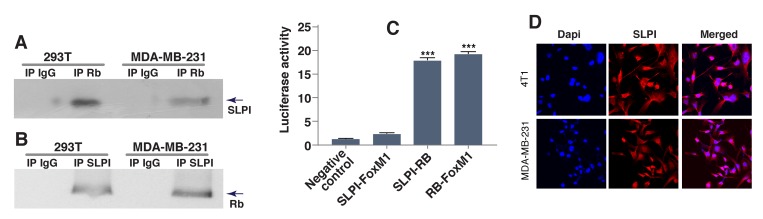
Figure 4. SLPI physically interacts with Rb
A., B. Co-immunoprecipitation of SLPI and Rb. Total cell lysates from two different cell lines (MDA-MB-231 and HEK293T) were immunoprecipitated and analyzed by immunoblotting with antibodies against SLPI and Rb. Irrelevant isotype-matched IgG antibody was use as a control. C. Interaction between SLPI and Rb assessed by mammalian two-hybrid system. We cloned Rb into pBIND, and SLPI and FoxM1 into pACT vectors to generate fusion proteins. Forty-eight hours after transfection the cells were lysed and the amount of luciferases were quantitated using the Dual-Luciferase Reporter Assay System. pACT-FoxM1 and pBIND-Rb were used as a positive control for established physical interaction. Error bars represent SEM; n = 3, * P < 0.01. D. Localization of SLPI protein in breast cancer cells. The images were taken using an Olympus U-TBI90 microscope with 60x Objective. The images show immunostaining with anti-SLPI antibodies (red) and DAPI (blue).
Figure 5
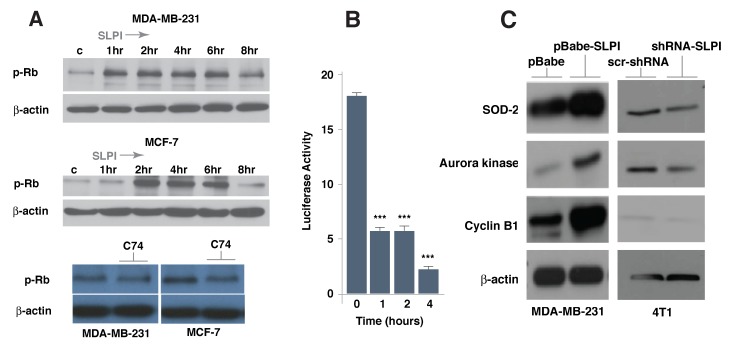
Figure 5. SLPI increases Rb phosphorylation and activates FoxM1 target genes in breast cancer cells
A. SLPI activated Rb phosphorylation within 1-2 h. MD-MB-231 and MCF7 cells were exposed to recombinant SLPI protein (1.5 µg/mL); proteins obtained from these cells were subjected to gel electrophoresis and Western Blot analysis using antibodies directed against phospho-Rb and β-actin as a loading control. In a time dependent manner, SLPI activates Rb phosphorylation. Compound C74 repressed Rb phosphorylation. MD-MB-231 and MCF7 cells were treated with 1 µM of C74 for 16 h. B. The dynamics of SLPI-induced disruption of the physical interaction between Rb and FoxM1. Using a mammalian two-hybrid system with a pair of pBIND-Rb and pACT-FoxM1 fusion proteins with HEK293T cells, we measured the dynamics of binding of Rb to FoxM1 following recombinant SLPI protein treatment. The SLPI was added to cell media in concentration of 1.5 µg/mL. C.. Expression of FoxM1 target genes correlate with SLPI level. Western blotting was performed with lysed proteins from MDA-MB-231 cells overexpressing SLPI (pBabe-SLPI), compared to control (pBabe). SLPI was silenced in 4T1 cells using shRNA SLPI lentiviruses and compared to control cells with scr-shRNA lentiviruses. FoxM1 target genes - cyclin B1, aurora kinase B and superoxide dismutase-2 (SOD-2) - were up-regulated in cells with SLPI overexpression and down-regulated if SLPI was suppressed by shRNA.
Figure 6
Figure 6. SLPI regulates binding of FoxM1 to its target MMP2 gene and increases cancer cell transmigration through an endothelial cell layer
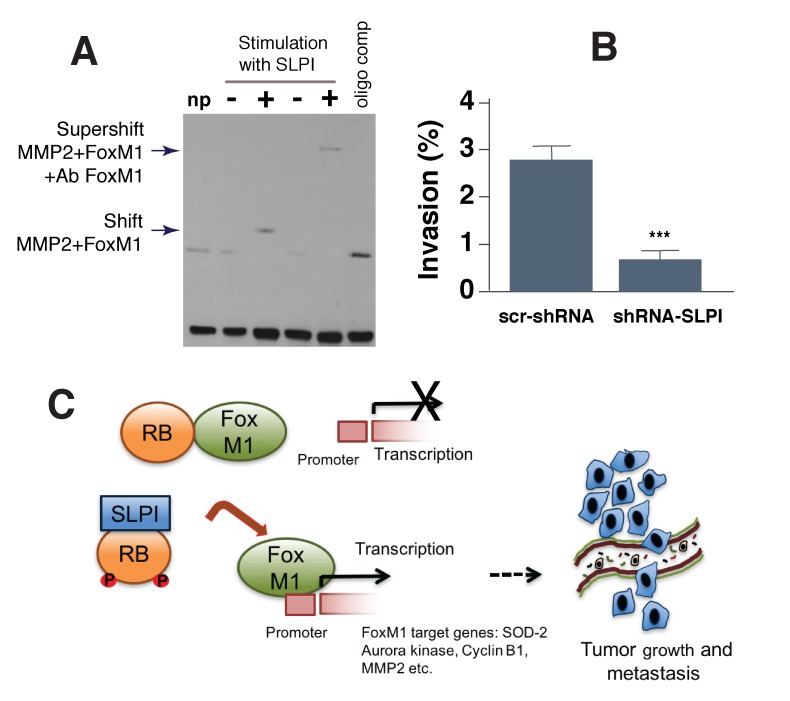
A. SLPI regulated FoxM1 binding to the MMP2 promoter sequence in gel shift assay (EMSA). All lanes contained biotin end-labeled MMP2 duplex DNA. NP (lane 1) is a control without protein. Lanes 2 and 3 contained protein extract without and with addition of SLPI protein. Lane 4: non stimulated with SLPI protein extract. Lane 5: supeshift with cells stimulated by SLPI and protein extract was incubated with FoxM1 antibodies. Arrows indicate bands shifted and supershifted by antibodies against FoxM1. Lane 6: the loss of FoxM1-specific DNA-binding in the presence of FoxM1 oligo competitor. B. SLPI increases transmigration of breast cancer cells through an endothelial layer in a transwell assay. 4T1 cells with down-regulated SLPI (SLPI shRNA) had decreased transmigration across an endothelial monolayer compared to control 4T1 cells. Error bars represent SEM; n = 10, * P < 0.001. C. Schematic representation of SLPI’s effects on the regulation of the Rb/FoxM1 complex. In the presence of low levels of SLPI, Rb protein binds to FoxM1 and represses the activity of this transcriptional factor. Inhibition of FoxM1 leads to repression of FoxM1 target genes that are associated with tumor growth and metastasis. In cancer cells that express high levels of SLPI, it physically interacts with Rb to facilitate Rb release from FoxM1. This makes FoxM1 available to initiate transcription of target genes involved in tumor growth and metastasis.

References

    1. Bianchini G, Balko JM, Mayer IA, Sanders ME, Gianni L. Triple-negative breast cancer: challenges and opportunities of a heterogeneous disease. Nat Rev Clin Oncol. 2016;13:674–690. - PMC - PubMed
    1. Sledge GW, Mamounas EP, Hortobagyi GN, Burstein HJ, Goodwin PJ, Wolff AC. Past, present, and future challenges in breast cancer treatment. J Clin Oncol. 2014;32:1979–1986. - PMC - PubMed
    1. Chen ST, Pan TL, Juan HF, Chen TY, Lin YS, Huang CM. Breast tumor microenvironment: proteomics highlights the treatments targeting secretome. J Proteome Res. 2008;7:1379–1387. - PMC - PubMed
    1. Lorusso G, Rüegg C. New insights into the mechanisms of organ-specific breast cancer metastasis. Semin Cancer Biol. 2012;22:226–233. - PubMed
    1. Chaffer CL, Weinberg RA. A perspective on cancer cell metastasis. Science. 2011;331:1559–1564. - PubMed

LinkOut - more resources