Review
. 2017 Dec 22:7:519.
doi: 10.3389/fcimb.2017.00519. eCollection 2017.

A Roadmap for Tick-Borne Flavivirus Research in the "Omics" Era

Affiliations
Review

A Roadmap for Tick-Borne Flavivirus Research in the "Omics" Era

Jeffrey M Grabowski et al. Front Cell Infect Microbiol. .

Abstract

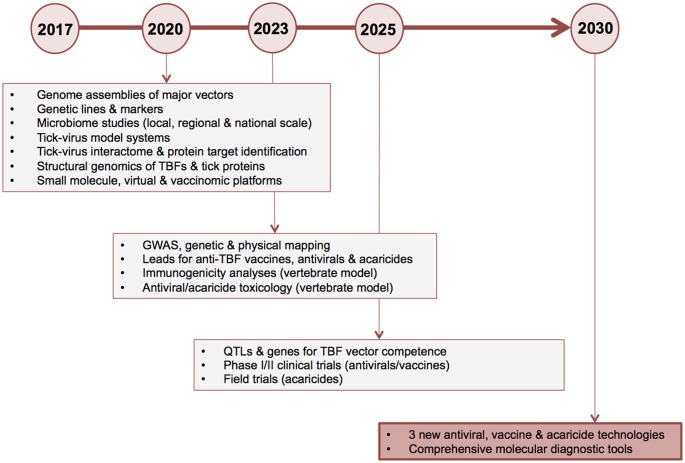
Tick-borne flaviviruses (TBFs) affect human health globally. Human vaccines provide protection against some TBFs, and antivirals are available, yet TBF-specific control strategies are limited. Advances in genomics offer hope to understand the viral complement transmitted by ticks, and to develop disruptive, data-driven technologies for virus detection, treatment, and control. The genome assemblies of Ixodes scapularis, the North American tick vector of the TBF, Powassan virus, and other tick vectors, are providing insights into tick biology and pathogen transmission and serve as nucleation points for expanded genomic research. Systems biology has yielded insights to the response of tick cells to viral infection at the transcript and protein level, and new protein targets for vaccines to limit virus transmission. Reverse vaccinology approaches have moved candidate tick antigenic epitopes into vaccine development pipelines. Traditional drug and in silico screening have identified candidate antivirals, and target-based approaches have been developed to identify novel acaricides. Yet, additional genomic resources are required to expand TBF research. Priorities include genome assemblies for tick vectors, "omic" studies involving high consequence pathogens and vectors, and emphasizing viral metagenomics, tick-virus metabolomics, and structural genomics of TBF and tick proteins. Also required are resources for forward genetics, including the development of tick strains with quantifiable traits, genetic markers and linkage maps. Here we review the current state of genomic research on ticks and tick-borne viruses with an emphasis on TBFs. We outline an ambitious 10-year roadmap for research in the "omics era," and explore key milestones needed to accomplish the goal of delivering three new vaccines, antivirals and acaricides for TBF control by 2030.

Keywords: Flaviviridae; Ixodidae; acaricide; anti-viral; genetics; genomics; tick-borne flavivirus; vaccine.


Figures
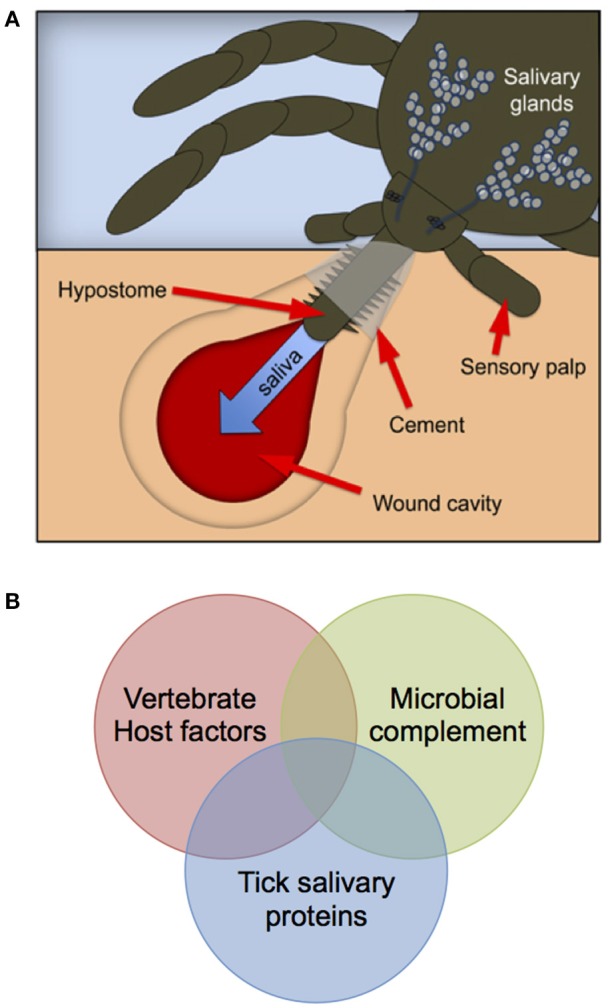
Figure 1
Figure 1
Schematic depicting the concept of the “systems biology” of a tick bite. Each tick bite (A) comprises a unique combination of host-derived factors, tick salivary proteins and the microbial flora delivered to the feeding site (B), thus underpinning the need for “personalized” approaches to pathogen detection and treatment. (A) reproduced from Figure 1 of Gulia-Nuss et al. (2016) and reprinted by permission from Macmillan Publishers Ltd. ©copyright 2016.
Figure 2
Figure 2
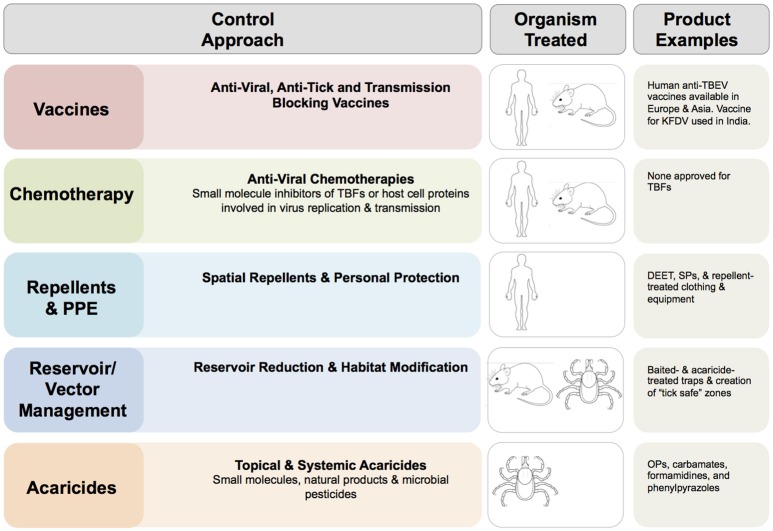
Options for control of tick-borne flaviviruses (TBFs). Common approaches for control of TBFs and examples of commercially available products are shown. DEET, N,N-Diethyl-meta-toluamide; OP, Organophosphate; POWV, Powassan virus; PPE, personal protective equipment; SP, Synthetic pyrethroid, TBEV, tick-borne encephalitis virus. The images of human, mouse and tick indicate the dead-end (human) host, non-human vertebrate reservoir and arthropod vector, as appropriate for virus in question.
Figure 3
Figure 3
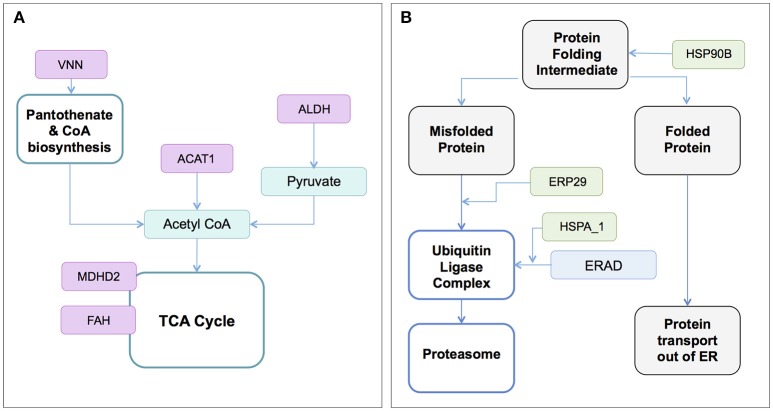
Enzymes and biochemical/metabolic pathways associated with the infection and replication of the tick-borne flavivirus, LGTV (Weisheit et al., ; Grabowski et al., 2017a). RNAi-induced knockdown of transcripts for proteins identified to (A) the pantothenate and CoA biosynthesis, and TCA cycles, and (B) Protein folding and degradation processes was associated with reduced LGTV infection in Ixodes scapularis ISE6 cells. Viral infection was assessed by the end points of viral genome replication and infectious virus release. Biosynthetic pathways (teal or blue rectangles), protein states (gray shaded rectangles) and enzymes/proteins (magenta or green rectangles) are shown. VNN and ACAT1 reduced LGTV genome replication and viral replication, while ALDH, MDH2, and FAH reduced LGTV replication only. HSP90B (ISCW022766); ERP29 (ISCW18425); HSP1_8 (ISCW024057, ISCW024910); VNN, (ISCW004822); ACAT1 (ISCW016117); ALDH (ISCW015982); MDH2 (ISCW003528); FAH (ISCW020196). ACAT, acetyl-CoA acetyltransferase; ALDH, aldehyde dehydrogenase; ER, endoplasmic reticulum; ERAD, endoplasmic reticulum-associated degradation; ERP29, endoplasmic reticulum protein 29; FAH, fumarylacetoacetate hydrolase; HSPA1_8, heat shock protein 70 family A members 1-8; HSP90B, heat shock protein 90 beta family; MDH2, malate dehydrogenase 2; TCA, tricarboxylic acid.
Figure 4
Figure 4
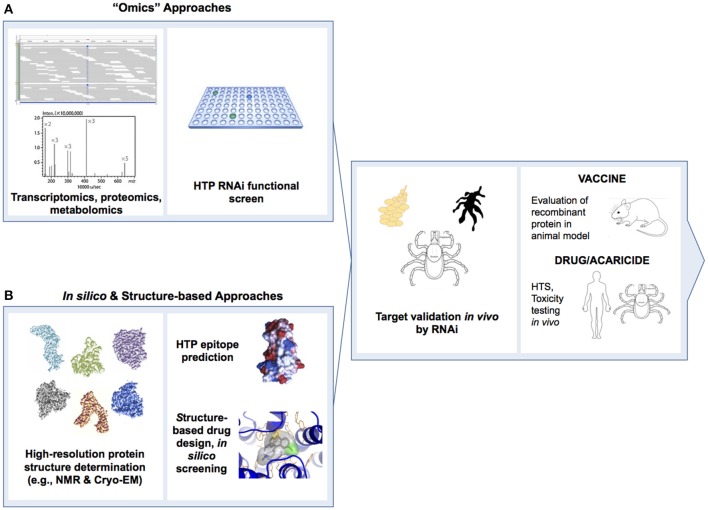
Schematic depicting the major steps in (A) wet-lab “omic” and (B) in silico-processes to identify tick protein targets for development of transmission blocking vaccines, antivirals and acaricides to control TBFs. Antigenic virus or tick proteins identified in (A,B) would proceed to vaccine clinical trial. Virus and tick proteins identified in (A) would proceed to high-throughput screen (HTS) development and identification of small molecule drugs and acaricides. Tick proteins identified in (B) would proceed to pharmacological assays and development of additional HTS. Third panel from left depicts RNAi functional studies in tick salivary glands and midgut, and whole ticks. Cryo-EM, cryo-electron microscopy; HTP, high-throughput; HTS, high-throughput screen; NMR, nuclear magnetic resonance; RNAi, RNA interference.
Figure 5
Figure 5
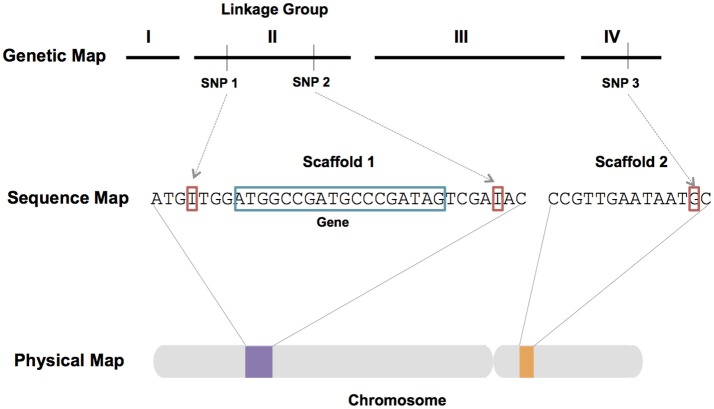
Schematic diagram showing the integration of genetic, sequence and physical maps. Genetic markers such as single nucleotide polymorphism (SNP) markers enable the association of assembled sequence reads with genetic linkage groups. Sequence can be oriented on chromosomes via physical mapping. Integrated maps and fine scale genetic mapping techniques can be used to identify regions of the genome associated with quantitative trait loci (QTL) and genes associated with phenotypes of interest.
Figure 6
Figure 6
Ten-year roadmap for “omics” research to combat tick-borne flaviviruses. The proposed timeline for delivery of new antiviral, vaccine and acaricide control technologies by a target date of 2030 is shown on the horizontal axis. Key deliverables (boxed text) and corresponding major milestone dates of 2020, 2023, 2025, and 2030 (circles) are shown. GWAS, genome-wide association studies; HTP, high-throughput; HTS, high throughput screening; TBF, tick-borne flavivirus; QTL, quantitative trait loci.

References

    1. Abbas R. Z., Zaman M. A., Colwell D. D., Gilleard J., Iqbal Z. (2014). Acaricide resistance in cattle ticks and approaches to its management: the state of play. Vet. Parasitol. 203, 6–20. 10.1016/j.vetpar.2014.03.006 - DOI - PubMed
    1. Abbink P., Larocca R. A., De La Barrera R. A., Bricault C. A., Moseley E. T., Boyd M., et al. (2016). Protective efficacy of multiple vaccine platforms against Zika virus challenge in rhesus monkeys. Science 353, 1129–1132. 10.1126/science.aah6157 - DOI - PMC - PubMed
    1. Alberdi P., Mansfield K. L., Manzano-Roman R., Cook C., Ayllon N., Villar M., et al. (2016). Tissue-specific signatures in the transcriptional response to Anaplasma phagocytophilum infection of Ixodes scapularis and Ixodes ricinus tick cell lines. Front. Cell. Infect. Microbiol. 6:20. 10.3389/fcimb.2016.00020 - DOI - PMC - PubMed
    1. Alzahrani A. G., Al Shaiban H. M., Al Mazroa M. A., Al-Hayani O., Macneil A., Rollin P. E., et al. (2010). Alkhurma hemorrhagic fever in humans, Najran, Saudi Arabia. Emerging Infect. Dis. 16, 1882–1888. 10.3201/eid1612.100417 - DOI - PMC - PubMed
    1. Aniker S. P., Work T. H., Chandrasekharaiya T., Murthy D. P., Rodrigues F. M., Ahmed R., et al. (1962). The administration of formalin-inactivated RSSE virus vaccine in the Kyasanur Forest disease area of Shimoga District, Mysore State. Indian J. Med. Res. 50, 147–152. - PubMed

Publication types

MeSH terms