Multicenter Study
. 2018 Mar;33(3):305-331.
doi: 10.1007/s11606-017-4221-9. Epub 2018 Jan 8.

Racial, Ethnic, and Gender Equity in Veteran Satisfaction with Health Care in the Veterans Affairs Health Care System

Affiliations
Multicenter Study

Racial, Ethnic, and Gender Equity in Veteran Satisfaction with Health Care in the Veterans Affairs Health Care System

Susan L Zickmund et al. J Gen Intern Med. 2018 Mar.

Abstract

Background: Patient satisfaction is an important dimension of health care quality. The Veterans Health Administration (VA) is committed to providing high-quality care to an increasingly diverse patient population.

Objective: To assess Veteran satisfaction with VA health care by race/ethnicity and gender.

Design and participants: We conducted semi-structured telephone interviews with gender-specific stratified samples of black, white, and Hispanic Veterans from 25 predominantly minority-serving VA Medical Centers from June 2013 to January 2015.

Main measures: Satisfaction with health care was assessed in 16 domains using five-point Likert scales. We compared the proportions of Veterans who were very satisfied, somewhat satisfied, and less than satisfied (i.e., neither satisfied nor dissatisfied, somewhat dissatisfied, or very dissatisfied) in each domain, and used random-effects multinomial regression to estimate racial/ethnic differences by gender and gender differences by race/ethnicity.

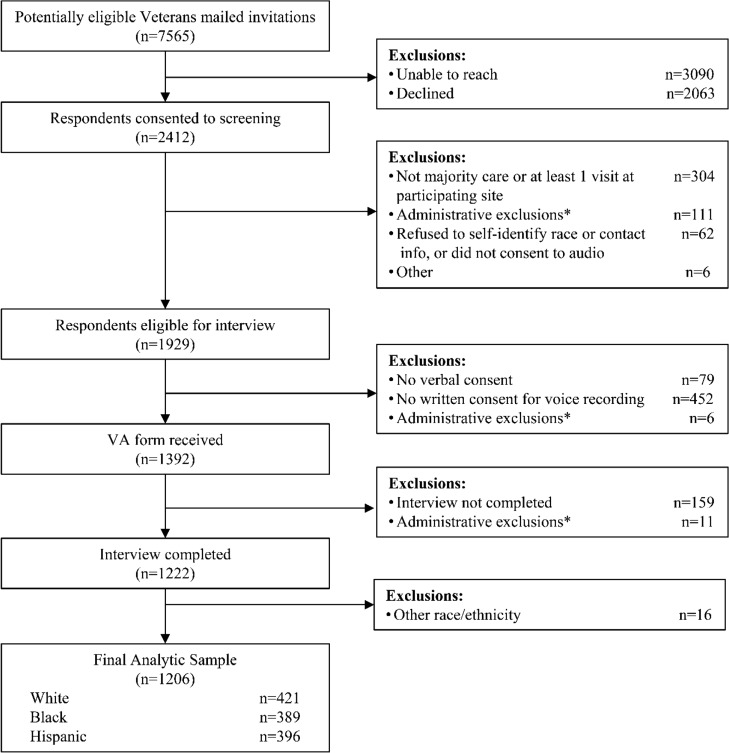
Key results: Interviews were completed for 1222 of the 1929 Veterans known to be eligible for the interview (63.3%), including 421 white, 389 black, and 396 Hispanic Veterans, 616 of whom were female. Veterans were less likely to be somewhat satisfied or less than satisfied versus very satisfied with care in each of the 16 domains. The highest satisfaction ratings were reported for costs, outpatient facilities, and pharmacy (74-76% very satisfied); the lowest ratings were reported for access, pain management, and mental health care (21-24% less than satisfied). None of the joint tests of racial/ethnic or gender differences in satisfaction (simultaneously comparing all three satisfaction levels) was statistically significant (p > 0.05). Pairwise comparisons of specific levels of satisfaction revealed racial/ethnic differences by gender in three domains and gender differences by race/ethnicity in five domains, with no consistent directionality across demographic subgroups.

Conclusions: Our multisite interviews of a diverse sample of Veterans at primarily minority-serving sites showed generally high levels of health care satisfaction across 16 domains, with few quantitative differences by race/ethnicity or gender.

Keywords: health care disparities; patient satisfaction; veterans.


Conflict of interest statement

All authors declare that they have no conflict of interest.

Figures

Figure 1
Figure 1
Percentage of Veteran respondents less than satisfied, somewhat satisfied, and very satisfied with overall VA health care, by study facility. Facilities are numbered according to their documented percentage of white Veterans in the initial sampling frame, with 1 denoting the lowest percentage of whites (23.3%), and 22–25 denoting the participating facilities with the highest percentages of whites (62.7–85.6%, respectively).
Figure 2
Figure 2
Percentage of Veteran respondents less than satisfied, somewhat satisfied, and very satisfied with VA health care, by domain. Satisfaction with cost of care; physical aspects of the facility; the pharmacy; inpatient, specialist, and mental health care; pain management; and women’s health were only assessed when applicable. N indicates the number of valid survey responses to the satisfaction questions for each domain. Abbreviations: VAMC = Veterans Affairs Medical Center, CBOC = Community-Based Outpatient Clinic.
Figure 3
Figure 3
Domain-specific multinomial model comparisons of health care satisfaction for all Veteran respondents. Each set of two rate ratios (RRs) compares the probability of reporting being “less than satisfied” versus “very satisfied” (left entry) and the probability of reporting being “somewhat satisfied” versus “very satisfied” (right entry). RRs to the left of 1.0 favor “very satisfied”. Abbreviations: VAMC = Veterans Affairs Medical Center, CBOC = Community-Based Outpatient Clinic.
Figure 4
Figure 4
Gender-specific comparisons of health care satisfaction by race/ethnicity. The set of relative rate ratios (RRRs) for each domain compares the gender-specific RRs of reporting “less than satisfied” versus “very satisfied” (left entry) and the RRs of reporting being “somewhat satisfied” versus “very satisfied” (right entry). RRRs to the left of 1.0 favor black (or Hispanic) Veterans being “very satisfied” relative to white Veterans of the same gender. Abbreviations: VAMC = Veterans Affairs Medical Center, CBOC = Community-Based Outpatient Clinic.
Figure 5
Figure 5
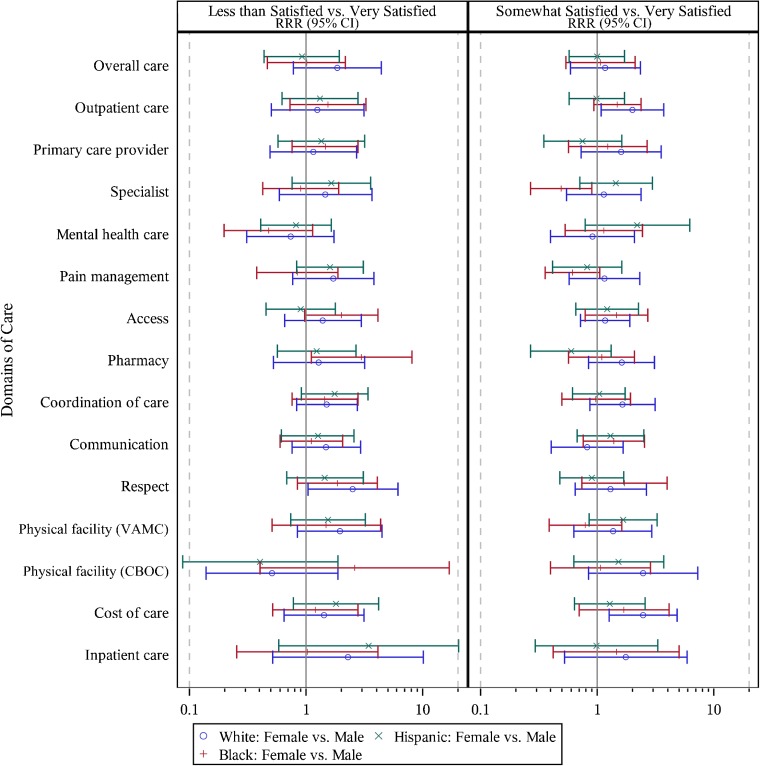
Race/ethnicity-specific comparisons of health care satisfaction by gender. The set of relative rate ratios (RRRs) for each domain compares the race/ethnicity-specific RRs of reporting “less than satisfied” versus “very satisfied” (left entry) and the RRs of reporting being “somewhat satisfied” versus “very satisfied” (right entry). RRRs to the left of 1.0 favor female Veterans being “very satisfied” relative to male Veterans of the same race/ethnicity. Abbreviations: VAMC = Veterans Affairs Medical Center, CBOC = Community-Based Outpatient Clinic.
Fig. 6
Fig. 6
Participant recruitment and study enrollment, with exclusion criteria applied sequentially. The predominant reason for administrative exclusion was that a recruitment cell was filled by the time a potential respondent worked their way through the multi-step recruitment process

Comment in

References

    1. Institute of Medicine Committee on Quality of Health Care in America . Crossing the quality chasm: A new health system for the 21st century. Washington (DC): National Academies Press; 2001.
    1. Zickmund SL, Burkitt KH, Gao S, et al. Racial differences in satisfaction with VA health care: A mixed methods pilot study. J Racial Ethn Health Disparities. 2015;2(3):317–329. doi: 10.1007/s40615-014-0075-6. - DOI - PubMed
    1. Zolnierek KBH, Dimatteo MR. Physician communication and patient adherence to treatment: A meta-analysis. Med Care. 2009;47(8):826–834. doi: 10.1097/MLR.0b013e31819a5acc. - DOI - PMC - PubMed
    1. Anhang Price R, Elliott MN, Zaslavsky AM, et al. Examining the role of patient experience surveys in measuring health care quality. Med Care Res Rev. 2014;71(5):522–554. doi: 10.1177/1077558714541480. - DOI - PMC - PubMed
    1. Sequist TD, Schneider EC, Anastario M, et al. Quality monitoring of physicians: Linking patients' experiences of care to clinical quality and outcomes. J Gen Intern Med. 2008;23(11):1784–1790. doi: 10.1007/s11606-008-0760-4. - DOI - PMC - PubMed

Publication types

LinkOut - more resources