Review
. 2019 Jan;97(1):29-44.
doi: 10.1002/jnr.24213. Epub 2018 Jan 3.

Retinoblastoma, the visible CNS tumor: A review

Affiliations
Review

Retinoblastoma, the visible CNS tumor: A review

Helen Dimaras et al. J Neurosci Res. 2019 Jan.

Abstract

The pediatric ocular cancer retinoblastoma is the only central nervous system (CNS) tumor readily observed without specialized equipment: it can be seen by, and in, the naked eye. This accessibility enables unique imaging modalities. Here, we review this cancer for a neuroscience audience, highlighting these clinical and research imaging options, including fundus imaging, optical coherence tomography, ultrasound, and magnetic resonance imaging. We also discuss the subtype of retinoblastoma driven by the MYCN oncogene more commonly associated with neuroblastoma, and consider trilateral retinoblastoma, in which an intracranial tumor arises along with ocular tumors in patients with germline RB1 gene mutations. Retinoblastoma research and clinical care can offer insights applicable to CNS malignancies, and also benefit from approaches developed elsewhere in the CNS.

Keywords: MYCN; cancer genetics; neuroimaging; optical coherence tomography; pediatric cancer; pineoblastoma.


Conflict of interest statement

CONFLICT OF INTEREST

The authors have no conflicts of interest.

Figures
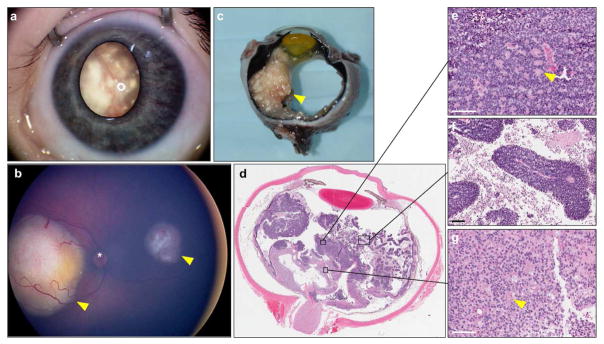
Fig. 1
Fig. 1
Clinical features of retinoblastoma. (a) External RetcamTM image of retinoblastoma; calcified tumor is visible through the pupil as leukocoria. (b) RetcamTM fundus image revealing two tumors (arrowheads), * = optic nerve head. (c) Gross pathology of an enucleated eye. A large, calcified tumor is apparent on the left side of the globe (arrowhead). (d) Pupillary-optic nerve section of an eye enucleated for retinoblastoma as primary treatment. (e) Homer Wright rosettes (arrowhead) and packed cells; (f) Viable collars of cells around blood vessels, and abundant necroses between them; (g) Area of retinoma, with fleurettes (arrowhead). Scale bars = 100 μm.
Fig. 2
Fig. 2
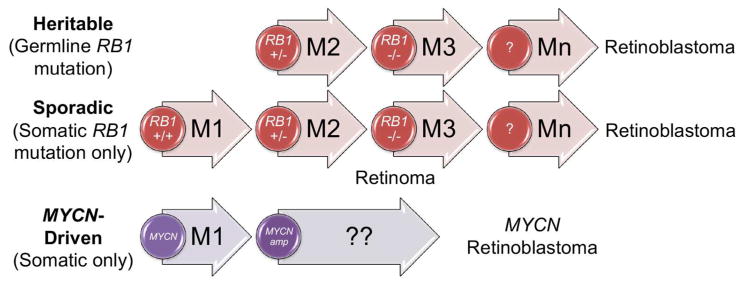
Retinoblastoma genetics. The cancer can initiate with a germline RB1 mutation followed by a single somatic hit, or with two somatic mutations (M1 and M2). Loss of RB1 leads to the benign retinoma; further mutations (M3 to Mn) are required for malignancy. Retinoblastoma can also initiate by amplification of MYCN, with other genomic changes as yet unknown.
Fig. 3
Fig. 3
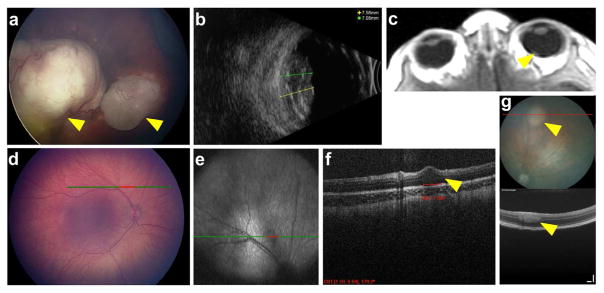
Retinoblastoma imaging. (a–b) RetcamTM (a) image of an eye reveals two large tumors, and ultrasound image (b) allows measurement of tumor height (yellow and green lines). (c) Axial T1 MRI post-gadolinium reveals tumor at back of eye (arrowhead). (d–f) Imaging of the eye of an infant with heritable retinoblastoma by RetcamTM (d) shows no visible tumor. OCT scan line shown in green/red. OCT imaging (e, en face; f, transverse section) reveals small tumor appearing to arise out of the inner nuclear layer of the retina (arrowhead). (g) Fundus photo (top) and OCT image (bottom) show a retinoblastoma-like tumor (arrowheads) arising in the TAg-RB mouse model. OCT scan line shown in red. Scale bars = 100 μm.
Fig. 4
Fig. 4
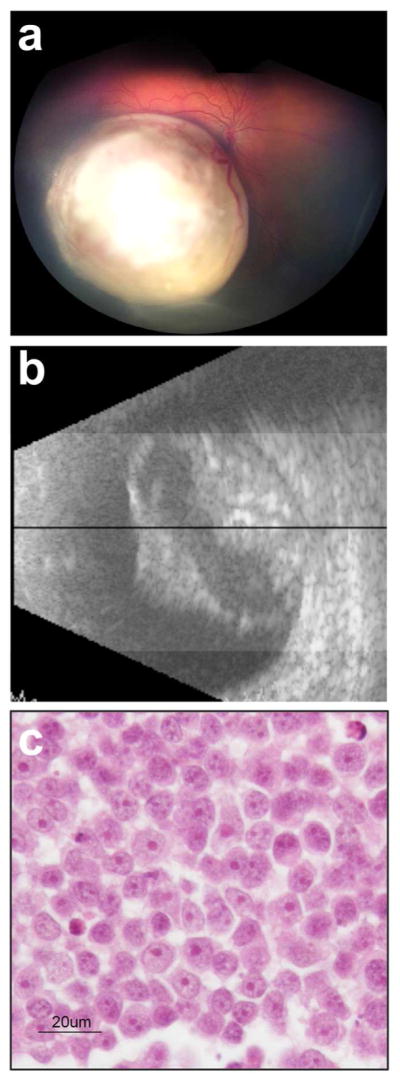
MYCN retinoblastoma. (a) Tumor appears retinoblastoma-like on fundus image. (b) Ultrasound reveals characteristic calcification. (c) Histopathology of tumor in enucleated eye reveals round nuclei with prominent large multiple nucleoli; contrast with RB1−/− retinoblastoma in Fig. 1e. Adapted with permission from (Rushlow et al. 2013).
Fig. 5
Fig. 5
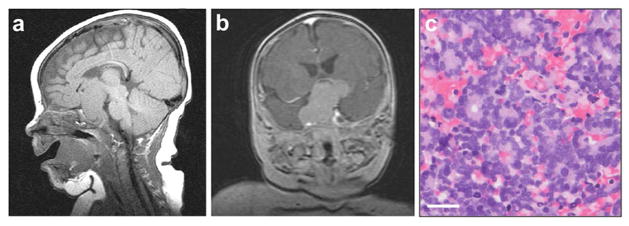
Trilateral retinoblastoma. (a) Sagittal T1-weighted and (b) coronal T2-weighted fluid-attenuated inversion recovery (FLAIR) contrast MRI reveals suprasellar mass in a patient who also has bilateral retinoblastoma. (c) Histology of this mass reveals abundant Flexner-Wintersteiner and Homer Wright rosettes. Scale bar = 25 μm.

References

    1. Bader JL, Miller RW, Meadows AT, Zimmerman LE, Champion LA, Voute PA. Trilateral retinoblastoma. Lancet. 1980;2(8194):582–583. - PubMed
    1. Bastawrous A. Increasing access to eye care ... there’s an app for that. Peek: smartphone technology for eye health. Int J Epidemiol. 2016;45(4):1040–1043. - PubMed
    1. Bastawrous A, Rono HK, Livingstone IA, Weiss HA, Jordan S, Kuper H, Burton MJ. Development and validation of a smartphone-based visual acuity test (Peek Acuity) for clinical practice and community-based fieldwork. JAMA Ophthalmol. 2015;133(8):930–937. - PMC - PubMed
    1. Beck Popovic M, Balmer A, Maeder P, Braganca T, Munier FL. Benign pineal cysts in children with bilateral retinoblastoma: a new variant of trilateral retinoblastoma? Pediatr Blood Cancer. 2006;46(7):755–761. - PubMed
    1. Benavente CA, Dyer MA. Genetics and epigenetics of human retinoblastoma. Annu Rev Pathol. 2015;10:547–562. - PubMed

Publication types