Review
. 2018 Jul;193(1):13-23.
doi: 10.1111/cei.13098. Epub 2018 Feb 2.

Driving chronicity in rheumatoid arthritis: perpetuating role of myeloid cells

Affiliations
Review

Driving chronicity in rheumatoid arthritis: perpetuating role of myeloid cells

S Alivernini et al. Clin Exp Immunol. 2018 Jul.

Abstract

Acute inflammation is a complex and tightly regulated homeostatic process that includes leucocyte migration from the vasculature into tissues to eliminate the pathogen/injury, followed by a pro-resolving response promoting tissue repair. However, if inflammation is uncontrolled as in chronic diseases such as rheumatoid arthritis (RA), it leads to tissue damage and disability. Synovial tissue inflammation in RA patients is maintained by sustained activation of multiple inflammatory positive-feedback regulatory pathways in a variety of cells, including myeloid cells. In this review, we will highlight recent evidence uncovering biological mechanisms contributing to the aberrant activation of myeloid cells that contributes to perpetuation of inflammation in RA, and discuss emerging data on anti-inflammatory mediators contributing to sustained remission that may inform a novel category of therapeutic targets.

Keywords: arthritis (including rheumatoid arthritis); cytokines; inflammation; macrophage.


Figures

Figure 1
Figure 1
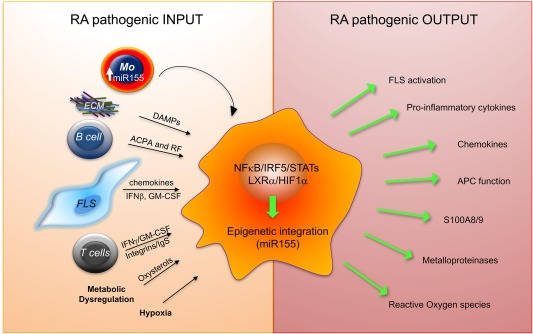
Mechanisms of macrophage cell activation promoting chronic inflammation in rheumatoid arthritis. Synovial macrophages differentiate from epigenetically reprogrammed monocytes that migrate from the circulation into synovial fluid and tissue. Synovial damage‐associated molecular patterns (DAMPs) (e.g. fibronectin) binding to Toll‐like receptors (TLRs), anti‐citrullinated protein antibody (ACPA) or rheumatoid factor binding to Fc‐gamma receptor (FcyR), oxysterols, hypoxia and direct integrin‐mediated and cytokine‐mediated crosstalk with T cells and fibroblast‐like synoviocytes (FLSs) promote synovial macrophage proinflammatory activation. This response is co‐ordinated by several transcription factors and integrated by epigenetic regulators, e.g. microRNA155 that inhibits a negative‐regulator of inflammation Src homology 2‐containing inositol phosphatase‐1 (SHIP1); thus, maintains synovial macrophages chronic activation. ECM = extracellular matrix proteins; GM‐CSF = granulocyte‐macrophage colony‐stimulating factor; HIF1α = hypoxia‐inducible factor 1‐alpha; IgS = Ig‐superfamily; IRF5 = interferon regulatory factor 5; LXRα = Liver X Receptor alpha; miR = microRNA; MMPs = metalloproteinases; NF‐κB = nuclear factor kappa B; RF: rheumatoid factor; STAT = signal transducer and activator of transcription. This figure presents a novel development of concepts that were presented in our previous review 75.
Figure 2
Figure 2
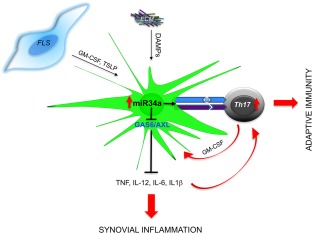
Mechanisms of dendritic cell activation promoting chronic inflammation in and adaptive immunity in rheumatoid arthritis (RA). Local production of GM‐CSF and TSLP (e.g. by FLS) and release of DAMPs activate synovial CD1c+ dendritic cells (DCs) to release proinflammatory mediators and to stimulate autoreactive T cells. Synovial CD1c+ and their blood precursors express high levels of epigenetic regulator microRNA34a that sustains their proinflammatory and T helper type 17 (Th17) differentiating cytokine production, antigen presentation by major histocompatibility complex (MHC) class II and interaction with T cells. This is, in part, mediated by microRNA34a‐ induced repression of Axl. Axl, upon binding of its ligand GAS6, induces SOCSs (suppressor of cytokine signaling) and terminates DC proinflammatory cytokine production and DC‐driven T cell activation. Thus, low expression of Axl in CD1c+DCs in RA patients could contribute to the initiation and perpetuation of disease by facilitating the activation of autoreactive T cells and cytokine production upon initial bystander trigger of dendritic cells (DC), e.g. infection or tissue damage. AXL = AXL‐receptor tyrosine kinase; DAMPs = damage‐associated molecular patterns; ECM = extracellular matrix proteins; FLS = fibroblast‐like synoviocytes; GAS6 = growth arrest‐specific 6; GM‐CSF = granulocyte‐macrophage colony‐stimulating factor; miR = microRNA; TSLP = thymic stromal lymphopoietin.

References

    1. Okada Y, Wu D, Trynka G et al Genetics of rheumatoid arthritis contributes to biology and drug discovery. Nature 2014; 506:376–81. - PMC - PubMed
    1. Smolen JS, Aletaha D, McInnes IB. Rheumatoid arthritis. Lancet 2016; 388:2023–38. - PubMed
    1. Malmstrom V, Catrina AI, Klareskog L. The immunopathogenesis of seropositive rheumatoid arthritis: from triggering to targeting. Nat Rev Immunol 2017; 17:60–75. - PubMed
    1. McInnes IB, Schett G. Pathogenetic insights from the treatment of rheumatoid arthritis. Lancet 2017; 389:2328–37. - PubMed
    1. Catrina AI, Svensson CI, Malmstrom V, Schett G, Klareskog L. Mechanisms leading from systemic autoimmunity to joint‐specific disease in rheumatoid arthritis. Nat Rev Rheumatol 2017; 13:79–86. - PubMed

Publication types

MeSH terms