. 2018 Apr;218(1):81-93.
doi: 10.1111/nph.14970. Epub 2018 Jan 8.

Suppression of a single BAHD gene in Setaria viridis causes large, stable decreases in cell wall feruloylation and increases biomass digestibility

Affiliations

Suppression of a single BAHD gene in Setaria viridis causes large, stable decreases in cell wall feruloylation and increases biomass digestibility

Wagner R de Souza et al. New Phytol. 2018 Apr.

Abstract

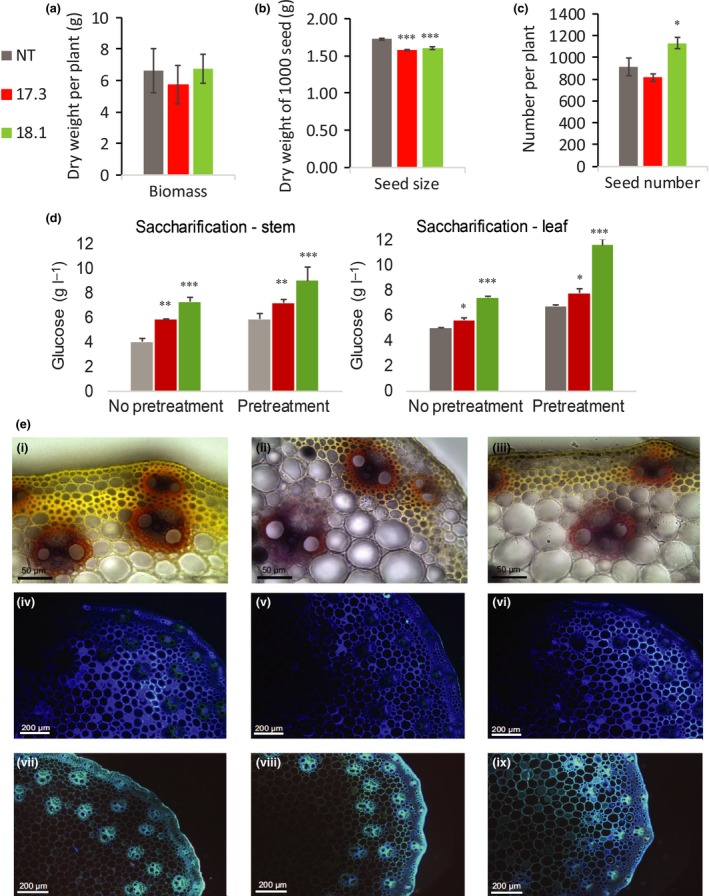
Feruloylation of arabinoxylan (AX) in grass cell walls is a key determinant of recalcitrance to enzyme attack, making it a target for improvement of grass crops, and of interest in grass evolution. Definitive evidence on the genes responsible is lacking so we studied a candidate gene that we identified within the BAHD acyl-CoA transferase family. We used RNA interference (RNAi) silencing of orthologs in the model grasses Setaria viridis (SvBAHD01) and Brachypodium distachyon (BdBAHD01) and determined effects on AX feruloylation. Silencing of SvBAHD01 in Setaria resulted in a c. 60% decrease in AX feruloylation in stems consistently across four generations. Silencing of BdBAHD01 in Brachypodium stems decreased feruloylation much less, possibly due to higher expression of functionally redundant genes. Setaria SvBAHD01 RNAi plants showed: no decrease in total lignin, approximately doubled arabinose acylated by p-coumarate, changes in two-dimensional NMR spectra of unfractionated cell walls consistent with biochemical estimates, no effect on total biomass production and an increase in biomass saccharification efficiency of 40-60%. We provide the first strong evidence for a key role of the BAHD01 gene in AX feruloylation and demonstrate that it is a promising target for improvement of grass crops for biofuel, biorefining and animal nutrition applications.

Keywords: cell wall acylation; ferulic acid; grass evolution; hydroxycinnamates; lignocellulosic feedstock.


Figures

Figure 1
Figure 1
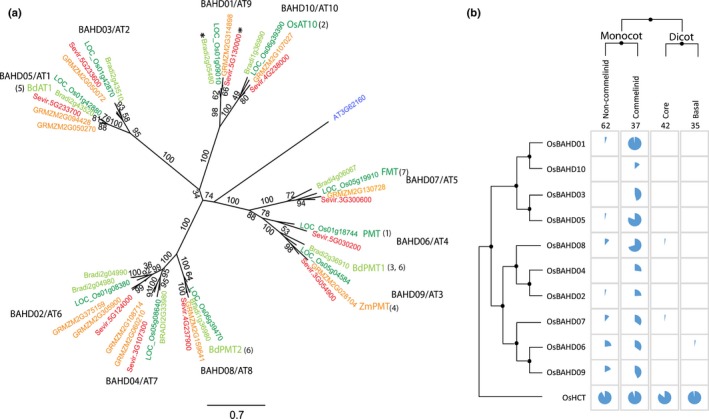
(a) Phylogenetic tree of candidate clade of BAHD genes (Mitchell et al., 2007) showing BAHD names for each branch from Molinari et al. (2013) and alternative AT names from Bartley et al. (2013). All genes from Arabidopsis, rice, Brachypodium, maize and Setaria in sub‐clade A are shown. Support for the topology is shown as a percentage of bootstrap runs. Named genes have evidence on function from: 1, Withers et al. (2012); 2, Bartley et al. (2013); 3, Petrik et al. (2014); 4, Marita et al. (2014); 5, Buanafina et al. (2016); 6, Sibout et al. (2016); 7, Karlen et al. (2016). Asterisks mark the genes we studied here. (b) Distribution of orthologs present in the 1KP project (Matasci et al., 2014) to the candidate rice genes and to related OsHCT genes. Proportions of species (out of the total number shown at the top of the grid) that have orthologs are shown as blue pie chart slices.
Figure 2
Figure 2
SvBAHD01 gene expression (a) and ester‐linked HCA and lignin content (b–d) of cell walls in leaves and stems of Setaria control (NT) and T3 plants from the 17.3 and 18.1 RNAi‐silenced lines (= 3; error bars ± SEM; significance of difference of transgenic from control indicated if difference in means > least significant difference from ANOVA at: *, < 0.05; **, < 0.01; ***, < 0.001).
Figure 3
Figure 3
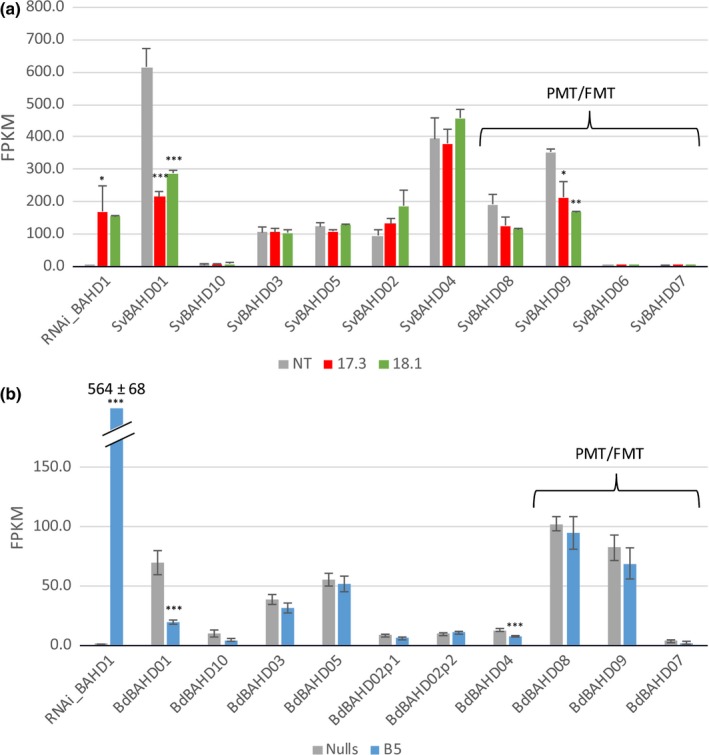
RNA‐seq analysis of BAHD gene expression in (a) Setaria SvBAHD01 RNAi lines and (b) Brachypodium BdBAHD01 RNAi lines. Genes associated with monolignol acylation (PMT and FMT) are indicated. Transcript abundance is measured as fragment per kilobase per million mapped reads (FPKM;= 3; error bars ± SEM; significance of difference of transgenic from control indicated if difference in means > least significant difference from ANOVA at: *, < 0.05; **, < 0.01; ***, < 0.001).
Figure 4
Figure 4
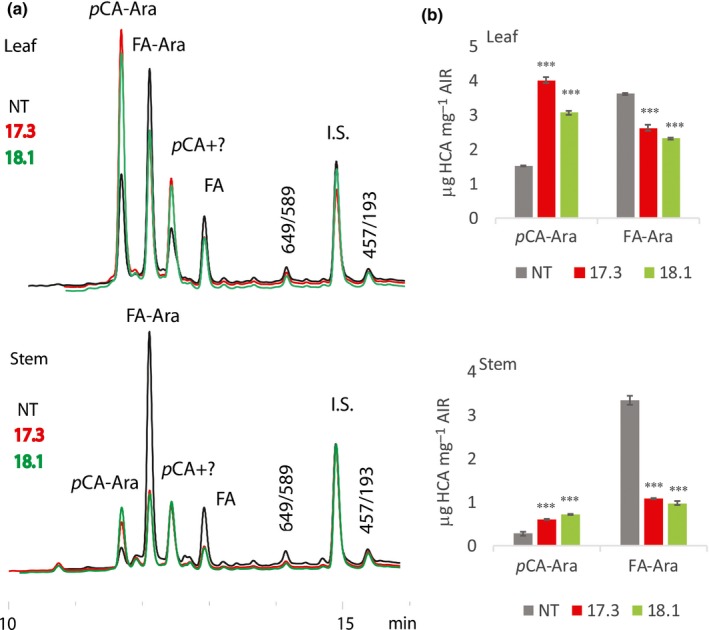
HCA conjugates in supernatant following mild acidolysis of Setaria alcohol‐insoluble residue (AIR). (a) Parts of representative HPLC chromatograms showing UV absorption. Major peaks for p‐coumarate (pCA)‐Ara and ferulate (FA)‐Ara were identified by LCMS (Supporting Information Fig. S2; Table S3). pCA co‐elutes with an unknown UV‐absorbing compound. Minor peaks are labeled according to their dominant parent/daughter ion m/z from LCMS; 649/589 and 457/193 are probably Ara‐diFA‐Ara and Xyl‐Ara‐FA, respectively. (b) Mean pCA‐Ara and FA‐Ara contents expressed as μg HCA equivalent per mg AIR estimated from similar chromatograms as shown in (a) (= 3; error bars ± SEM; significance of difference of transgenic from control indicated if difference in means > least significant difference from ANOVA at: ***, < 0.001).
Figure 5
Figure 5
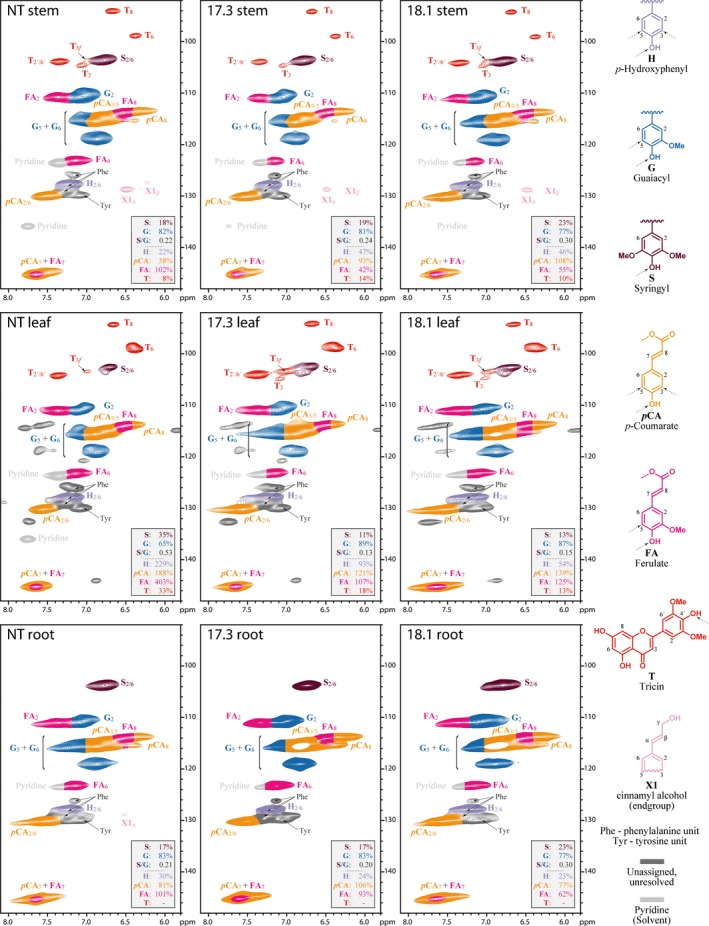
2D‐NMR heteronuclear single‐quantum coherence (HSQC) partial spectra of stem, leaf and root tissues from the WT control (NT) and the two transgenic lines (17.3 and 18.1) of Setaria. Color coding of the contours matches that of the assigned structures; where contour overlap occurs, the colorization is only approximate. The analytical data are from volume integrals of correlation peaks representing reasonably well‐resolved (except for H) C/H pairs in similar environments; thus, they are from S 2/6, G 2, H 2/6, FA 2, pCA 2/6 and T 2′/6′, with obvious correction for those units that have two C/H pairs per unit. All relative integrals are on a G + S = 100% basis; H‐units are over‐quantified due to an overlapping peak from protein phenylalanine (Phe) units (Kim et al., 2017).
Figure 6
Figure 6
Biomass (a), seed size (b), seed number (c), saccharification (d) and stem morphology (e) of Setaria SvBAHD01 RNAi plants. (a–d) Means ± SEM from 10 (a, b) or five (c, d) replicate plants, significance of difference of transgenic from control indicated if difference in means > least significant difference from ANOVA at: *, < 0.05; **, < 0.01; ***, < 0.001. (e) Representative stem sections from NT (i, iv, vii), 17.3 (ii, v, viii) and 18.1 plants (iii, vi, ix) stained with phloroglucinol (i–iii), auramine O (iv–vi) and showing autofluorsence (vii–ix).

Comment in

References

    1. Akin DE. 1990. Diazonium compounds localize grass cell wall phenolics: relation to wall digestibility. Crop Science 30: 985–989.
    1. Anders N, Wilkinson MD, Lovegrove A, Freeman J, Tryfona T, Pellny TK, Weimar T, Mortimer JC, Stott K, Baker JM et al 2012. Glycosyl transferases in family 61 mediate arabinofuranosyl transfer onto xylan in grasses. Proceedings of the National Academy of Sciences, USA 109: 989–993. - PMC - PubMed
    1. Bartley LE, Peck ML, Kim SR, Ebert B, Manisseri C, Chiniquy DM, Sykes R, Gao LF, Rautengarten C, Vega‐Sanchez ME et al 2013. Overexpression of a BAHD acyltransferase, OsAt10, alters rice cell wall hydroxycinnamic acid content and saccharification. Plant Physiology 161: 1615–1633. - PMC - PubMed
    1. Bennetzen JL, Schmutz J, Wang H, Percifield R, Hawkins J, Pontaroli AC, Estep M, Feng L, Vaughn JN, Grimwood J et al 2012. Reference genome sequence of the model plant Setaria . Nature Biotechnology 30: 555–561. - PubMed
    1. Bouvier d'Yvoire M, Bouchabke‐Coussa O, Voorend W, Antelme S, Cézard L, Legée F, Lebris P, Legay S, Whitehead C, McQueen‐Mason SJ et al 2013. Disrupting the cinnamyl alcohol dehydrogenase 1 gene (BdCAD1) leads to altered lignification and improved saccharification in Brachypodium distachyon . Plant Journal 73: 496–508. - PubMed

Publication types

MeSH terms

LinkOut - more resources