


Prevalence and longitudinal trends of food allergy during childhood and adolescence: Results of the Isle of Wight Birth Cohort study
- PMID: 29315919
- PMCID: PMC5869129
- DOI: 10.1111/cea.13088
Prevalence and longitudinal trends of food allergy during childhood and adolescence: Results of the Isle of Wight Birth Cohort study
Abstract
Background: The prevalence and time trends of food allergy change during childhood depending on the age of the child and the type of food.
Objective: To study prevalence and longitudinal trends in food allergy from birth to 18 years in an unselected birth cohort in the Isle of Wight.
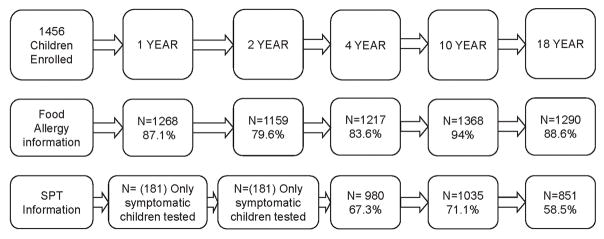
Method: Information on food allergy was collected at ages 1, 2, 4, 10 and 18 years from the Isle of Wight Birth Cohort (n = 1456). Skin prick testing (SPT) was performed at the age of 1 and 2 years in symptomatic children. At 4, 10 and 18 years of age, participants were tested to a panel of food and aeroallergens. Food allergy was diagnosed based on the criteria: symptoms suggestive of a typical IgE-mediated reaction and reaction <4 hours following exposure to a known food allergen. McNemar's test was used to determine significance of changes in prevalence over time.
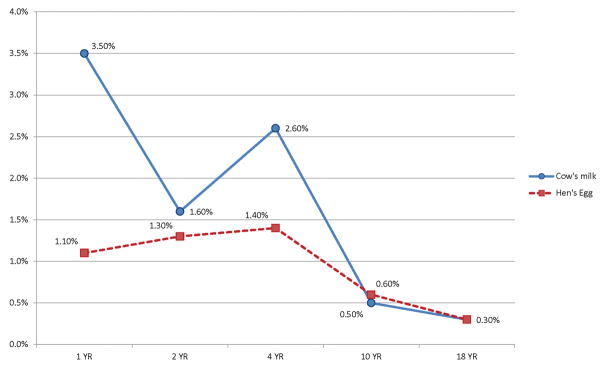
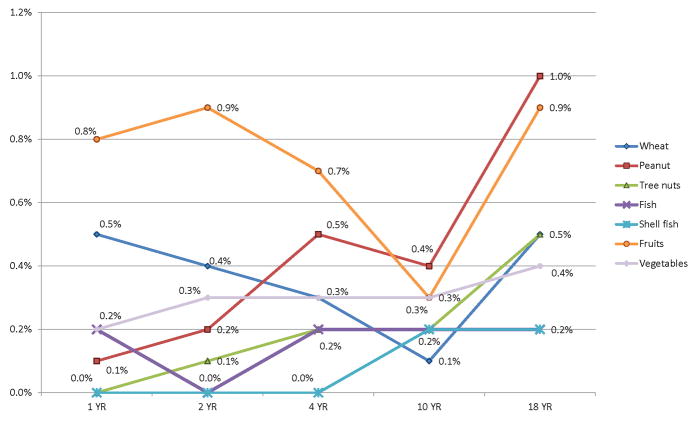
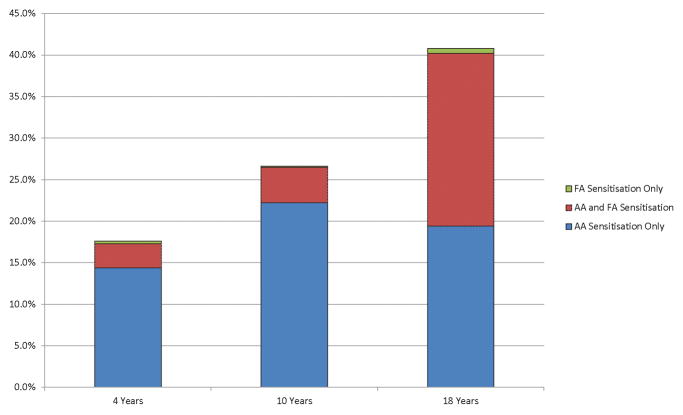
Results: The prevalence of food allergy remained relatively constant in early childhood (5.3%, 4.4% and 5.0% at 1, 2 and 4 years, respectively), with significant decline at 10 years (2.3%, P < .001 vs 4 years) followed by significant rise at 18 years (4%, P = .02 vs 10 years). Cow's milk (1.6%-3.5%) and egg (1.1%-1.4%) were the most common allergens in the first 10 years with peanut (1%) and tree nuts (0.5%) becoming more prevalent beyond 10 years. Fruit and wheat allergy were less common at 10 years, and shellfish and kiwi emerged during adolescence. The prevalence of food allergy plus positive SPT was 1.3%, 0.8%, 0.8%, 0.9% and 2.2% at 1, 2, 4, 10 and 18 years, respectively.
Conclusion: Food allergy is highly prevalent in infancy with partial resolution during late childhood. However, a number of children acquire new food allergy during adolescence resulting in a relatively higher prevalence at 18 years.
Keywords: IgE; epidemiology; food allergy; paediatrics.
© 2018 John Wiley & Sons Ltd.
Conflict of interest statement
None of the authors have any conflicts of interests to declare.
Figures
References
-
- Johansson SGO, Bieber T, Dahl R, Friedmann PS, Lanier BQ, Lockey RF, et al. Revised nomenclature for allergy for global use: Report of the Nomenclature Review Committee of the World Allergy Organization, October 2003. Journal of Allergy and Clinical Immunology. 2004;113(5):832–6. - PubMed
-
- Roberts G, Lack G. J Allergy Clin Immunol. Vol. 115. United States: 2005. Diagnosing peanut allergy with skin prick and specific IgE testing; pp. 1291–6. - PubMed
-
- Rona RJ, Keil T, Summers C, Gislason D, Zuidmeer L, Sodergren E, et al. The prevalence of food allergy: A meta-analysis. Journal of Allergy and Clinical Immunology. 2007;120(3):638–46. - PubMed
-
- Nwaru BI, Hickstein L, Panesar SS, Muraro A, Werfel T, Cardona V, et al. The epidemiology of food allergy in Europe: a systematic review and meta-analysis. Allergy. 2014;69(1):62–75. - PubMed
-
- Venter C, Patil V, Grundy J, Glasbey G, Twiselton R, Arshad SH, et al. Prevalence and cumulative incidence of food hyper-sensitivity in the first 10 years of life. Pediatric allergy and immunology : official publication of the European Society of Pediatric Allergy and Immunology. 2016;27(5):452–8. - PubMed
Publication types
MeSH terms
Grants and funding
LinkOut - more resources
Full Text Sources
Other Literature Sources
Medical
