


Effects of exenatide once weekly plus dapagliflozin, exenatide once weekly, or dapagliflozin, added to metformin monotherapy, on body weight, systolic blood pressure, and triglycerides in patients with type 2 diabetes in the DURATION-8 study
- PMID: 29316164
- PMCID: PMC5969082
- DOI: 10.1111/dom.13206
Effects of exenatide once weekly plus dapagliflozin, exenatide once weekly, or dapagliflozin, added to metformin monotherapy, on body weight, systolic blood pressure, and triglycerides in patients with type 2 diabetes in the DURATION-8 study
Abstract
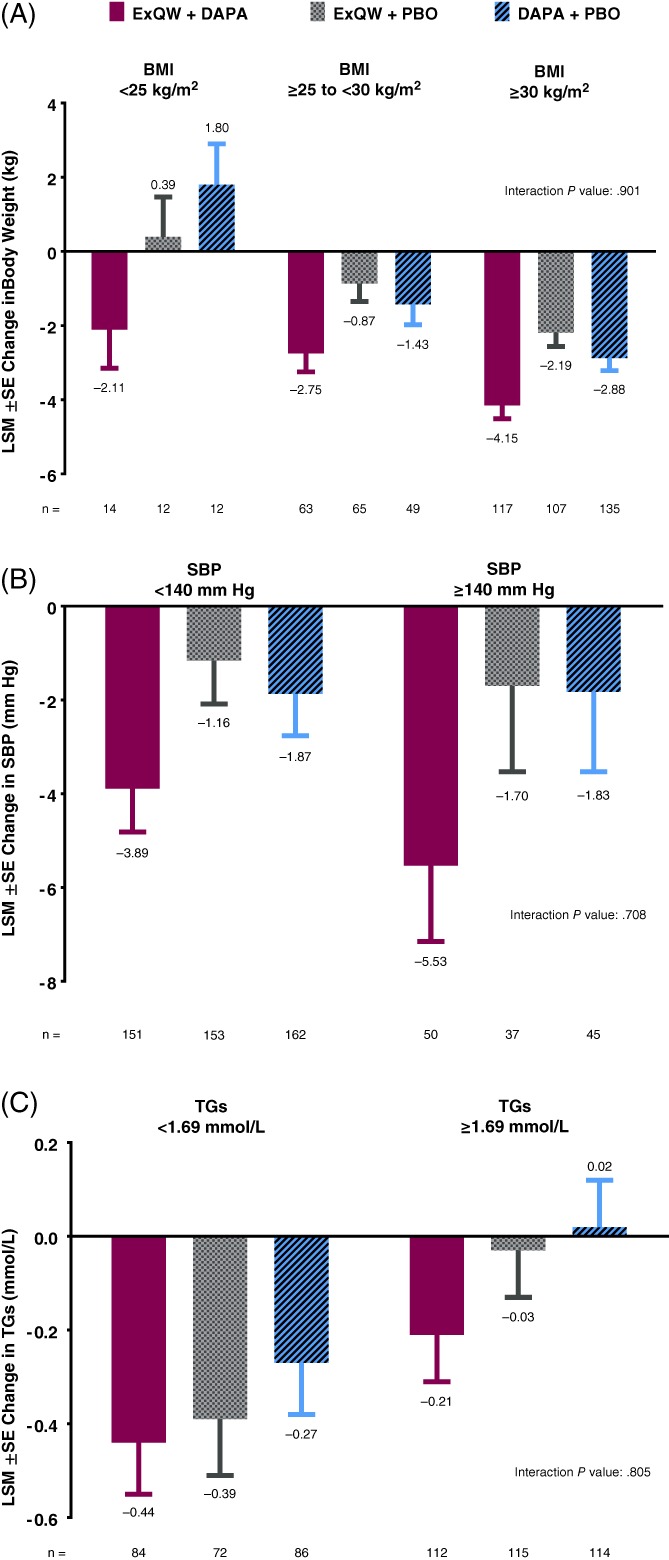
This post hoc analysis assessed the effects on cardiovascular risk factors of body weight, systolic blood pressure (SBP) and triglycerides after 28 weeks' treatment with exenatide once weekly plus dapagliflozin, as compared with exenatide once weekly or dapagliflozin, in patient subpopulations from the DURATION-8 trial of patients with type 2 diabetes mellitus (T2DM) inadequately controlled with metformin alone. Subgroups of patients were stratified according to their baseline body weight, SBP and triglyceride levels. Body weight, SBP and triglyceride levels were reduced across most respective subgroups, with no significant subgroup-by-treatment interactions. For each treatment, weight loss was numerically greater as baseline body mass index increased. SBP reductions were greater among patients with SBP ≥140 vs <140 mm Hg for exenatide once weekly plus dapagliflozin and exenatide once weekly. Reductions in triglyceride levels were greater among patients with baseline triglycerides <1.69 vs ≥1.69 mmol/L for each treatment. The combination of exenatide once weekly plus dapagliflozin reduced cardiovascular risk factors across baseline subgroups for each variable to a greater extent than did either individual drug; the greatest effects were observed in the high baseline subgroups for body weight and SBP.
Keywords: GLP-1 analogue; SGLT2 inhibitor; dapagliflozin; exenatide; type 2 diabetes.
© 2018 The Authors. Diabetes, Obesity and Metabolism published by John Wiley & Sons Ltd.
Conflict of interest statement
S.A.J. has worked as a consultant for AstraZeneca, Eli Lilly, and Janssen. J.P.F. has received research support from AbbVie, AstraZeneca, Boehringer Ingelheim, Bristol‐Myers Squibb, Eli Lilly, IONIS, Janssen, Johnson and Johnson, Ligand, Merck, Mylan, Novartis, Novo Nordisk, Pfizer, Sanofi, Theracos, and vTv Therapeutics, and has participated in scientific advisory boards and received consulting fees from AstraZeneca, Bristol‐Myers Squibb, Novo Nordisk, Sanofi, and Theracos. C.G. has participated in scientific advisory boards and received consulting fees from Alfa Wasserman, AstraZeneca, Bayer AG, Berlin‐Chemie Menarini, Eli Lilly, Merck Sharp & Dohme, Novo Nordisk, and Sanofi. A.A. has received research grants from AbbVie, AstraZeneca, Kowa Pharmaceuticals, Novo Nordisk, and Sanofi‐Aventis. E.H. and P.Ö. are employees of AstraZeneca.
Figures
References
-
- Karagiannis T, Liakos A, Bekiari E, et al. Efficacy and safety of once‐weekly glucagon‐like peptide 1 receptor agonists for the management of type 2 diabetes: a systematic review and meta‐analysis of randomized controlled trials. Diabetes Obes Metab. 2015;17:1065‐1074. - PubMed
Publication types
MeSH terms
Substances
LinkOut - more resources
Full Text Sources
Other Literature Sources
Medical
