


Co-causation of reduced newborn size by maternal undernutrition, infections, and inflammation
- PMID: 29316198
- PMCID: PMC6055652
- DOI: 10.1111/mcn.12585
Co-causation of reduced newborn size by maternal undernutrition, infections, and inflammation
Abstract
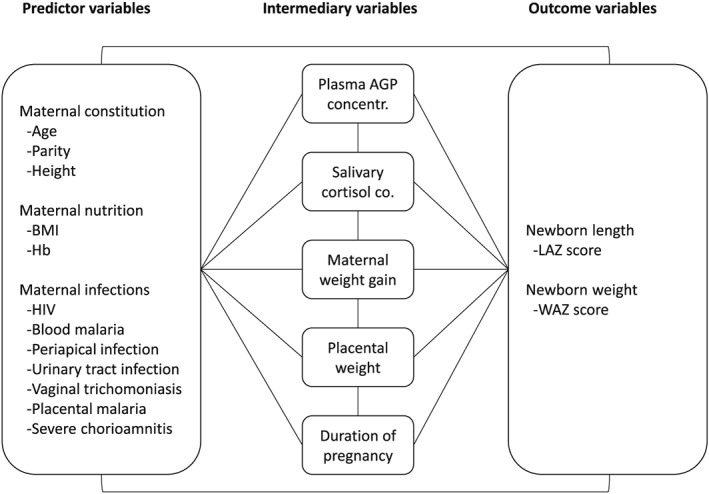
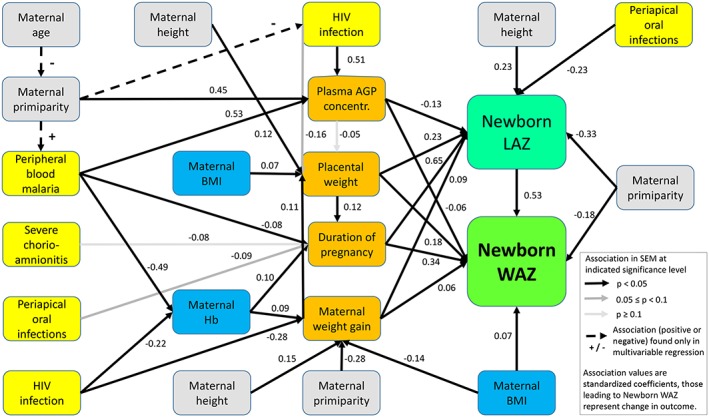
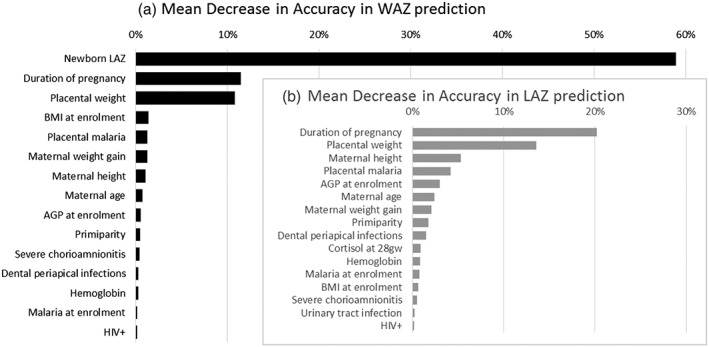
More than 20 million babies are born with low birthweight annually. Small newborns have an increased risk for mortality, growth failure, and other adverse outcomes. Numerous antenatal risk factors for small newborn size have been identified, but individual interventions addressing them have not markedly improved the health outcomes of interest. We tested a hypothesis that in low-income settings, newborn size is influenced jointly by multiple maternal exposures and characterized pathways associating these exposures with newborn size. This was a prospective cohort study of pregnant women and their offspring nested in an intervention trial in rural Malawi. We collected information on maternal and placental characteristics and used regression analyses, structural equation modelling, and random forest models to build pathway maps for direct and indirect associations between these characteristics and newborn weight-for-age Z-score and length-for-age Z-score. We used multiple imputation to infer values for any missing data. Among 1,179 pregnant women and their babies, newborn weight-for-age Z-score was directly predicted by maternal primiparity, body mass index, and plasma alpha-1-acid glycoprotein concentration before 20 weeks of gestation, gestational weight gain, duration of pregnancy, placental weight, and newborn length-for-age Z-score (p < .05). The latter 5 variables were interconnected and were predicted by several more distal determinants. In low-income conditions like rural Malawi, maternal infections, inflammation, nutrition, and certain constitutional factors jointly influence newborn size. Because of this complex network, comprehensive interventions that concurrently address multiple adverse exposures are more likely to increase mean newborn size than focused interventions targeting only maternal nutrition or specific infections.
Keywords: LAZ; Malawi; WAZ; low-income countries; newborn size; pathways.
© 2018 The Authors. Maternal & Child Nutrition published by John Wiley & Sons, Ltd.
Conflict of interest statement
M. Z. works as a director of research for Nutriset S.A.S, a company that produces and sells lipid‐based nutrient supplements and which also prepared the LNS supplements purchased for the current trial. The other authors have no financial relationships relevant to this article to disclose. The findings and conclusions contained within the article are those of the authors and do not necessarily reflect positions or policies of the USAID, the United States Government, the Bill & Melinda Gates Foundation, or the other funders. One of the co‐authors (MD) is employed by FHI 360, which provided USAID funding for the study to UC Davis through the FANTA Project. The other funders had no role in the study design, data collection and analysis, decision to publish, or preparation of the manuscript. The corresponding author (PA) had full access to the data and final responsibility for the decision to submit for publication.
Figures
References
-
- Ashorn, P. , Alho, L. , Ashorn, U. , Cheung, Y. B. , Dewey, K. G. , Gondwe, A. , … Maleta, K. (2015a). Supplementation of maternal diets during pregnancy and for 6 months postpartum and infant diets thereafter with small‐quantity lipid‐based nutrient supplements does not promote child growth by 18 months of age in rural Malawi: A randomized controlled trial. The Journal of Nutrition, 145(6), 1345–1353. - PubMed
-
- Ashorn, P. , Alho, L. , Ashorn, U. , Cheung, Y. B. , Dewey, K. G. , Harjunmaa, U. , … Maleta, K. (2015b). The impact of lipid‐based nutrient supplement provision to pregnant women on newborn size in rural Malawi: A randomized controlled trial. The American Journal of Clinical Nutrition, 101(2), 387–397. 10.3945/ajcn.114.088617 - DOI - PubMed
-
- Ashorn, P. , Vanhala, H. , Pakarinen, O. , Ashorn, U. , & De Costa, A. (2015). Prevention of intrauterine growth restriction and preterm birth with presumptive antibiotic treatment of pregnant women: A literature review. Nestle Nutrition Institute Workshop Series, 81, 37–50. 10.1159/000365802 - DOI - PubMed
-
- Bhutta, Z. A. , Das, J. K. , Rizvi, A. , Gaffey, M. F. , Walker, N. , Horton, S. , … Maternal and Child Nutrition Study Group (2013). Evidence‐based interventions for improvement of maternal and child nutrition: What can be done and at what cost? Lancet, 382(9890), 452–477. 10.1016/S0140-6736(13)60996-4 - DOI - PubMed
Publication types
MeSH terms
Substances
LinkOut - more resources
Full Text Sources
Other Literature Sources
Medical
