


Polybrominated diphenyl ethers (PBDEs) and hydroxylated PBDE metabolites (OH-PBDEs) in maternal and fetal tissues, and associations with fetal cytochrome P450 gene expression
- PMID: 29316516
- PMCID: PMC6561508
- DOI: 10.1016/j.envint.2017.12.030
Polybrominated diphenyl ethers (PBDEs) and hydroxylated PBDE metabolites (OH-PBDEs) in maternal and fetal tissues, and associations with fetal cytochrome P450 gene expression
Abstract
Background: Human fetal exposures to polybrominated diphenyl ethers (PBDEs) and their metabolites (OH-PBDEs) are unique from adults, and in combination with a different metabolic profile, may make fetal development more sensitive to adverse health outcomes from these exposures. However, we lack data to characterize human fetal PBDE exposures and the metabolic factors that can influence these exposures.
Objective: We examined differences between 2nd trimester maternal and fetal exposures to PBDEs and OH-PBDEs. We also characterized fetal cytochrome P450 (CYP) mRNA expression and its associations with PBDE exposures.
Methods: We collected paired samples of maternal serum and fetal liver (n=86) with a subset having matched placenta (n=50). We measured PBDEs, OH-PBDEs, and mRNA expression of CYP genes (e.g. CYP1A1, -2E1, -2J2, -2C9) in all samples. As a sensitivity analysis, we measured PBDEs and OH-PBDEs in umbilical cord serum from a subset (n=22).
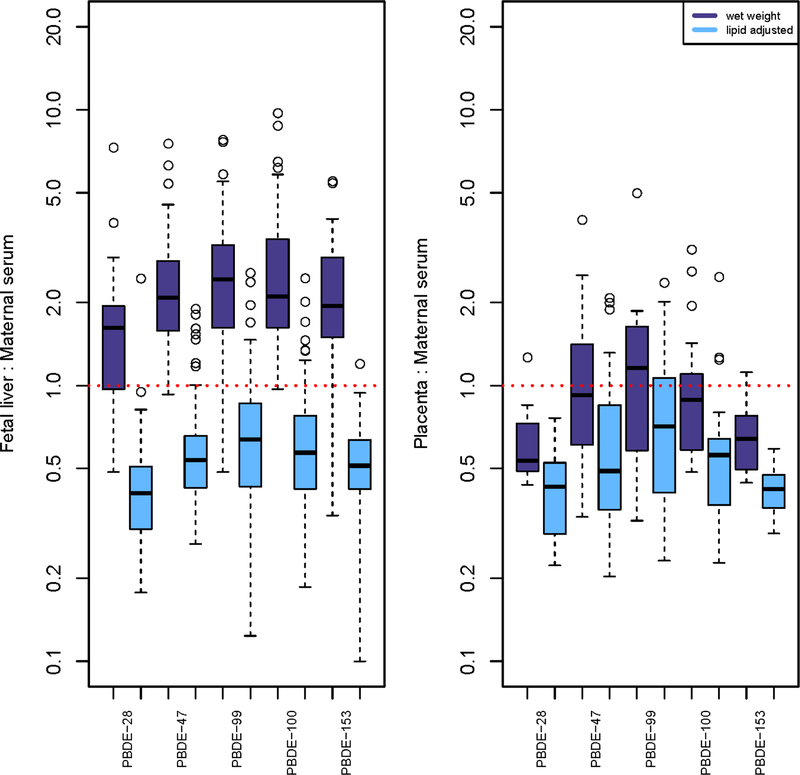
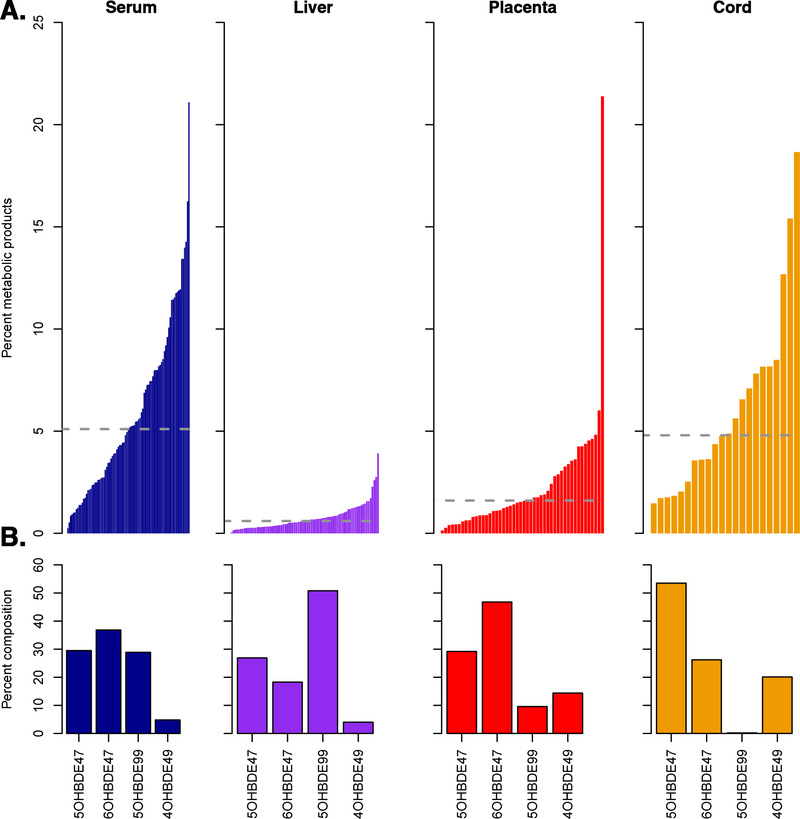
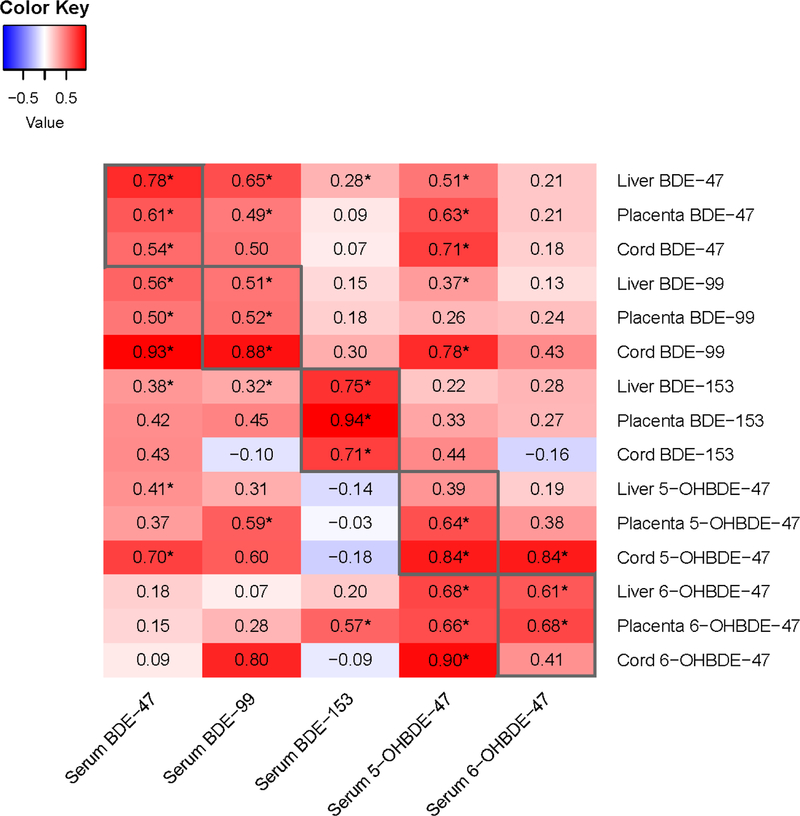
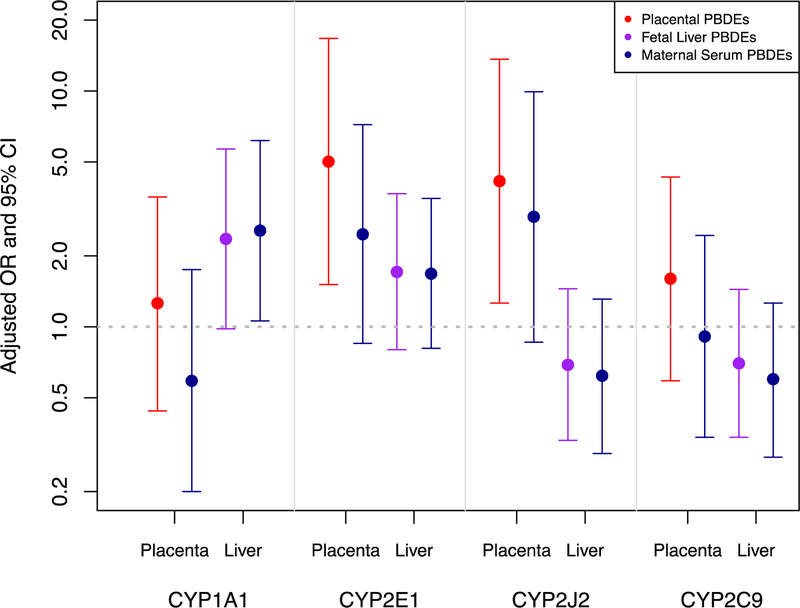
Results: BDE-47 was detected in ≥96% of all tissues. Unadjusted ∑PBDEs concentrations were highest in fetal liver (geometric mean (GM)=0.72ng/g), whereas lipid-adjusted concentrations were highest in cord serum (111.12ng/g lipid). In both cases, fetal concentrations were approximately two times higher than maternal serum levels (GM=0.33ng/g or 48.75ng/g lipid). ΣOH-PBDEs were highest in maternal and cord sera and 20-200 times lower than PBDE concentrations. In regression models, maternal BDE-47 explained more of the model variance of liver than of placenta BDE-47 concentrations (adjusted R2=0.79 vs 0.48, respectively). In adjusted logistic regression models, ∑PBDEs were positively associated with expression of CYP2E1 and -2J2 (placenta), and -1A1 (liver) (p<0.05).
Conclusion: Our findings suggest that under normal conditions of mid-gestation, the human fetus is directly exposed to concentrations of PBDEs that may be higher than previously estimated based on maternal serum and that these exposures are associated with the expression of mRNAs coding for CYP enzymes. These results will help frame and interpret findings from studies that use maternal or cord blood as proxy measures of fetal exposures, and will inform the molecular pathways by which PBDEs affect human health.
Keywords: Brominated flame retardants; Cytochrome P-450 enzymes; Endocrine disrupters; Fetal metabolism; OH-PBDEs; Organohalogen chemicals; Placenta transport; Prenatal exposures.
Copyright © 2017. Published by Elsevier Ltd.
Figures
References
-
- Abbasi G, Buser AM, Soehl A, Murray MW, Diamond ML. 2015. Stocks and flows of PBDEs in products from use to waste in the U.S. and Canada from 1970 to 2020. Environ Sci Technol 49:1521–1528. - PubMed
-
- Blanco J, Mulero M, Domingo JL, Sánchez DJ. 2012. Gestational exposure to BDE-99 produces toxicity through up-regulation of CYP isoforms and ROS production in the fetal rat liver. Toxicol Sci:kfs082 - PubMed
-
- Croom EL, Stevens JC, Hines RN, Wallace AD, Hodgson E. 2009. Human hepatic CYP2B6 developmental expression: the impact of age and genotype. Biochemical pharmacology 78:184–190. - PubMed
Publication types
MeSH terms
Substances
Grants and funding
LinkOut - more resources
Full Text Sources
Other Literature Sources
Medical
Research Materials
