


Association between Diet-Quality Scores, Adiposity, Total Cholesterol and Markers of Nutritional Status in European Adults: Findings from the Food4Me Study
- PMID: 29316612
- PMCID: PMC5793277
- DOI: 10.3390/nu10010049
Association between Diet-Quality Scores, Adiposity, Total Cholesterol and Markers of Nutritional Status in European Adults: Findings from the Food4Me Study
Abstract
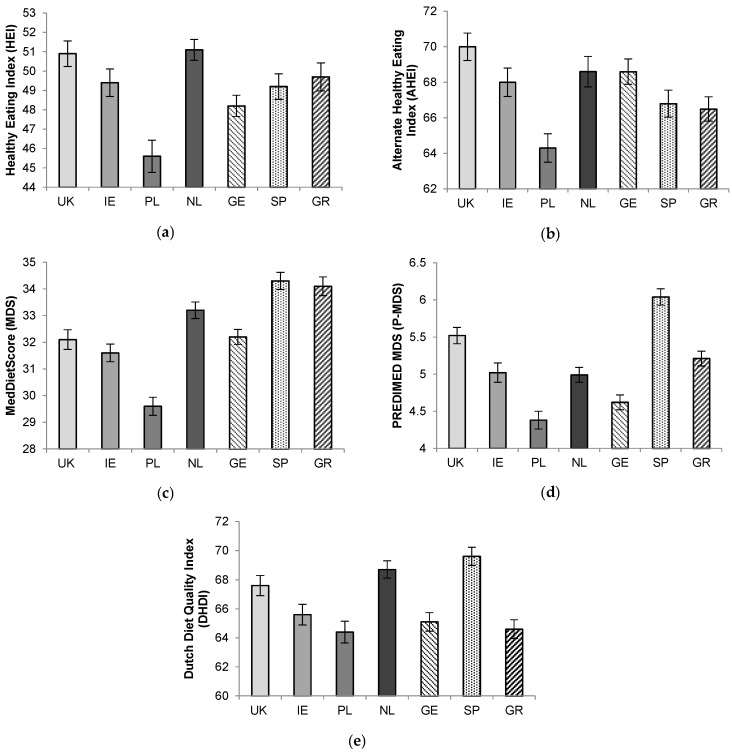
Diet-quality scores (DQS), which are developed across the globe, are used to define adherence to specific eating patterns and have been associated with risk of coronary heart disease and type-II diabetes. We explored the association between five diet-quality scores (Healthy Eating Index, HEI; Alternate Healthy Eating Index, AHEI; MedDietScore, MDS; PREDIMED Mediterranean Diet Score, P-MDS; Dutch Healthy Diet-Index, DHDI) and markers of metabolic health (anthropometry, objective physical activity levels (PAL), and dried blood spot total cholesterol (TC), total carotenoids, and omega-3 index) in the Food4Me cohort, using regression analysis. Dietary intake was assessed using a validated Food Frequency Questionnaire. Participants (n = 1480) were adults recruited from seven European Union (EU) countries. Overall, women had higher HEI and AHEI than men (p < 0.05), and scores varied significantly between countries. For all DQS, higher scores were associated with lower body mass index, lower waist-to-height ratio and waist circumference, and higher total carotenoids and omega-3-index (p trends < 0.05). Higher HEI, AHEI, DHDI, and P-MDS scores were associated with increased daily PAL, moderate and vigorous activity, and reduced sedentary behaviour (p trend < 0.05). We observed no association between DQS and TC. To conclude, higher DQS, which reflect better dietary patterns, were associated with markers of better nutritional status and metabolic health.
Keywords: Dutch Healthy Diet Index; Healthy Eating Index; Mediterranean Diet Score; diet scores; dried blood spots; metabolic health; nutritional biomarkers; personalized nutrition.
Conflict of interest statement
T.E.G. is founder, stockowner and C.E.O. of Vitas; C.A.D. is founder, board member, stockowner, and consultant for Vitas Ltd. None of the other authors reports a conflict of interest.
Figures
References
Publication types
MeSH terms
Substances
Grants and funding
LinkOut - more resources
Full Text Sources
Other Literature Sources
Medical
Research Materials
Miscellaneous
