


Radical Scavenging and Anti-Inflammatory Activities of Representative Anthocyanin Groupings from Pigment-Rich Fruits and Vegetables
- PMID: 29316619
- PMCID: PMC5796118
- DOI: 10.3390/ijms19010169
Radical Scavenging and Anti-Inflammatory Activities of Representative Anthocyanin Groupings from Pigment-Rich Fruits and Vegetables
Abstract
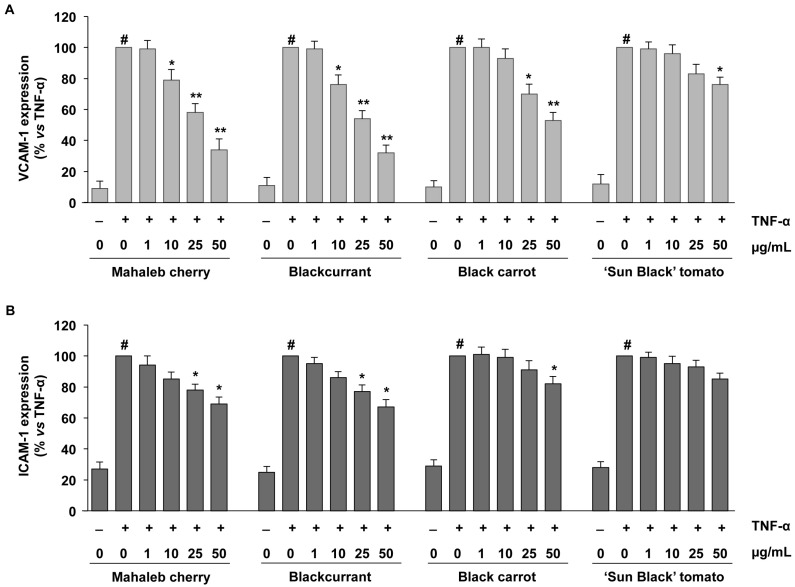
Anthocyanins, the naturally occurring pigments responsible for most red to blue colours of flowers, fruits and vegetables, have also attracted interest because of their potential health effects. With the aim of contributing to major insights into their structure-activity relationship (SAR), we have evaluated the radical scavenging and biological activities of selected purified anthocyanin samples (PASs) from various anthocyanin-rich plant materials: two fruits (mahaleb cherry and blackcurrant) and two vegetables (black carrot and "Sun Black" tomato), differing in anthocyanin content (ranging from 4.9 to 38.5 mg/g DW) and molecular structure of the predominant anthocyanins. PASs from the abovementioned plant materials have been evaluated for their antioxidant capacity using Trolox Equivalent Antioxidant Capacity (TEAC) and Oxygen Radical Absorbance Capacity (ORAC) assays. In human endothelial cells, we analysed the anti-inflammatory activity of different PASs by measuring their effects on the expression of endothelial adhesion molecules VCAM-1 and ICAM-1. We demonstrated that all the different PASs showed biological activity. They exhibited antioxidant capacity of different magnitude, higher for samples containing non-acylated anthocyanins (typical for fruits) compared to samples containing more complex anthocyanins acylated with cinnamic acid derivatives (typical for vegetables), even though this order was slightly reversed when ORAC assay values were expressed on a molar basis. Concordantly, PASs containing non-acylated anthocyanins reduced the expression of endothelial inflammatory antigens more than samples with aromatic acylated anthocyanins, suggesting the potential beneficial effect of structurally diverse anthocyanins in cardiovascular protection.
Keywords: ICAM-1; VCAM-1; anthocyanins with aromatic acylation; black carrot; blackcurrant; endothelial adhesion molecules.; mahaleb cherry; non-acylated anthocyanins; structure–activity relationship (SAR); “Sun Black” tomato.
Conflict of interest statement
The authors declare no conflict of interest.
Figures
References
-
- Andersen Ø.M., Jordheim M. The anthocyanins. In: Andersen Ø.M., Markham K.R., editors. Flavonoids: Chemistry, Biochemistry and Applications. CRC Press; Boca Raton, FL, USA: 2006. pp. 471–551.
-
- Andersen Ø.M. (University of Bergen, Norway). Jan, 2018. Unpublished data.
-
- De Pascual-Teresa S., Sanchez-Ballesta M.T. Anthocyanins: From plant to health. Phytochem. Rev. 2008;7:281–299. doi: 10.1007/s11101-007-9074-0. - DOI
MeSH terms
Substances
LinkOut - more resources
Full Text Sources
Other Literature Sources
Miscellaneous
