Quantitative Assessment of Hand Dysfunction in Patients with Early Parkinson's Disease and Focal Hand Dystonia
- PMID: 29316781
- PMCID: PMC5790625
- DOI: 10.14802/jmd.17046
Quantitative Assessment of Hand Dysfunction in Patients with Early Parkinson's Disease and Focal Hand Dystonia
Abstract
Objective: Motor impairments related to hand function are common symptoms in patients with movement disorders, such as Parkinson's disease (PD) and focal hand dystonia (FHD). However, hand dysfunction has not been quantitatively assessed as a clinical tool for screening patient groups from healthy controls (HCs). The aim of our study was 1) to quantitatively assess hand dysfunction in patients with PD and FHD and its usefulness as a screening tool 2) to grade disease severity in PD and FHD based on hand dysfunction.
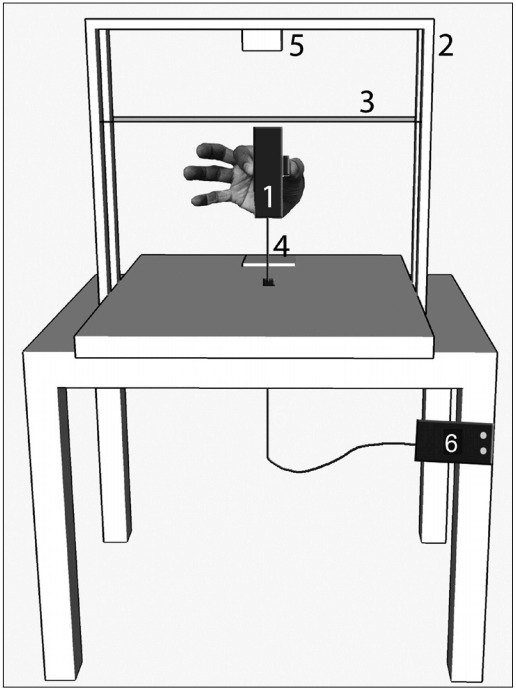
Methods: The current case-control study included HCs (n = 50) and patients with known history of PD (n = 25) or FHD (n = 16). Hand function was assessed by a precision grip task while participants lifted objects of 1.3 N and 1.7 N under dry skin conditions, followed by very wet skin conditions (VWSCs). Receiver operating characteristic and summative scoring analyses were performed.
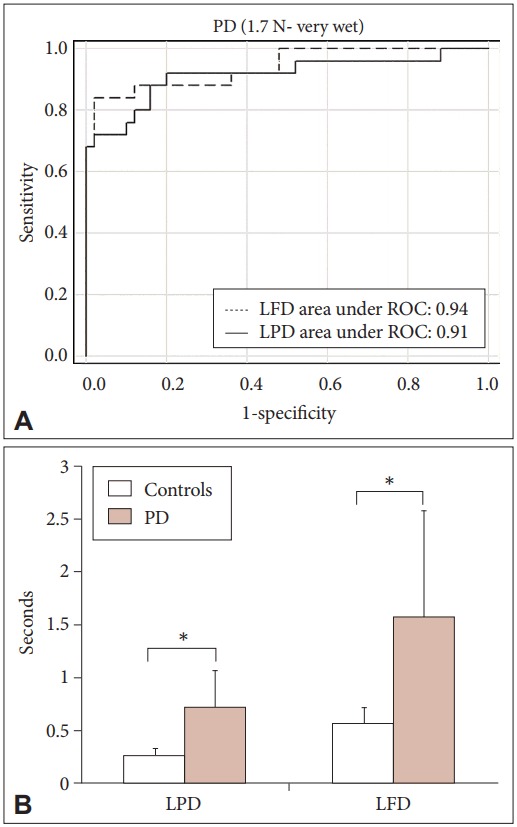
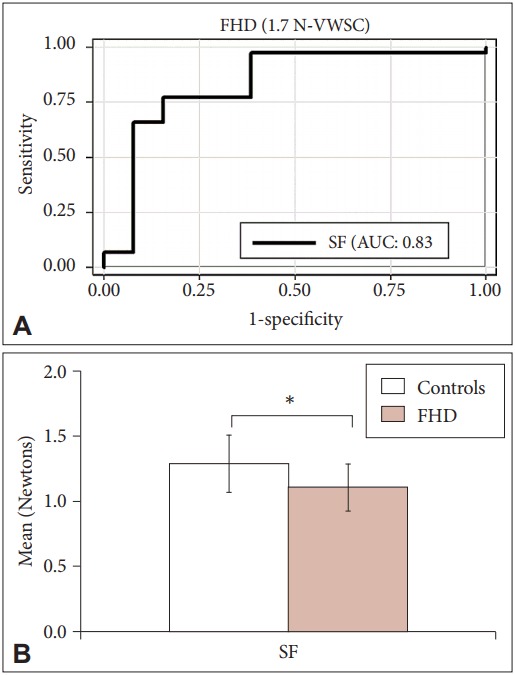
Results: In PD, the combination of loading phase duration and lifting phase duration at quantitative cutoffs of 0.36 and 0.74 seconds identified 21/25 patients as diseased and 49/50 subjects as HCs with 1.7 N under VWSCs. In PD, 5/21 was graded as "mild" and 16/21 as "moderate cases." In FHD, slip force at a cutoff of 1.2 N identified 13/16 patients as diseased and 41/50 subjects as HC with 1.7 N under VWSCs, but disease severity could not be graded.
Conclusion: Our results demonstrate the use of precision grip task as an important clinical tool in assessment of hand dysfunction in movement disorder patients. Use of quantitative cutoffs may improve diagnostic accuracy and serve as a valuable adjunct to existing clinical assessment methods.
Keywords: Parkinson’s; focal hand dystonia; hand dysfunction; lifting phase duration; loading phase duration; precision grip; slip force.
Conflict of interest statement
The authors have no financial conflicts of interest.
Figures
References
-
- Agostino R, Currà A, Giovannelli M, Modugno N, Manfredi M, Berardelli A. Impairment of individual finger movements in Parkinson’s disease. Mov Disord. 2003;18:560–565. - PubMed
-
- Forssberg H, Ingvarsson PE, Iwasaki N, Johansson RS, Gordon AM. Action tremor during object manipulation in Parkinson’s disease. Mov Disord. 2000;15:244–254. - PubMed
-
- Uitti RJ, Baba Y, Wszolek ZK, Putzke DJ. Defining the Parkinson’s disease phenotype: initial symptoms and baseline characteristics in a clinical cohort. Parkinsonism Relat Disord. 2005;11:139–145. - PubMed
-
- Bleton JP, Teremetz M, Vidailhet M, Mesure S, Maier MA, Lindberg PG. Impaired force control in writer’s cramp showing a bilateral deficit in sensorimotor integration. Mov Disord. 2014;29:130–134. - PubMed
LinkOut - more resources
Full Text Sources
Other Literature Sources