


Tectonically-triggered sediment and carbon export to the Hadal zone
- PMID: 29317639
- PMCID: PMC5760703
- DOI: 10.1038/s41467-017-02504-1
Tectonically-triggered sediment and carbon export to the Hadal zone
Abstract
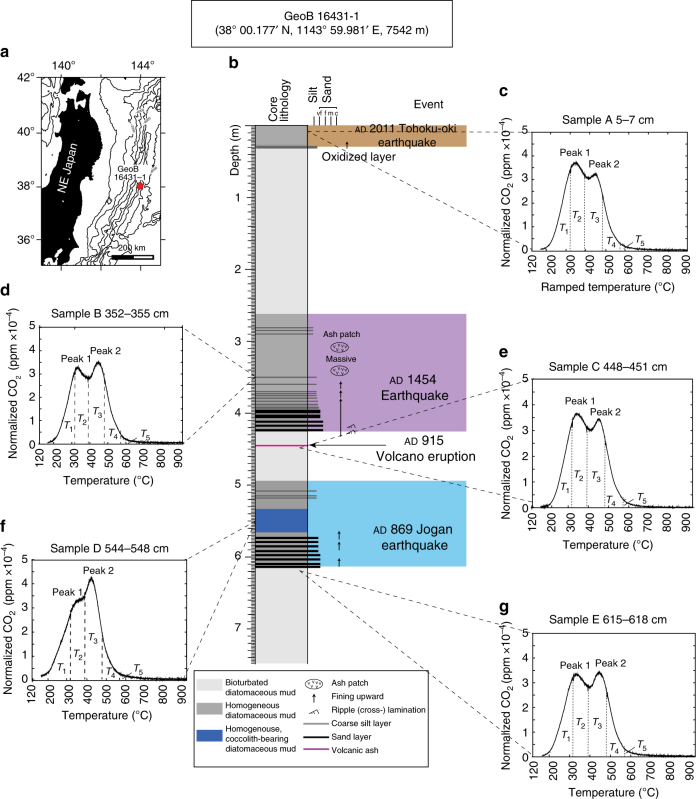
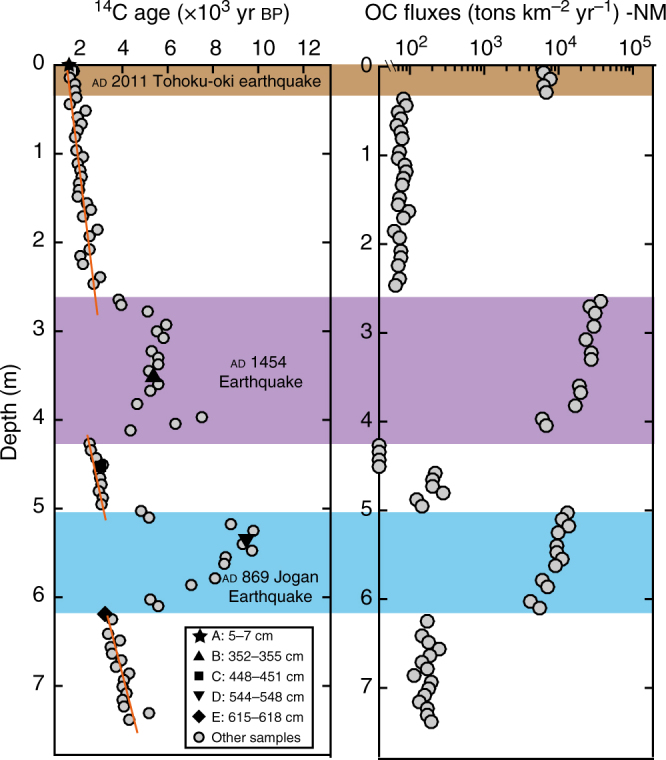
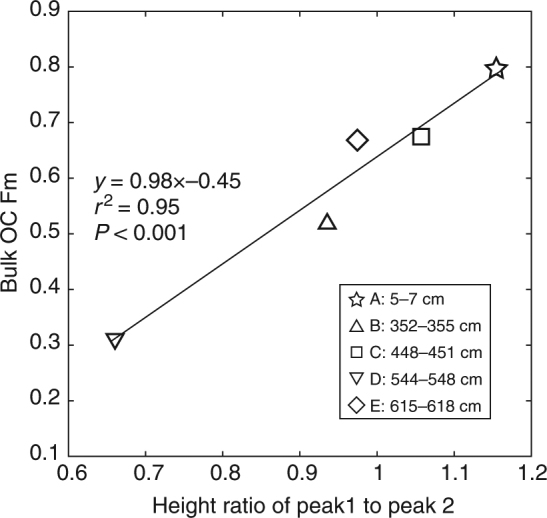
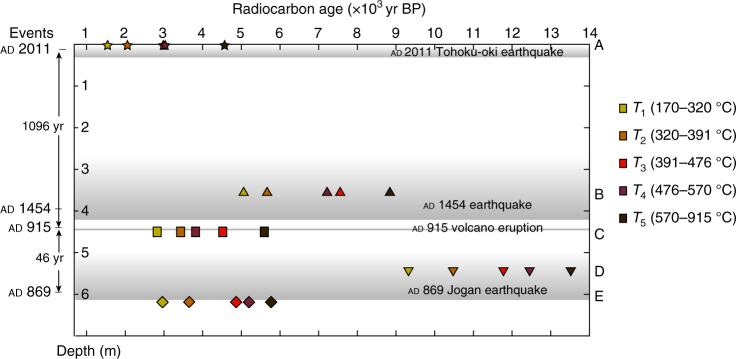
Sediments in deep ocean trenches may contain crucial information on past earthquake history and constitute important sites of carbon burial. Here we present 14C data on bulk organic carbon (OC) and its thermal decomposition fractions produced by ramped pyrolysis/oxidation for a core retrieved from the >7.5 km-deep Japan Trench. High-resolution 14C measurements, coupled with distinctive thermogram characteristics of OC, reveal hemipelagic sedimentation interrupted by episodic deposition of pre-aged OC in the trench. Low δ13C values and diverse 14C ages of thermal fractions imply that the latter material originates from the adjacent margin, and the co-occurrence of pre-aged OC with intervals corresponding to known earthquake events implies tectonically triggered, gravity-flow-driven supply. We show that 14C ages of thermal fractions can yield valuable chronological constraints on sedimentary sequences. Our findings shed new light on links between tectonically driven sedimentological processes and marine carbon cycling, with implications for carbon dynamics in hadal environments.
Conflict of interest statement
The authors declare no competing financial interests.
Figures
References
-
- Wolff T. The hadal community, an introduction. Deep Sea Res. 1960;6:95–124. doi: 10.1016/0146-6313(59)90063-2. - DOI
-
- Glud RN, et al. High rates of benthic microbial activity at 10900 meters depth: Results from the Challenger Deep (Mariana Trench) Nat. Geosci. 2013;6:284–288. doi: 10.1038/ngeo1773. - DOI
-
- Jamieson A. J. The Hadal Zone: Life in the Deepest Oceans. 1–382 (Cambridge University Press, UK, 2015).
-
- Turnewitsch R, et al. Recent sediment dynamics in hadal trenches: evidence for the influence of higher-frequency (tidal, near-inertial) fluid dynamics. Deep Sea Res. I. 2014;90:125–138. doi: 10.1016/j.dsr.2014.05.005. - DOI
Publication types
LinkOut - more resources
Full Text Sources
Other Literature Sources
Miscellaneous
