. 2018 Jan 9;8(1):200.
doi: 10.1038/s41598-017-18447-y.

Bacterial community assembly from cow teat skin to ripened cheeses is influenced by grazing systems

Affiliations

Bacterial community assembly from cow teat skin to ripened cheeses is influenced by grazing systems

Marie Frétin et al. Sci Rep. .

Abstract

The objectives of this study were to explore bacterial community assembly from cow teat skin to raw milk cheeses and to evaluate the role of farming systems on this assembly using 16S rRNA gene high-throughput sequencing. The two grazing systems studied (extensive vs. semi-extensive) had a greater effect on the microbiota of cow teat skin than on that of raw milks and cheeses. On teat skin, the relative abundance of several taxa at different taxonomic levels (Coriobacteriia, Bifidobacteriales, Corynebacteriales, Lachnospiraceae, Atopobium, and Clostridium) varied depending on the grazing system and the period (early or late summer). In cheese, the abundance of sub-dominant lactic acid bacteria (LAB) varied depending on the grazing system. Overall, 85% of OTUs detected in raw milks and 27% of OTUs detected in ripened cheeses were also found on cow teat skin. Several shared OTUs were assigned to taxa known to be involved in the development of cheese sensory characteristics, such as Micrococcales, Staphylococcaceae, and LAB. Our results highlight the key role of cow teat skin as a reservoir of microbial diversity for raw milk, and for the first time, that cow teat skin serves as a potential source of microorganisms found in raw-milk cheeses.


Conflict of interest statement

The authors declare that they have no competing interests.

Figures

Figure 1
Figure 1
Alpha-diversity inferred from 16S rRNA sequence data: number of observed OTUs (A), species richness (Chao1) (B), diversity indexes Shannon (C) and Simpson (D) in the four habitats (teat skin, raw milk, cheese core, and cheese rind) according to period (July and September) and grazing system (EXT and SEMI). Values are means of triplicate (n = 3) and bars in the columns represent the mean standard error. Habitats with different letters were significantly different (LSD test, P < 0.001).
Figure 2
Figure 2
The bacterial composition at phylum level in four habitats.
Figure 3
Figure 3
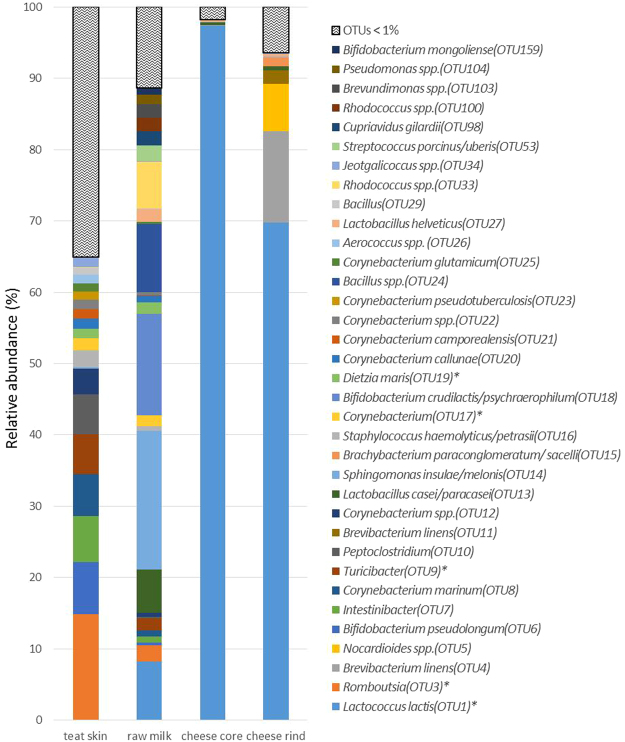
Relative abundance of 34 OTUs present at more than 1% in at least one of the habitats. The * symbol indicates the shared OTUs between two or more habitats.
Figure 4
Figure 4
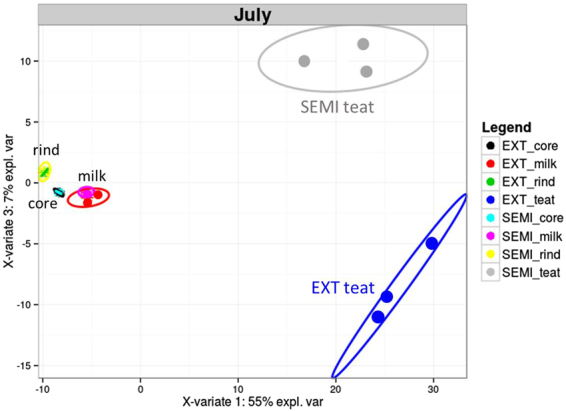
Partial least squares discriminant analysis (PLS-DA) performed on the relative abundance of 365 OTUs found in 24 samples of teat skin and dairy products (milk, cheese core, and cheese rind) from EXT and SEMI grazing systems in July. Plot of sample distribution is projected on principal components 1 and 3 (PC1 and PC3).
Figure 5
Figure 5
LEfSe cladogram demonstrating taxonomic differences in cow teat skin microbiota between the two grazing systems (EXT and SEMI) (A) in July, and (B) in September. Taxa and nodes highlighted in red and green were significantly more abundant in EXT and SEMI systems, respectively. The diameter of each circle is proportional to the abundance of the taxon. Only differentially abundant taxa at the genus or higher taxonomic ranks were indicated. For details on differentially abundant OTUs, see Tables S2 and S3. Nodes remaining light green indicate taxa that were not significantly differentially represented. The symbol * indicates identical taxa with a differential abundance at both periods.
Figure 6
Figure 6
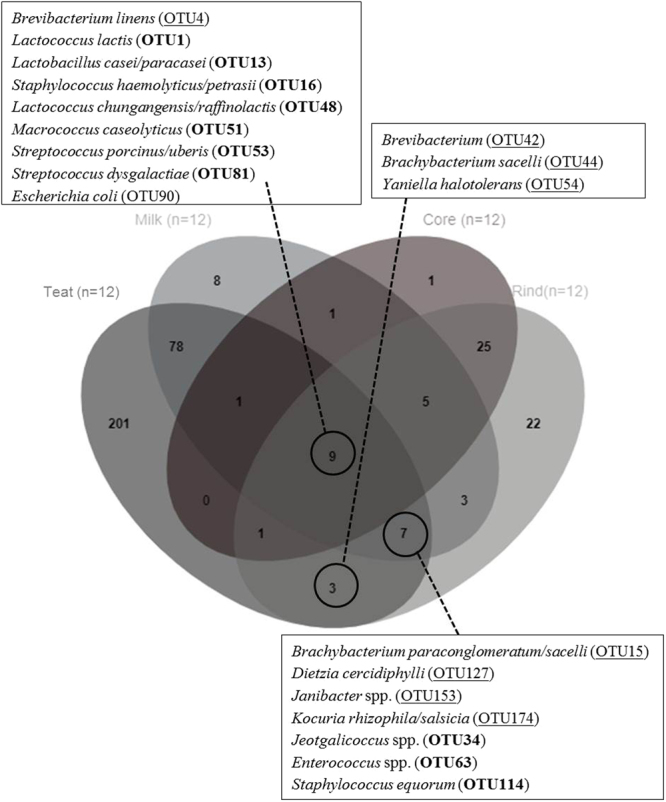
Venn diagram: occurrence of the 365 OTUs across the habitats from teat skin to ripened cheeses. The OTUs detected in at least two samples of the same habitat were conserved. The underlined OTUs were assigned to the phylum Actinobacteria and those in bold to the phylum Firmicutes.

References

    1. Verdier-Metz I, et al. Cow Teat Skin, a Potential Source of Diverse Microbial Populations for Cheese Production. Appl. Environ. Microbiol. 2012;78:326–333. doi: 10.1128/AEM.06229-11. - DOI - PMC - PubMed
    1. Zdanowicz M, Shelford JA, Tucker CB, Weary DM, von Keyserlingk MAG. Bacterial Populations on Teat Ends of Dairy Cows Housed in Free Stalls and Bedded with Either Sand or Sawdust. J. Dairy Sci. 2004;87:1694–1701. doi: 10.3168/jds.S0022-0302(04)73322-6. - DOI - PubMed
    1. Behrendt U, Müller T, Seyfarth W. The influence of extensification in grassland management on the populations of micro-organisms in the phyllosphere of grasses. Microbiol. Res. 1997;152:75–85. doi: 10.1016/S0944-5013(97)80026-2. - DOI
    1. Callaway TR, et al. Evaluation of bacterial diversity in the rumen and feces of cattle fed different levels of dried distillers grains plus solubles using bacterial tag-encoded FLX amplicon pyrosequencing. J. Anim. Sci. 2010;88:3977–3983. doi: 10.2527/jas.2010-2900. - DOI - PubMed
    1. Tajima K, et al. Diet-Dependent Shifts in the Bacterial Population of the Rumen Revealed with Real-Time PCR. Appl. Environ. Microbiol. 2001;67:2766–2774. doi: 10.1128/AEM.67.6.2766-2774.2001. - DOI - PMC - PubMed

Publication types