


Personal care product use as a predictor of urinary concentrations of certain phthalates, parabens, and phenols in the HERMOSA study
- PMID: 29317738
- PMCID: PMC6037613
- DOI: 10.1038/s41370-017-0003-z
Personal care product use as a predictor of urinary concentrations of certain phthalates, parabens, and phenols in the HERMOSA study
Abstract
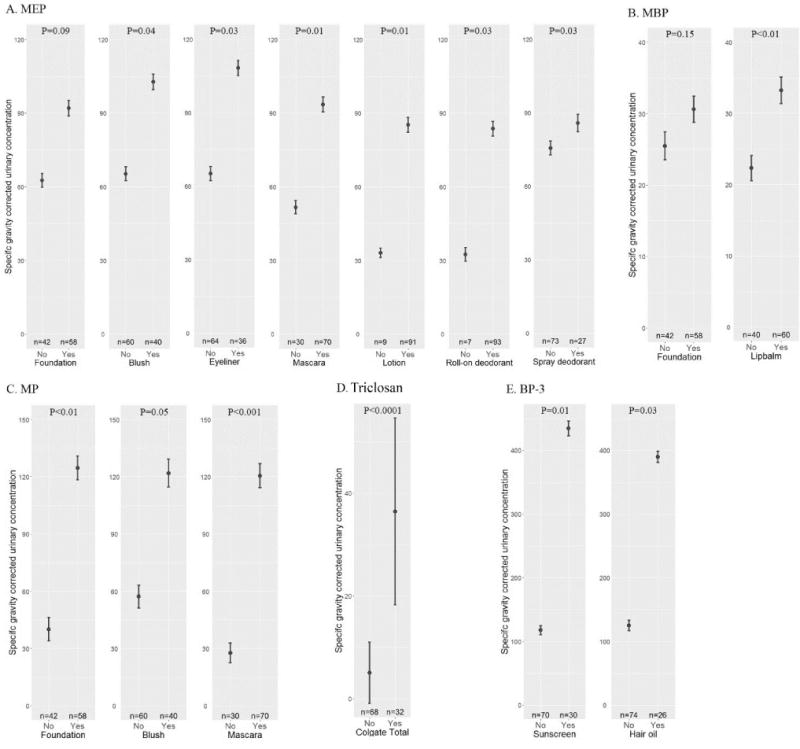
Use of personal care products, such as makeup, soaps, and sunscreen, may expose adolescent girls to potential endocrine disruptors, including phthalates, parabens, and other phenols. We evaluated the relationship between recent self-reported personal care product use and concentrations for urinary metabolites of phthalates, parabens, triclosan, and benzophenone-3 (BP-3) in 100 Latina adolescents. Girls who reported using makeup every day vs. rarely/never had higher urinary concentrations of monoethyl phthalate (MEP) (102.2 ng/mL vs. 52.4 ng/mL, P-value: 0.04), methyl paraben (MP) (120.5 ng/mL vs. 13.4 ng/mL, P-value < 0.01), and propyl paraben (PP) (60.4 ng/mL vs. 2.9 ng/mL, P-value < 0.01). Girls who reported recent use of specific makeup products, including foundation, blush, and mascara, had higher urinary concentrations of MEP, mono-n-butyl phthalate (MBP), MP, and PP. Use of Colgate Total toothpaste was associated with 86.7% higher urinary triclosan concentrations. Use of sunscreen was associated with 57.8% higher urinary concentrations of BP-3. Our findings suggest that personal care product use is associated with higher exposure to certain phthalates, parabens, and other phenols in urine. This may be especially relevant in adolescent girls who have high use of personal care products during a period of important reproductive development.
Keywords: Benzophenone-3; Parabens; Personal care products; Phthalates; Product use; Triclosan.
Conflict of interest statement
Conflicts of Interest:
The authors have no conflicts of interest. The authors declare no competing financial interest.
Figures
References
-
- Koniecki D, Wang R, Moody RP, Zhu J. Phthalates in cosmetic and personal care products: concentrations and possible dermal exposure. Environmental research. 2011;111(3):329–36. - PubMed
-
- Guo Y, Kannan K. A survey of phthalates and parabens in personal care products from the United States and its implications for human exposure. Environmental science & technology. 2013;47(24):14442–9. - PubMed
-
- Program NT. Butylparaben [CAS No. 94-26-8] Review of toxicological literature. 2005
Publication types
MeSH terms
Substances
Grants and funding
LinkOut - more resources
Full Text Sources
Other Literature Sources
Medical
Miscellaneous
