


Nitrogen Nutrition of Fruit Trees to Reconcile Productivity and Environmental Concerns
- PMID: 29320450
- PMCID: PMC5874593
- DOI: 10.3390/plants7010004
Nitrogen Nutrition of Fruit Trees to Reconcile Productivity and Environmental Concerns
Abstract
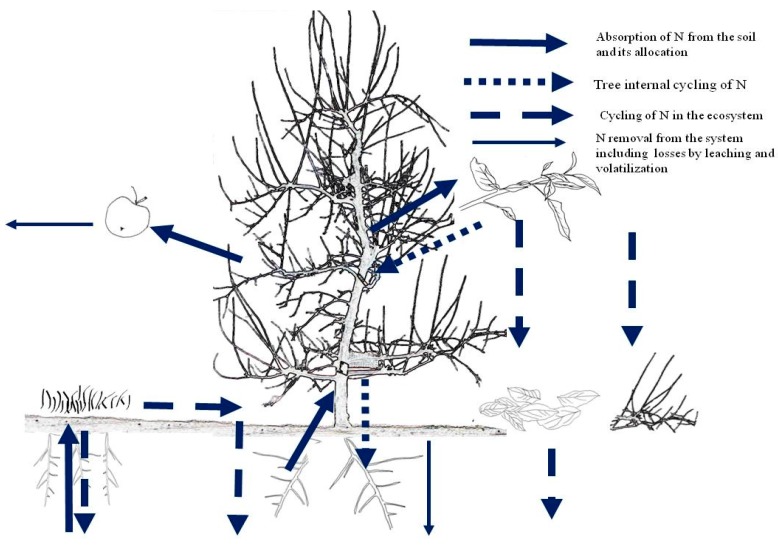
Although perennial fruit crops represent 1% of global agricultural land, they are of a great economic importance in world trade and in the economy of many regions. The perennial woody nature of fruit trees, their physiological stages of growth, the root distribution pattern, and the presence of herbaceous vegetation in alleys make orchard systems efficient in the use and recycling of nitrogen (N). The present paper intends to review the existing literature on N nutrition of young and mature deciduous and evergreen fruit trees with special emphasis to temperate and Mediterranean climates. There are two major sources of N contributing to vegetative tree growth and reproduction: root N uptake and internal N cycling. Optimisation of the use of external and internal N sources is important for a sustainable fruit production, as N use efficiency by young and mature fruit trees is generally lower than 55% and losses of fertilizer N may occur with the consequent economic and environmental concern. Organic alternatives to mineral N fertilizer like the application of manure, compost, mulching, and cover crops are scarcely used in perennial fruit trees, in spite of the fact that society's expectations call for more sustainable production techniques and the demand for organic fruits is increasing.
Keywords: N losses; N uptake; cover crops; deciduous and evergreen fruit trees; internal N cycling; mineral and organic N fertilization.
Conflict of interest statement
The authors declare no conflict of interest. The manuscript is not under consideration or published in another journal.
Figures
References
-
- Food and Agriculture Organization (FAO) How to Feed the World in 2050. FAO; Quebec, QC, Canada: 2009. p. 35.
-
- Pathak H., Nedwell D.B. Nitrous oxide emission from soil with different fertilizer, water levels and nitrification inhibitors. Water Air Soil Pollut. 2011;129:217–228. doi: 10.1023/A:1010316215596. - DOI
-
- Srivastava A.K. New paradigms in soil health management in fruit crops for improving farmers’ income. Shodh Chintan. 2017;9:191–224.
-
- Khan Z.I., Ahmad K., Ashraf M., Parveen R., Bibi Z., Mustafa I., Noorka I.R., Tahir H.M., Akram N.A., Ullah M.F., et al. Risk assessment of heavy metal and metalloid toxicity through a contaminated vegetable (Cucurbita maxima) from wastewater irrigated area: A case study for a site-specific risk assessment in Jhang, Pakistan. Hum. Ecol. Risk Assess. 2016;22:86–98. doi: 10.1080/10807039.2015.1055709. - DOI
LinkOut - more resources
Full Text Sources
Other Literature Sources
Miscellaneous
