


The impact of electronic consultation on a Canadian tertiary care pediatric specialty referral system: A prospective single-center observational study
- PMID: 29320539
- PMCID: PMC5761872
- DOI: 10.1371/journal.pone.0190247
The impact of electronic consultation on a Canadian tertiary care pediatric specialty referral system: A prospective single-center observational study
Abstract
Background: Champlain BASE™ (Building Access to Specialists through eConsultation) is a web-based asynchronous electronic communication service that allows primary-care- practitioners (PCPs) to submit "elective" clinical questions to a specialist. For adults, PCPs have reported improved access and timeliness to specialist advice, averted face-to-face specialist referrals in up to 40% of cases and high provider satisfaction.
Objective: To determine whether the expansion of eConsult to a pediatric setting would result in similar measures of improved healthcare system process and high provider acceptance reported in adults.
Design: Prospective observational cohort study.
Setting: Single Canadian tertiary-care academic pediatric hospital (June 2014-16) servicing 1.2 million people.
Participants: 1. PCPs already using eConsult. 2.Volunteer pediatric specialists provided services in addition to their regular workload. 3.Pediatric patients (< 18 years-old) referred for none-acute care conditions.
Main outcomes and measures: Specialty service utilization and access, impact on PCP course-of-action and referral-patterns and survey-based provider satisfaction data were collected.
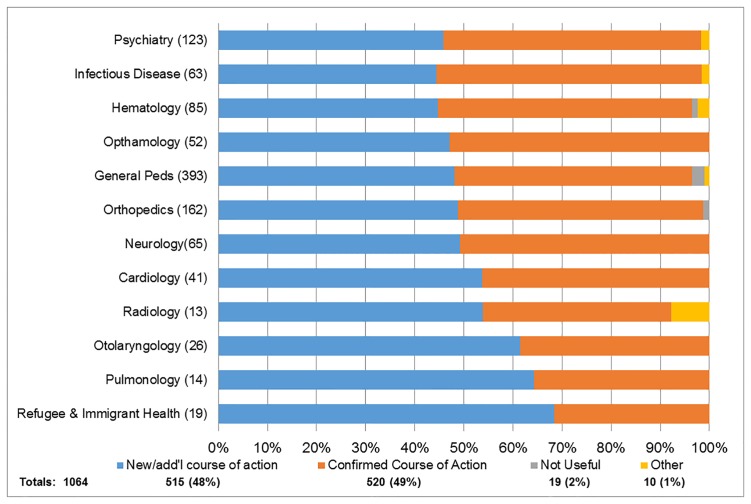
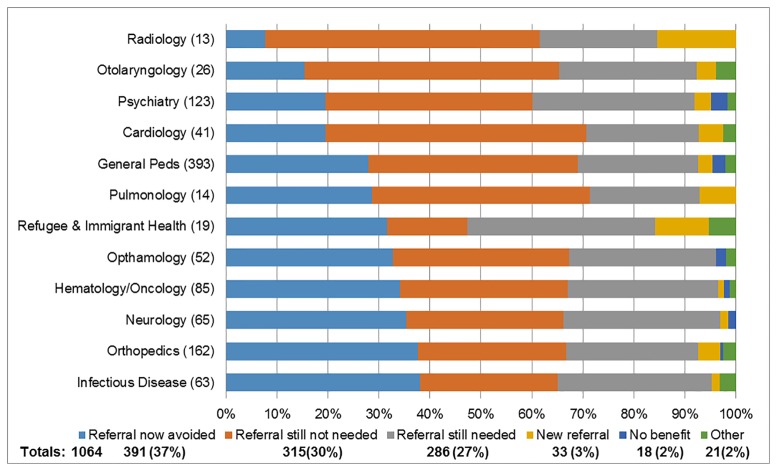
Results: 1064 eConsult requests from 367 PCPs were answered by 23 pediatric specialists representing 14 specialty-services. The top three specialties represented were: General Pediatrics 393 cases (36.9%), Orthopedics 162 (15.2%) and Psychiatry 123 (11.6%). Median specialist response time was 0.9 days (range <1 hour-27 days), most consults (63.2%) required <10minutes to complete and 21/21(100%) specialist survey-respondents reported minimal workload burden. For 515/1064(48.4%) referrals, PCPs received advice for a new or additional course of action; 391/1064(36.7%) referrals resulted in an averted face-to-face specialist visit. In 9 specialties with complete data, the median wait-time was significantly less (p<0.001) for an eConsult (1 day, 95%CI:0.9-1.2) compared with a face-to-face referral (132 days; 95%CI:127-136). The majority (>93.3%) of PCPs rated eConsult as very good/excellent value for both patients and themselves. All specialist survey-respondents indicated eConsult should be a continued service.
Conclusions and relevance: Similar to adults, eConsult improves PCP access and timeliness to elective pediatric specialist advice and influences their care decisions, while reporting high end-user satisfaction. Further study is warranted to assess impact on resource utilization and clinical outcomes.
Conflict of interest statement
Figures
References
-
- Schoen C, Osborn R, Squires D, Doty M, Rasmussen P, Pierson R, et al. A survey of primary care doctors in ten countries shows progress in use of health information technology, less in other areas. Health Aff (Millwood) 2012;31(12):2805–16. - PubMed
-
- Association CM. Experiences with Referral from Primary to Specialty Care. Ottawa, Ontario: Canadian Medical Association; 2012.
-
- Wright JG, Menaker RJ, the Canadian Paediatric Surgical Wait Times Study Group. Waiting for children’s surgery in Canada: the Canadian Paediatric Surgical Wait Times project. CMAJ. 2011; 183(9): e559–64. doi: 10.1503/cmaj.101530 - DOI - PMC - PubMed
-
- Williams L, O'Riordan S, McGuigan C, Hutchinson M, Tubridy N. A web-based electronic neurology referral system: a solution for an overburdened healthcare system? Ir Med J. 2012;105(9):301–3. - PubMed
-
- Whited JD, Warshaw EM, Edison KE, Kapur K, Thottapurathu L, Raju S, et al. Effect of store and forward teledermatology on quality of life: a randomized controlled trial. JAMA Dermatol. 2013;149(5):584–91. doi: 10.1001/2013.jamadermatol.380 - DOI - PMC - PubMed
Publication types
MeSH terms
LinkOut - more resources
Full Text Sources
Other Literature Sources
Medical
