. 2018 Jan 10;285(1870):20172599.
doi: 10.1098/rspb.2017.2599.

Rapid seasonal evolution in innate immunity of wild Drosophila melanogaster

Affiliations

Rapid seasonal evolution in innate immunity of wild Drosophila melanogaster

Emily L Behrman et al. Proc Biol Sci. .

Abstract

Understanding the rate of evolutionary change and the genetic architecture that facilitates rapid adaptation is a current challenge in evolutionary biology. Comparative studies show that genes with immune function are among the most rapidly evolving genes across a range of taxa. Here, we use immune defence in natural populations of Drosophila melanogaster to understand the rate of evolution in natural populations and the genetics underlying rapid change. We probed the immune system using the natural pathogens Enterococcus faecalis and Providencia rettgeri to measure post-infection survival and bacterial load of wild D. melanogaster populations collected across seasonal time along a latitudinal transect along eastern North America (Massachusetts, Pennsylvania and Virginia). There are pronounced and repeatable changes in the immune response over the approximately 10 generations between spring and autumn collections, with a significant but less distinct difference observed among geographical locations. Genes with known immune function are not enriched among alleles that cycle with seasonal time, but the immune function of a subset of seasonally cycling alleles in immune genes was tested using reconstructed outbred populations. We find that flies containing seasonal alleles in Thioester-containing protein 3 (Tep3) have different functional responses to infection and that epistatic interactions among seasonal Tep3 and Drosomycin-like 6 (Dro6) alleles underlie the immune phenotypes observed in natural populations. This rapid, cyclic response to seasonal environmental pressure broadens our understanding of the complex ecological and genetic interactions determining the evolution of immune defence in natural populations.

Keywords: Drosomycin-like 6; Drosophila melanogaster; Thioester-containing protein 3; epistasis; innate immunity; rapid adaptation.


Conflict of interest statement

The authors have no competing interests to declare.

Figures
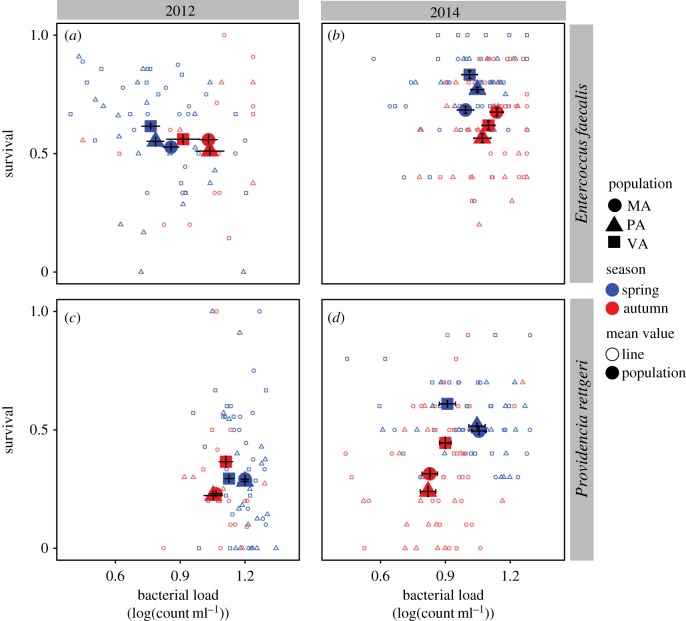
Figure 1.
Figure 1.
Immune defence relationship between bacterial load and survival in natural spring and autumn populations. Isofemale lines (small, outline) were used to calculate population mean ± s.e. (large, filled) from natural orchard populations collected along a latitudinal gradient in Massachusetts Pennsylvania and Virginia in the spring and autumn for two replicate years: 2012 (a,c) and 2014 (b,d). Immune defence was probed with two natural pathogens: a Gram-positive bacterium Enterococcus faecalis (a,b) and a Gram-negative bacterium Providencia rettgeri (c,d). Twenty isofemale lines from each collection were measured for 5-day survival after infection and bacterial load at 24 h post-infection scaled by average load for the experiment.
Figure 2.
Figure 2.
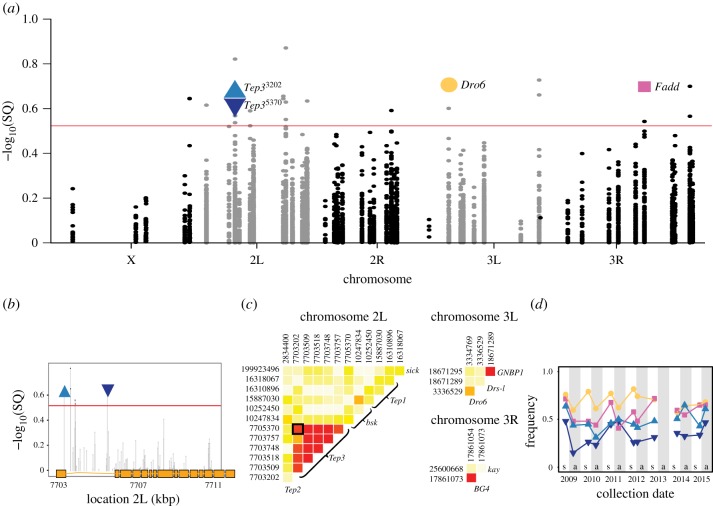
Seasonal changes in immune genes in natural populations. (a) Manhattan plot of SNPs in immune genes that change in frequency across seasonal time [29]. The red line indicates the seasonal q-value cutoff > 0.3 [29]. The SNPs on which functional analyses were performed are highlighted: Fadd, Dro6, Tep33202 and Tep35370. (b) Manhattan plot of SNPs in immune genes within Tep3 with genic structure along the x axis. Exons indicated in orange boxes. (c) Heat map showing linkage disequilibrium among SNPs in immune genes across each chromosome using DGRP. (d) Cycling of seasonal allele frequencies of candidate immune SNPs in Pennsylvania in the spring (s) and the autumn (a) from 2009 to 2015. (Online version in colour.)
Figure 3.
Figure 3.
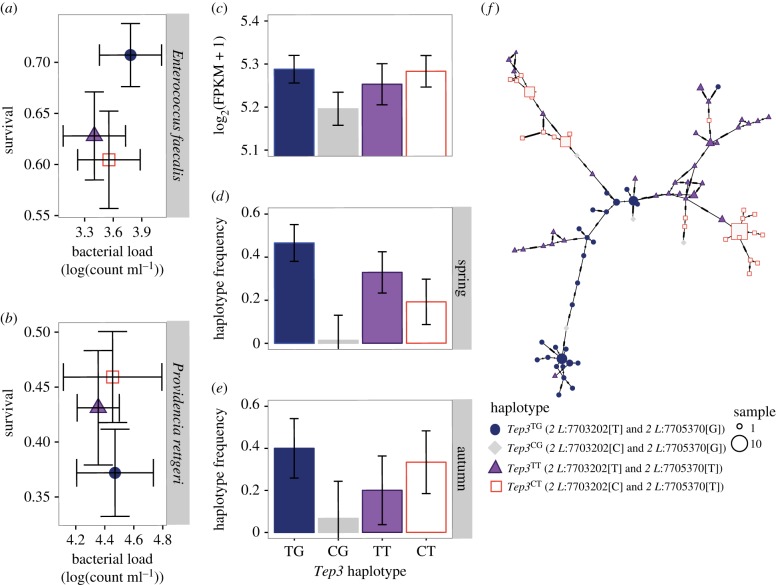
Functional difference of seasonal Tep3 alleles as defined by the focal SNPs. Mean ± s.e. for bacterial load 24 h post-infection and survival 5 days post-infection for the Tep3 genotypes. (a) Higher survival for the spring genotype than the autumn or combination genotypes when infected with E. faecalis. (b) Additive effect of alleles when infected with P. rettgeri. (c) Lower constitutive Tep3 mRNA expression in the rare Tep3CG haplotype from the published dataset of DGRP flies [48]. (d,e) Frequency of Tep3 haplotypes in the Pennsylvania orchard across seasonal time. (f) Minimum spanning network illustrates that LD among the SNPs is maintained in distinct haplotypes. (Online version in colour.)
Figure 4.
Figure 4.
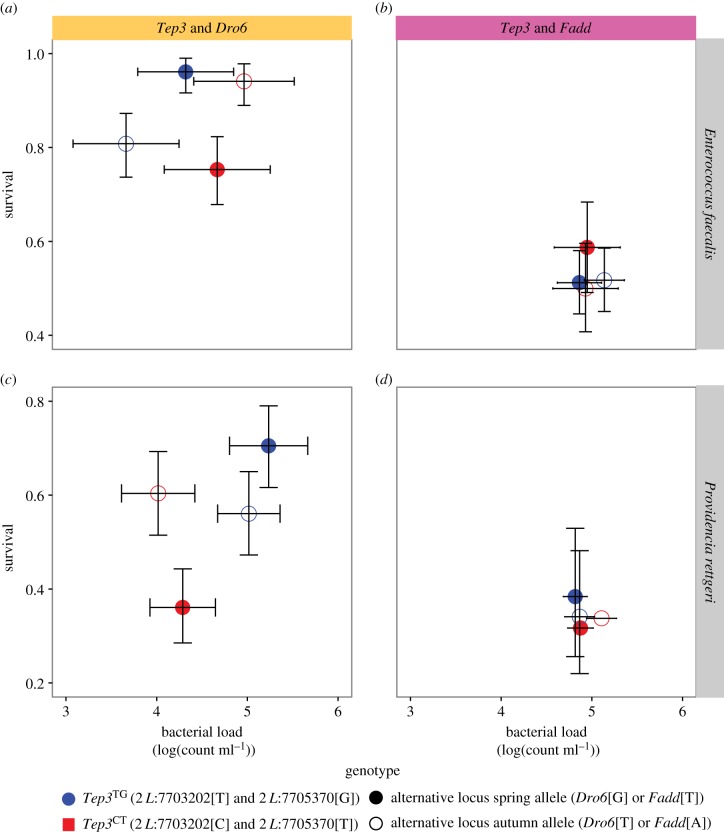
Intergenic interactions among Tep3, Dro6 and Fadd. Non-additive interaction among Tep3 and Dro6 alleles. No significant interaction among Tep3 and Fadd SNPs.

References

    1. Darwin C. 1859. On the origin of species by means of natural selection, or, the preservation of favoured races in the struggle for life. London, UK: J Murray. - PMC - PubMed
    1. Grant PR, Grant BR. 2002. Unpredictable evolution in a 30-year study of Darwin's finches. Science 296, 707–711. (10.1126/science.1070315) - DOI - PubMed
    1. Thompson JN. 2013. Relentless evolution. Chicago, IL: University of Chicago Press.
    1. Carroll SP, Hendry AP, Reznick DN, Fox CW. 2007. Evolution on ecological time-scales. Funct. Ecol. 21, 387–393. (10.1111/j.1365-2435.2007.01289.x) - DOI
    1. Messer PW, Ellner SP, Hairston NG Jr. 2016. Can population genetics adapt to rapid evolution? Trends Genet. 32, 408–418. (10.1016/j.tig.2016.04.005) - DOI - PubMed

Publication types

Substances

LinkOut - more resources