


Reversed gender ratio of autism spectrum disorder in Smith-Magenis syndrome
- PMID: 29321841
- PMCID: PMC5759230
- DOI: 10.1186/s13229-017-0184-2
Reversed gender ratio of autism spectrum disorder in Smith-Magenis syndrome
Abstract
Background: A substantial amount of research shows a higher rate of autistic type of problems in males compared to females. The 4:1 male to female ratio is one of the most consistent findings in autism spectrum disorder (ASD).Lately, the interest in studying ASD in genetic disorders has increased, and research has shown a higher prevalence of ASD in some genetic disorders than in the general population.Smith-Magenis syndrome (SMS) is a rare and complex genetic syndrome caused by an interstitial deletion of chromosome 17p11.2 or a mutation on the retinoic acid induced 1 gene. The disorder is characterised by intellectual disability, multiple congenital anomalies, obesity, neurobehavioural abnormalities and a disrupted circadian sleep-wake pattern.
Methods: Parents of 28 persons with SMS between 5 and 50 years old participated in this study. A total of 12 of the persons with SMS were above the age of 18 at the time of the study. A total of 11 came from Sweden and 17 were from Norway.We collected information regarding the number of autism spectrum symptoms using the Social Communication Questionnaire (SCQ) and the Social Responsiveness Scale (SRS). Adaptive behaviour was also measured using the Vineland Adaptive Behavior Scale II. The level of intellectual disability was derived from a review of the medical chart.
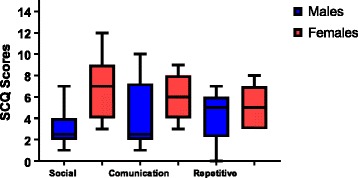
Results: We found significant gender differences in ASD symptomatology using the SCQ and SRS questionnaires. We found approximately three females per male above the SCQ cutoff. The same differences were not found in the intellectual level and adaptive behaviour or for behavioural and emotional problems.Gender had an independent contribution in a regression model predicting the total SCQ score, and neither the Vineland Adaptive Behavior Scale II nor the Developmental Behaviour Checklist had an independent contribution to the SCQ scores.
Conclusion: We found a clear reversed gender difference in ASD symptomatology in persons with SMS. This may be relevant in the search for female protective factors assumed to explain the male bias in ASD.
Keywords: Autism symptomatology; Gender; Smith-Magenis syndrome.
Conflict of interest statement
The study was approved by the regional ethics committee in Norway (REK 2015/1026). Written informed consent was given by parents/guardians to allow the researchers access to medical records from all hospitals in Norway.All the participants consented to publication.The authors declare that they have no competing interests.Springer Nature remains neutral with regard to jurisdictional claims in published maps and institutional affiliations.
Figures
References
-
- Halladay AK, Bishop S, Constantino JN, Daniels AM, Koenig K, Palmer K, Messinger D, Pelphrey K, Sanders SJ, Singer AT, et al. Sex and gender differences in autism spectrum disorder: summarizing evidence gaps and identifying emerging areas of priority. Mol Autism. 2015;6(1):36. doi: 10.1186/s13229-015-0019-y. - DOI - PMC - PubMed
-
- Jacquemont S, Coe Bradley P, Hersch M, Duyzend Michael H, Krumm N, Bergmann S, Beckmann Jacques S, Rosenfeld Jill A, Eichler Evan E. A higher mutational burden in females supports a “female protective model” in neurodevelopmental disorders. Am J Hum Genet. 2014;94(3):415–425. doi: 10.1016/j.ajhg.2014.02.001. - DOI - PMC - PubMed
Publication types
MeSH terms
LinkOut - more resources
Full Text Sources
Other Literature Sources
Medical
