


Traditional Persian Medicine and management of metabolic dysfunction in polycystic ovary syndrome
- PMID: 29321985
- PMCID: PMC5755987
- DOI: 10.1016/j.jtcme.2017.04.006
Traditional Persian Medicine and management of metabolic dysfunction in polycystic ovary syndrome
Abstract
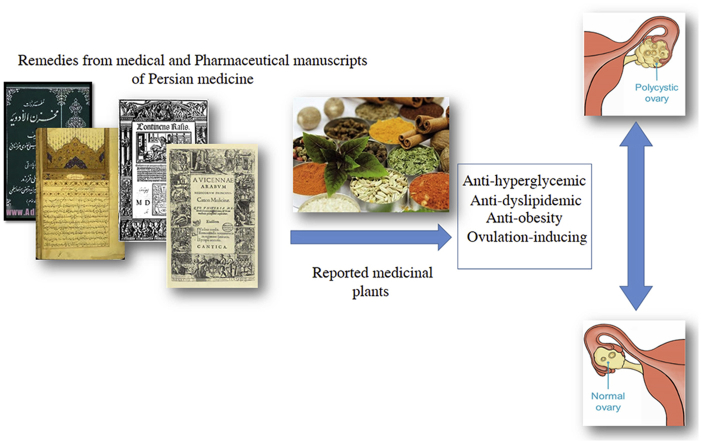
Polycystic ovary syndrome (PCOS) is a common endocrine disorder in women of reproductive age. Its cause is unknown and it remains the most enigmatic of reproductive disorders. The extant written documents of Traditional Persian Medicine (TPM) - with holistic approaches towards human health - contain remedies used for centuries. Before further experimental research on any of these treatments, it is appropriate to study current related scientific evidence on their possible pharmacological actions. This work aims to study PCOS and its treatments in TPM. To collect data from medieval medicinal texts, six of the most famous manuscripts of Persian medicine were studied. Medicinal treatments for a problem similar to PCOS were searched for in these books. The plants were listed and their authentications were confirmed in accordance with botanical books. PubMed and ScienceDirect databases were searched for related mechanisms of action or pharmacological activities of the medicinal plants reported. From numerous articles, the current work tried to cite the latest publications with regard to each reported plant and PCOS-related mechanisms of action. We studied herbal treatments recommended by ancient Persians to treat a condition called Habs-e-tams, which had the same symptoms of PCOS. It could be concluded that ancient physicians not only wanted to treat the irregular menstrual cycle-which is the most obvious symptom of PCOS-but also their treatment options were aimed at ameliorating the related underlying metabolic dysfunctions. The recommended herbs, which have the most scientific proof for their related actions, can be studied further in experimental analyses.
Keywords: Medicinal plant; Metabolic dysfunction; Persia; Pharmacopoeia; Polycystic ovary syndrome; Traditional Persian Medicine.
References
-
- Kim H.U., Ryu J.Y., Lee J.O., Lee S.Y. A systems approach to traditional oriental medicine. Nat Biotech. 2015;33:264–268. - PubMed
-
- Costantini S., Colonna G., Castello G. A holistic approach to study the effects of natural antioxidants on inflammation and liver cancer. Cancer Treat Res. 2014;159:311–323. - PubMed
-
- Arentz S., Abbott J.A., Smith C.A., Bensoussan A. Herbal medicine for the management of polycystic ovary syndrome (PCOS) and associated oligo/amenorrhoea and hyperandrogenism; a review of the laboratory evidence for effects with corroborative clinical findings. BMC Complement Altern Med. 2014;14:511. - PMC - PubMed
-
- Gorji A. Pharmacological treatment of headache using Traditional Persian Medicine. Trends Pharm Sci. 2003;24:331–334. - PubMed
Publication types
LinkOut - more resources
Full Text Sources
Other Literature Sources