Review
. 2018 Jun;127(2):175-186.
doi: 10.1007/s00412-018-0659-8. Epub 2018 Jan 10.

Ki-67: more than a proliferation marker

Affiliations
Review

Ki-67: more than a proliferation marker

Xiaoming Sun et al. Chromosoma. 2018 Jun.

Abstract

Ki-67 protein has been widely used as a proliferation marker for human tumor cells for decades. In recent studies, multiple molecular functions of this large protein have become better understood. Ki-67 has roles in both interphase and mitotic cells, and its cellular distribution dramatically changes during cell cycle progression. These localizations correlate with distinct functions. For example, during interphase, Ki-67 is required for normal cellular distribution of heterochromatin antigens and for the nucleolar association of heterochromatin. During mitosis, Ki-67 is essential for formation of the perichromosomal layer (PCL), a ribonucleoprotein sheath coating the condensed chromosomes. In this structure, Ki-67 acts to prevent aggregation of mitotic chromosomes. Here, we present an overview of functional roles of Ki-67 across the cell cycle and also describe recent experiments that clarify its role in regulating cell cycle progression in human cells.

Keywords: Cell cycle; Heterochromatin; Ki-67; Perichromosomal layer.


Conflict of interest statement

Conflict of Interest:

Xiaoming Sun declares that she has no conflict of interest.

Paul D. Kaufman declares that he has no conflict of interest.

Figures
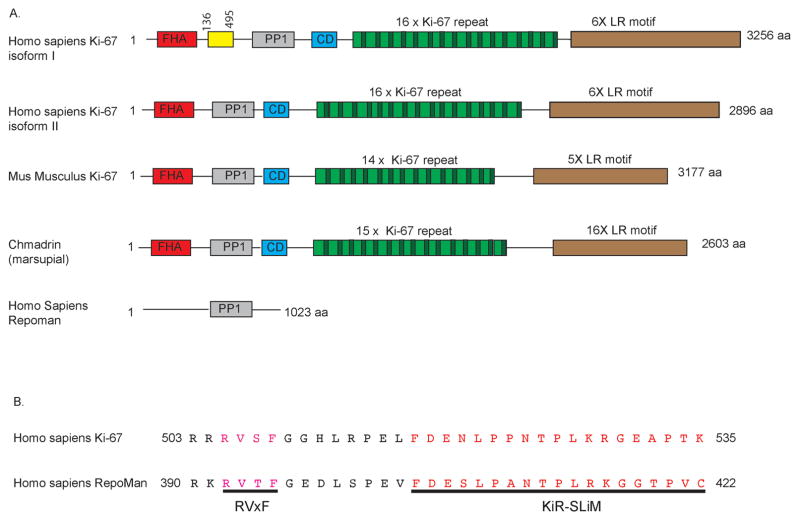
Figure 1
Figure 1. A schematic diagram of human Ki-67 structure
A: Comparison of evolutionarily conserved regions of Ki-67 (NCBI NP_002408) and RepoMan (NP_689775). FHA: forkhead-associated domain; PP1: PP1 binding domain; CD: conserved domain with unknown functions, LR: leucine-arginine rich domain B: Comparison of the primary sequences of PP1-binding domains of human Ki-67 (isoform I) and RepoMan (isoform I).
Figure 2
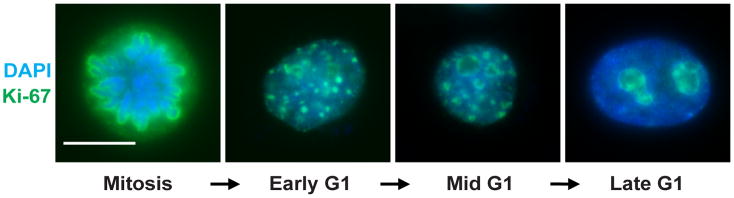
Figure 2. Ki-67 localization throughout the cell cycle
HeLa S3 cells were stained with anti-Ki67 antibodies (green) and DAPI to visualize DNA (blue), illustrating different Ki-67 localizations across the cell cycle. In mitotic cells, Ki-67 coats the condensed chromosomes as the foundation of the perichromosomal layer. As cells exit mitosis and enter early G1 phase, small puncta of Ki-67 leave the decondensing chromosomes. These then coalesce at the periphery of the reformed nucleoli as G1 phase progresses. Scale bar, 10 μm. This figure is reprinted from Matheson and Kaufman, Mol. Biol. Cell (2017), with permissions from the authors.

References

    1. Banani SF, Rice AM, Peeples WB, et al. Composition control of Phase-separated cellular bodies. Cell. 2016;166:651–663. doi: 10.1016/j.cell.2016.06.010. - DOI - PMC - PubMed
    1. Barr ML, Bertram EG. A morphological distinction between neurones of the male and female, and the behaviour of the nucleolar satellite during accelerated nucleoprotein synthesis. Nature. 1949;163:676. doi: 10.1038/163676a0. - DOI - PubMed
    1. Booth DG, Beckett AJ, Molina O, et al. 3D-CLEM Reveals that a Major Portion of Mitotic Chromosomes Is Not Chromatin. Mol Cell. 2016;64:790–802. doi: 10.1016/j.molcel.2016.10.009. - DOI - PMC - PubMed
    1. Booth DG, Earnshaw WC. Ki-67 and the Chromosome Periphery Compartment in Mitosis. Trends Cell Biol S0962-8924. 2017:30136–8. doi: 10.1016/j.tcb.2017.08.001. - DOI - PubMed
    1. Booth DG, Takagi M, Sanchez-Pulido L, et al. Ki-67 is a PP1-interacting protein that organises the mitotic chromosome periphery. Elife. 2014 doi: 10.7554/eLife.01641. - DOI - PMC - PubMed

Publication types

MeSH terms