. 2017 Dec 21;11(Suppl 7):132.
doi: 10.1186/s12918-017-0506-1.

Investigation and identification of functional post-translational modification sites associated with drug binding and protein-protein interactions

Affiliations

Investigation and identification of functional post-translational modification sites associated with drug binding and protein-protein interactions

Min-Gang Su et al. BMC Syst Biol. .

Abstract

Background: Protein post-translational modification (PTM) plays an essential role in various cellular processes that modulates the physical and chemical properties, folding, conformation, stability and activity of proteins, thereby modifying the functions of proteins. The improved throughput of mass spectrometry (MS) or MS/MS technology has not only brought about a surge in proteome-scale studies, but also contributed to a fruitful list of identified PTMs. However, with the increase in the number of identified PTMs, perhaps the more crucial question is what kind of biological mechanisms these PTMs are involved in. This is particularly important in light of the fact that most protein-based pharmaceuticals deliver their therapeutic effects through some form of PTM. Yet, our understanding is still limited with respect to the local effects and frequency of PTM sites near pharmaceutical binding sites and the interfaces of protein-protein interaction (PPI). Understanding PTM's function is critical to our ability to manipulate the biological mechanisms of protein.

Results: In this study, to understand the regulation of protein functions by PTMs, we mapped 25,835 PTM sites to proteins with available three-dimensional (3D) structural information in the Protein Data Bank (PDB), including 1785 modified PTM sites on the 3D structure. Based on the acquired structural PTM sites, we proposed to use five properties for the structural characterization of PTM substrate sites: the spatial composition of amino acids, residues and side-chain orientations surrounding the PTM substrate sites, as well as the secondary structure, division of acidity and alkaline residues, and solvent-accessible surface area. We further mapped the structural PTM sites to the structures of drug binding and PPI sites, identifying a total of 1917 PTM sites that may affect PPI and 3951 PTM sites associated with drug-target binding. An integrated analytical platform (CruxPTM), with a variety of methods and online molecular docking tools for exploring the structural characteristics of PTMs, is presented. In addition, all tertiary structures of PTM sites on proteins can be visualized using the JSmol program.

Conclusion: Resolving the function of PTM sites is important for understanding the role that proteins play in biological mechanisms. Our work attempted to delineate the structural correlation between PTM sites and PPI or drug-target binding. CurxPTM could help scientists narrow the scope of their PTM research and enhance the efficiency of PTM identification in the face of big proteome data. CruxPTM is now available at http://csb.cse.yzu.edu.tw/CruxPTM/ .


Conflict of interest statement

Ethics approval and consent to participate

Not applicable.

Consent for publication

Not applicable.

Competing interests

The authors declare that they have no competing interests.

Publisher’s Note

Springer Nature remains neutral with regard to jurisdictional claims in published maps and institutional affiliations.

Figures
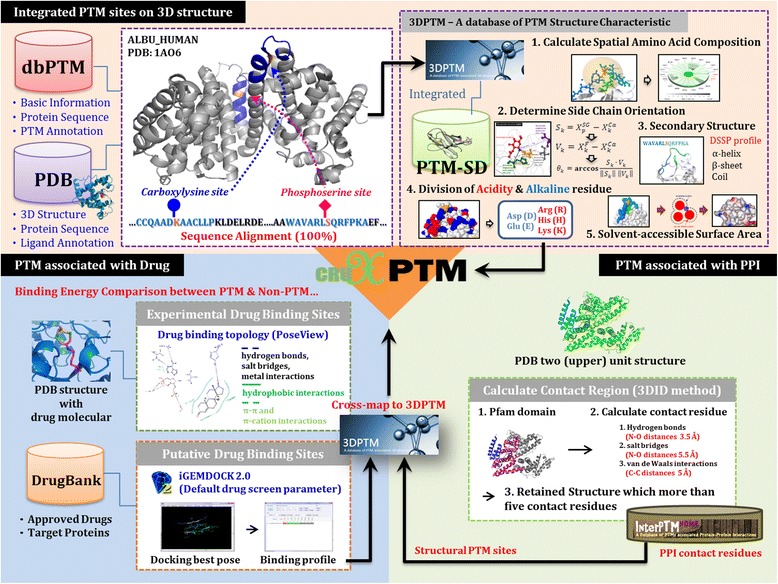
Fig. 1
Fig. 1
Flowchart of the analyses performed in this study. The experimentally verified PTM sites were acquired from dbPTM. Since drug binding sites and protein-protein interaction sites were extracted from protein structural information, we mapped all experimentally confirmed PTM sites to known 3D structures in the PDB by using UniProtKB ID and sequence identity. Then, the PTM sites were cross-matched with drug binding sites and PPI contacting sites for the identification of PTM sites associated with drug binding and PPI. Finally, these data were integrated with a PTM structural analytical method and computing programs for building up a web-based system
Fig. 2
Fig. 2
Investigation of the five structural characteristics for PTM substrate sites. To characterize PTM substrate sites, the structural characteristics such as (a) spatial amino acid composition, (b) the orientation of side chains around PTM substrate sites, (c) secondary structure of flanking sequences, (d) division of acidity and alkaline residues, and (e) solvent-accessible surface area were investigated
Fig. 3
Fig. 3
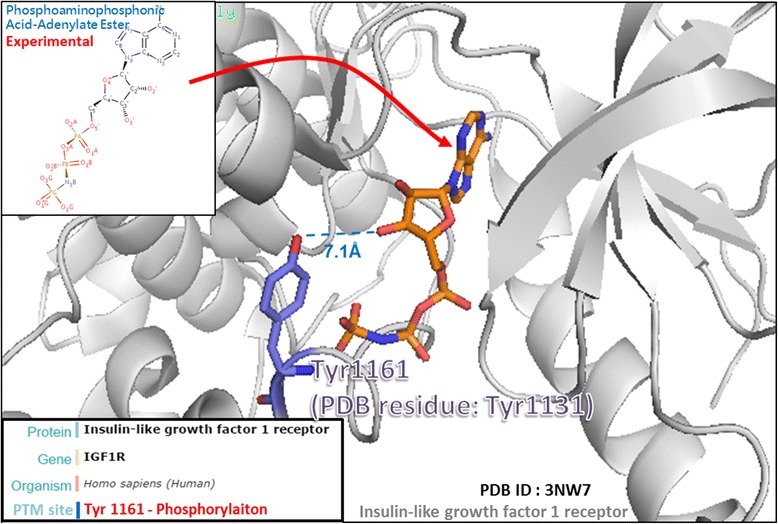
A case study of the Tyr1131 phosphorylation site associated with drug binding on insulin-like growth factor 1 receptor (IGF1R). The IGF1R is a type of kinases and an inhibitor of the IGF1R could maintain the protein in an inactive conformation. Since the IGF1R was phosphorylated, the crystal structure of its activation loops would be rearranged in such a way that significantly decreases the inhibitor’s affinity. Thus, Tyr1131 phosphorylation site may provide a functional role by modulating the structure of the target protein and reducing the affinity between the inhibitor and the target site
Fig. 4
Fig. 4
A case study of the Lys217 carboxylation site associated with drug binding on urease subunit alpha (URE1). Urease is responsible for hydrolyzing urea into carbon dioxide and ammonia. The active site of all known ureases is composed of a bis-μ-hydroxo dimeric nickel center, located in the alpha (α)-subunit, and has an interatomic distance of ~3.5 Å. Our analysis shows that acetohydroxamic acid might inhibit urease activity by competing with nickel atoms in the enzyme to form a chelate. This could potentially interrupt the hydrolysis (Lys217 carboxylation) of urea, which reduces the concentration of urinary ammonia and lowers urine pH
Fig. 5
Fig. 5
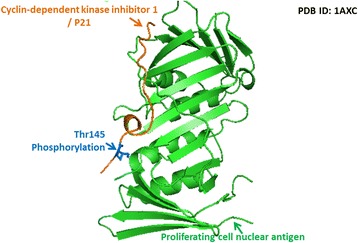
A case study of the Thr145 phosphorylation site located in the interacting region of p21–PCNA complex (PDBID: 1AXC). The phosphorylation of the Thr145 residue of p21, which corresponds to the PCNA binding region (from residue 144 to 151), may inhibit the interaction between p21 and PCNA, resulting in PCNA binding with other DNA polymerase components [54]
Fig. 6
Fig. 6
A case study of the Tyr127 phosphorylation site located in the interacting region of RhoGDI–Rac1 complex (PDBID: 1HH4). A disordered N-terminal domain of RhoGDI1 contains a tyrosine residue (Tyr27), which is localized to the docking interface. The phosphorylated Tyr127 has been reported to facilitate the dissociation of RhoA, Rac1, and cdc from RhoGDI1, making GTPases available for activation [57]
Fig. 7
Fig. 7
A case study of the phosphorylation sites located in the interacting region of the ternary complex of eIF4E-m7GpppA-4EBP1 peptide (PDBID: 1WKW). There are three substrate sites (Thr50, Tyr54 and Ser65) of phosphorylation within the binding region of the 4EBP1, which can regulate its interaction with eIF4E. These sites are reported to modulate the reversible binding of 4EBP1 with eIF4E, and hyper-phosphorylation at these sites decreases the strength of interaction between the two proteins [59]

References

    1. Lander ES, Linton LM, Birren B, Nusbaum C, Zody MC, Baldwin J, Devon K, Dewar K, Doyle M, FitzHugh W, et al. Initial sequencing and analysis of the human genome. Nature. 2001;409(6822):860–921. doi: 10.1038/35057062. - DOI - PubMed
    1. van Kasteren SI, Kramer HB, Jensen HH, Campbell SJ, Kirkpatrick J, Oldham NJ, Anthony DC, Davis BG. Expanding the diversity of chemical protein modification allows post-translational mimicry. Nature. 2007;446(7139):1105–1109. doi: 10.1038/nature05757. - DOI - PubMed
    1. Lee TY, Huang HD, Hung JH, Huang HY, Yang YS, Wang TH. dbPTM: an information repository of protein post-translational modification. Nucleic Acids Res. 2006;34(Database issue):D622–D627. doi: 10.1093/nar/gkj083. - DOI - PMC - PubMed
    1. Lee TY, Bo-Kai Hsu J, Chang WC, Huang HD. RegPhos: a system to explore the protein kinase-substrate phosphorylation network in humans. Nucleic Acids Res. 2011;39(Database issue):D777–D787. doi: 10.1093/nar/gkq970. - DOI - PMC - PubMed
    1. Seet BT, Dikic I, Zhou MM, Pawson T. Reading protein modifications with interaction domains. Nat Rev Mol Cell Biol. 2006;7(7):473–483. doi: 10.1038/nrm1960. - DOI - PubMed