


Regulatory T cells as a new therapeutic target for atherosclerosis
- PMID: 29323337
- PMCID: PMC6289392
- DOI: 10.1038/aps.2017.140
Regulatory T cells as a new therapeutic target for atherosclerosis
Abstract
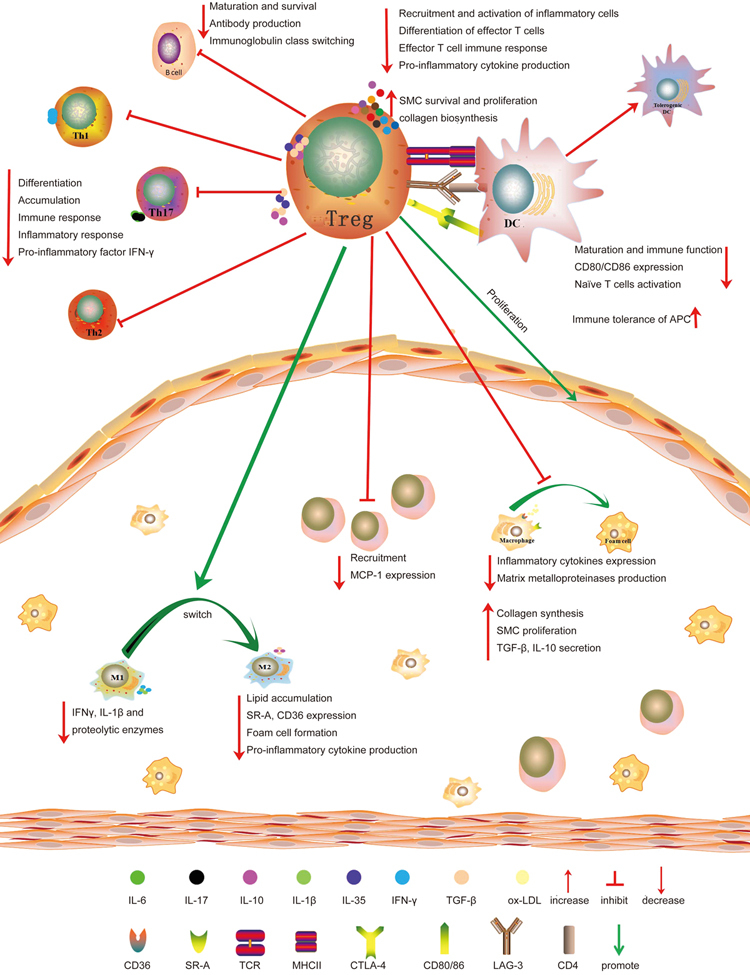
Atherosclerosis is an autoimmune disease caused by self- and non-self-antigens contributing to excessive activation of T and B cell immune responses. These responses further aggravate vascular infiammation and promote progression of atherosclerosis and vulnerability to plaques via releasing pro-infiammatory cytokines. Regulatory T cells (Tregs) as the major immunoregulatory cells, in particular, induce and maintain immune homeostasis and tolerance by suppressing the immune responses of various cells such as T and B cells, natural killer (NK) cells, monocytes, and dendritic cells (DCs), as well as by secreting inhibitory cytokines interleukin (IL)-10, IL-35 and transcription growth factor β (TGF-β) in both physiological and pathological states. Numerous evidence demonstrates that reduced numbers and dysfunction of Treg may be involveved in atherosclerosis pathogenesis. Increasing or restoring the numbers and improving the immunosuppressive capacity of Tregs may serve as a fundamental immunotherapy to treat atherosclerotic cardiovascular diseases. In this article, we briefiy present current knowledge of Treg subsets, summarize the relationship between Tregs and atherosclerosis development, and discuss the possibilities of regulating Tregs for prevention of atherosclerosis pathogenesis and enhancement of plaque stability. Although the exact molecular mechanisms of Treg-mediated protection against atherosclerosis remain to be elucidated, the strategies for targeting the regulation of Tregs may provide specific and significant approaches for the prevention and treatment of atherosclerotic cardiovascular diseases.
Keywords: atherosclerosis; cardiovascular diseases; immune regulation; regulatory T cells; treatment strategy.
Figures
References
-
- Jiang J, Mo ZC, Yin K, Zhao GJ, Lv YC, Ouyang XP, et al. Epigallocatechin-3-gallate prevents TNF-alpha-induced NF-kappaB activation thereby upregulating ABCA1 via the Nrf2/Keap1 pathway in macrophage foam cells. Int J Mol Med. 2012;29:946–56. - PubMed
-
- Yu XH, Jiang HL, Chen WJ, Yin K, Zhao GJ, Mo ZC, et al. Interleukin-18 and interleukin-12 together downregulate ATP-binding cassette transporter A1 expression through the interleukin-18R/nuclear factor-kappaB signaling pathway in THP-1 macrophage-derived foam cells. Circ J. 2012;76:1780–91. - PubMed
-
- Ketelhuth DF, Hansson GK. Adaptive response of T and B cells in atherosclerosis. Circ Res. 2016;118:668–78. - PubMed
Publication types
MeSH terms
Substances
LinkOut - more resources
Full Text Sources
Other Literature Sources
Medical
