. 2018 Jan;13(1):307-323.
doi: 10.1038/nprot.2017.131. Epub 2018 Jan 11.

CRISPR-Cas9-based genome-wide screening of Toxoplasma gondii

Affiliations

CRISPR-Cas9-based genome-wide screening of Toxoplasma gondii

Saima M Sidik et al. Nat Protoc. 2018 Jan.

Erratum in

Abstract

Apicomplexan parasites, such as Toxoplasma gondii, cause extensive morbidity and mortality in humans and livestock, highlighting the need for a deeper understanding of their molecular biology. Although techniques for the generation of targeted gene disruptions have long been available for apicomplexans, such methods are not readily scalable to the entire genome. We recently used CRISPR-Cas9 to disrupt all nuclear protein-coding genes in T. gondii using a pooled format. The method relies on transfection of a guide RNA library into parasites constitutively expressing Cas9. Here, we present the complete workflow of such a screen, including preparation of the guide RNA library, growth and testing of the recipient strain, generation of the mutant population, culture conditions for the screen, preparation of genomic DNA libraries, next-generation sequencing of the guide RNA loci, and analysis to detect fitness-conferring genes. This method can be deployed to study how culture conditions affect the repertoire of genes needed by parasites, which will enable studies of their metabolic needs, host specificity, and drug-resistance mechanisms. In addition, by manipulating the background in which the screen is performed, researchers will be able to investigate genetic interactions, which may help uncover redundancy or epistasis in the parasite genome. Using this method, a genome-wide screen and its analysis can be completed in 3 weeks, after ∼1 month of preparation to generate the library and grow the cells needed, making it a powerful tool for uncovering functionally important genes in apicomplexan parasites.


Figures
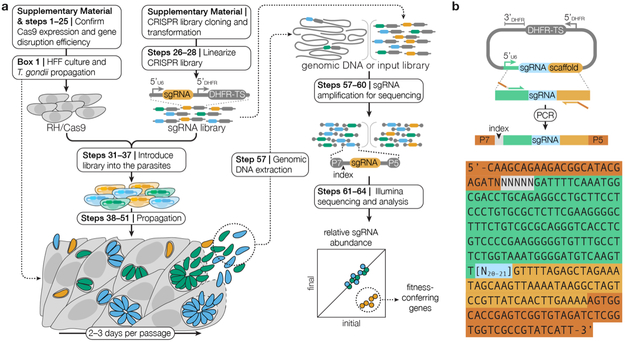
Figure 1.
Figure 1.. A Schematic of the CRISPR Screening Procedure.
(a) RH/Cas9 parasites that have been shown to express active Cas9 are transfected with the linearized CRISPR library. After one week of growth in HFF cells, transfected parasites may be analyzed to identify fitness-conferring genes or subjected to additional selective pressures prior to analysis. Genomic DNA is extracted from the post-growth and post-selection populations and sgRNAs are amplified from this genomic DNA and from the input library through two sequential PCRs. The Illumina sequencing adaptors P5 and P7, as well as indices that facilitate multiplexing, are added during the second PCR. The abundances of sgRNAs in the transfected library relative to all subsequent samples are quantified using next-generation sequencing. Genes that confer fitness will be lower abundance in post-growth or post-selection populations relative to the transfected CRISPR library. (b) Diagram of the amplification of sgRNAs from the CRISPR library prior to sequencing. The sequence of the amplicon is illustrated with N’s denoting the barcode for multiplexing (gray) and the sgRNA (blue). Regions or homology to the vector (orange and green), and Illumina sequencing adaptors (red) are also highlighted.
Figure 2.
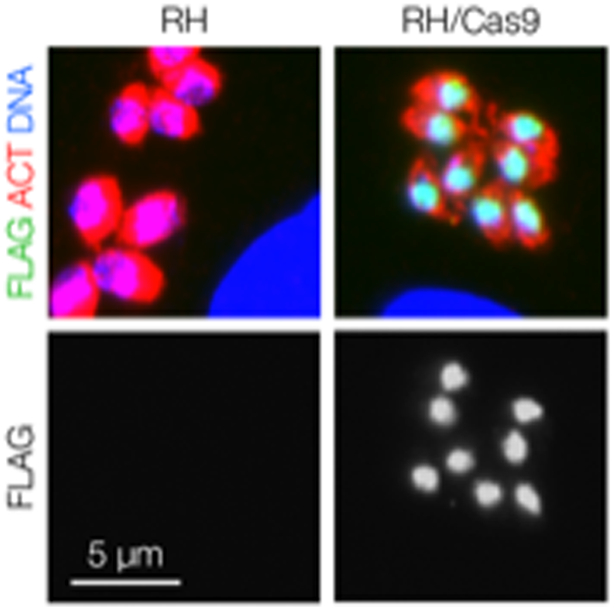
Figure 2.. Assessing Cas9 Expression by Immunofluorescence.
Cas9 is visible as a green nuclear dot in RH/Cas9 parasites stained with mouse anti-FLAG followed by Alexa488-conjugated goat anti-mouse. An antibody against a cytoplasmic protein such as actin can be used as a counterstain, and Hoechst can be used to visualize DNA. The parental strain RH lacks the green nuclear staining that is indicative of Cas9 expression. See the Supplementary Methods for a detailed procedure.
Figure 3.
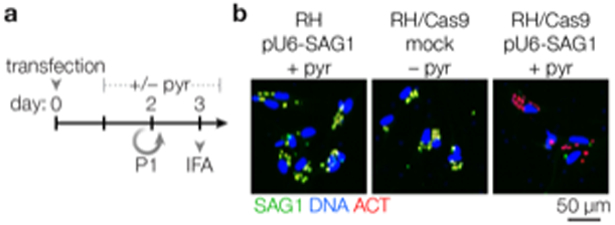
Figure 3.. Assessing Cas9 Activity Using an sgRNA Targeting SAG1.
(a) RH/Cas9 and RH are transfected with pU6-SAG1 or mock transfected, then cultured for 3 days. Pyrimethamine is added after 24 hours to select for transfected parasites (or not, in the case of mock transfected parasites). (b) Immunofluorescence assays (IFAs) performed after 3 days reveal loss of SAG1. Active Cas9 is expected to result in loss of SAG1 in 90–97% of parasite vacuoles. See steps 1–25 for a detailed procedure.
Figure 4.
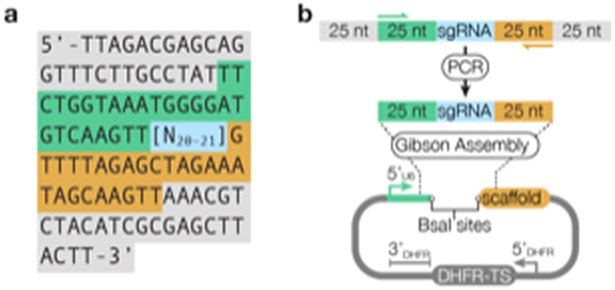
Figure 4.. Cloning a CRISPR library into pU6-DHFR.
(a) Oligonucleotide arrays contain sgRNAs (highlighted in blue) flanked by regions homologous to pU6-DHFR (green and orange) and sequences for the isolation of sgRNAs targeting subsets of genes (gray). (b) sgRNAs plus regions bearing homology to pU6-SAG1 are amplified using Primer 5 and Primer 6 (Table 1). The resulting DNA fragments are inserted into BsaI-linearized pU6-DHFR using Gibson Assembly. See the Supplementary Methods for a detailed procedure.
Figure 5.
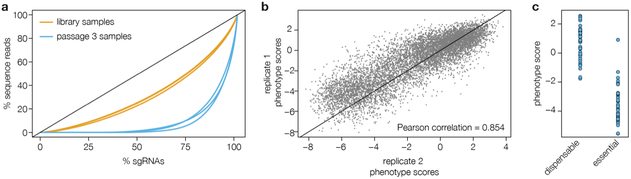
Figure 5.. Anticipated Screening Results.
(a) Lorenz curves illustrating the abundance disparity in four CRISPR library (orange) and four Passage 3 (blue) samples after Next-Generation Sequencing. (b) Correlation between phenotype scores of two biological replicates of a CRISPR screen for T. gondii genes that confer fitness when parasites are grown in HFF cells. Perfect correlation is indicated by a diagonal line. (c) Phenotype scores associated with 40 known dispensable and 40 known essential genes after a screen for fitness-conferring genes.

References

    1. World Health Organization. World Malaria Report. 2015, World Health Organization; World Malaria Report http://www.who.int/malaria/publications/world-malaria-report-2015/report... Date: (2015).
    1. Checkley W et al. A review of the global burden, novel diagnostics, therapeutics, and vaccine targets for cryptosporidium. Lancet Infect Dis 15, 85–94 (2015). - PMC - PubMed
    1. Torgerson PR & Mastroiacovo P The global burden of congenital toxoplasmosis: a systematic review. Bull. World Health Organ. 91, 501–508 (2013). - PMC - PubMed
    1. Agriculture, U. S. D. O. Toxoplasma on U.S. Sheep Operations.
    1. Garrison E et al. A Forward Genetic Screen Reveals that Calcium-dependent Protein Kinase 3 Regulates Egress in Toxoplasma. PLoS Pathog 8, e1003049 (2012). - PMC - PubMed

Publication types

MeSH terms

Substances