. 2018 Feb 28;46(4):1927-1944.
doi: 10.1093/nar/gkx1315.

Eukaryotic translational termination efficiency is influenced by the 3' nucleotides within the ribosomal mRNA channel

Affiliations

Eukaryotic translational termination efficiency is influenced by the 3' nucleotides within the ribosomal mRNA channel

Andrew G Cridge et al. Nucleic Acids Res. .

Abstract

When a stop codon is at the 80S ribosomal A site, there are six nucleotides (+4 to +9) downstream that are inferred to be occupying the mRNA channel. We examined the influence of these downstream nucleotides on translation termination success or failure in mammalian cells at the three stop codons. The expected hierarchy in the intrinsic fidelity of the stop codons (UAA>UAG>>UGA) was observed, with highly influential effects on termination readthrough mediated by nucleotides at position +4 and position +8. A more complex influence was observed from the nucleotides at positions +5 and +6. The weakest termination contexts were most affected by increases or decreases in the concentration of the decoding release factor (eRF1), indicating that eRF1 binding to these signals was rate-limiting. When termination efficiency was significantly reduced by cognate suppressor tRNAs, the observed influence of downstream nucleotides was maintained. There was a positive correlation between experimentally measured signal strength and frequency of the signal in eukaryotic genomes, particularly in Saccharomyces cerevisiae and Drosophila melanogaster. We propose that termination efficiency is not only influenced by interrogation of the stop signal directly by the release factor, but also by downstream ribosomal interactions with the mRNA nucleotides in the entry channel.


Figures
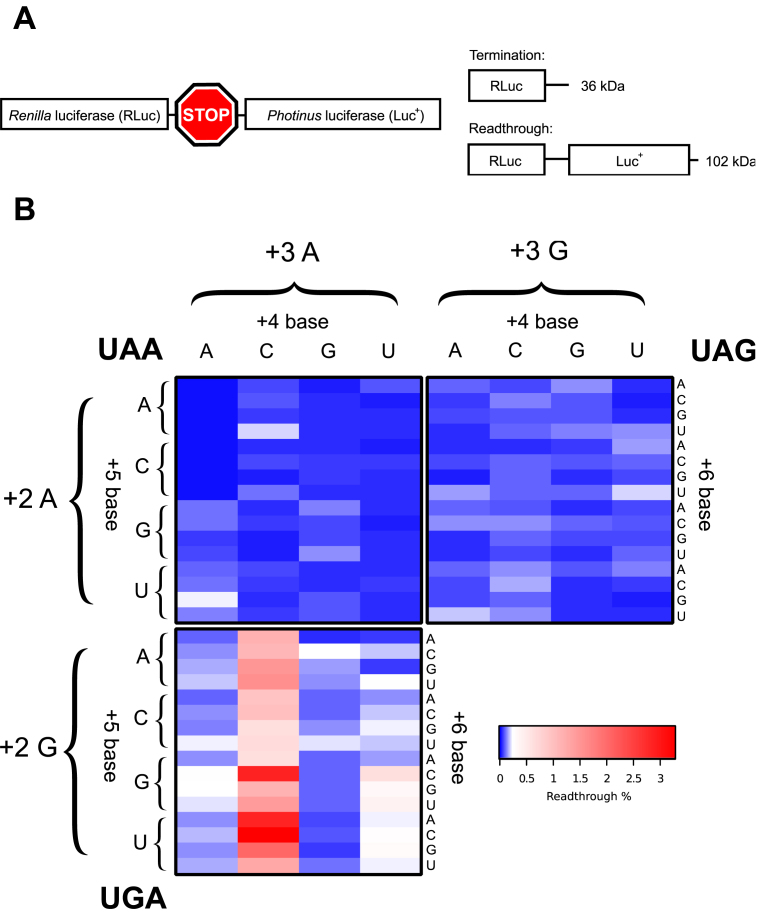
Figure 1.
Figure 1.
(A) Schematic of the pGL3s-hRLuc construct. Upon translation of the dual luciferase mRNA two protein products were produced, a 36 kDa termination product (RLuc only) and a 102 kDa readthrough product (RLuc:Luc+ fusion). (B) Heat map of mean measured readthrough efficiency for 192 constructs (all possible permutations of the +4 to +6 positions for each stop codon). Top left quadrant, UAA; top right quadrant, UAG; bottom left quadrant, UGA. ‘+2’ and ‘+3’ refer to the identity of the second and third bases in the stop codon; ‘+4’, ‘+5’ and ‘+6’ refer to the three nucleotides immediately 3′ to the stop codon. Data are available in Supplementary Table S1.
Figure 2.
Figure 2.
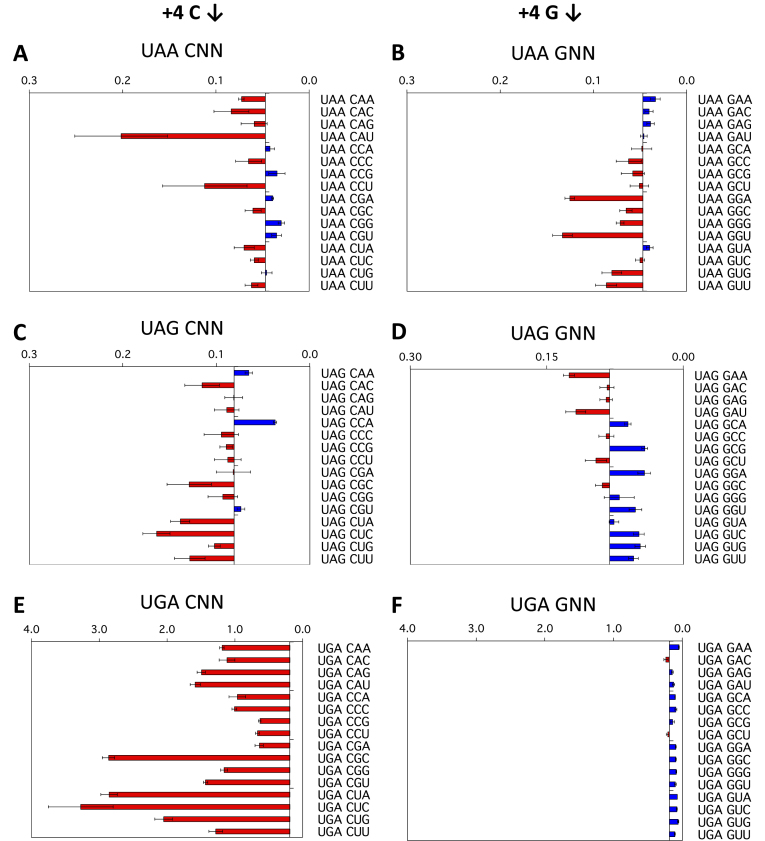
Termination efficiencies of the +1UAA(C/G)NN+6, +1UAG(C/G)NN+6 and +1UGA(C/G)NN+6 signals (+4 position). Termination efficiencies of the +1UAA(C/G)NN+6 (A, B), +1UAG(C/G)NN+6 (C, D) and +1UGA(C/G)NN+6 (E, F) sequence contexts measured in COS-7 cultured cells. Readthrough (%) was calculated by comparison to near-cognate control constructs (CAG/UAA, UAU/UAG, and UGG/UGA) and plotted on the x-axis. Termination efficiencies are presented according to the identity of the base immediately following the termination codon (+4). Results are graphed relative to the median termination efficiency for the series (0.047% UAA, 0.081% UAG and 0.190% UGA). Red bars represent levels of readthrough greater than the median (left) and blue bars represent levels of readthrough less than the median (right). Experiments were performed in triplicate with two independently isolated constructs for each signal context. Mean values are presented ± SEM.
Figure 3.
Figure 3.
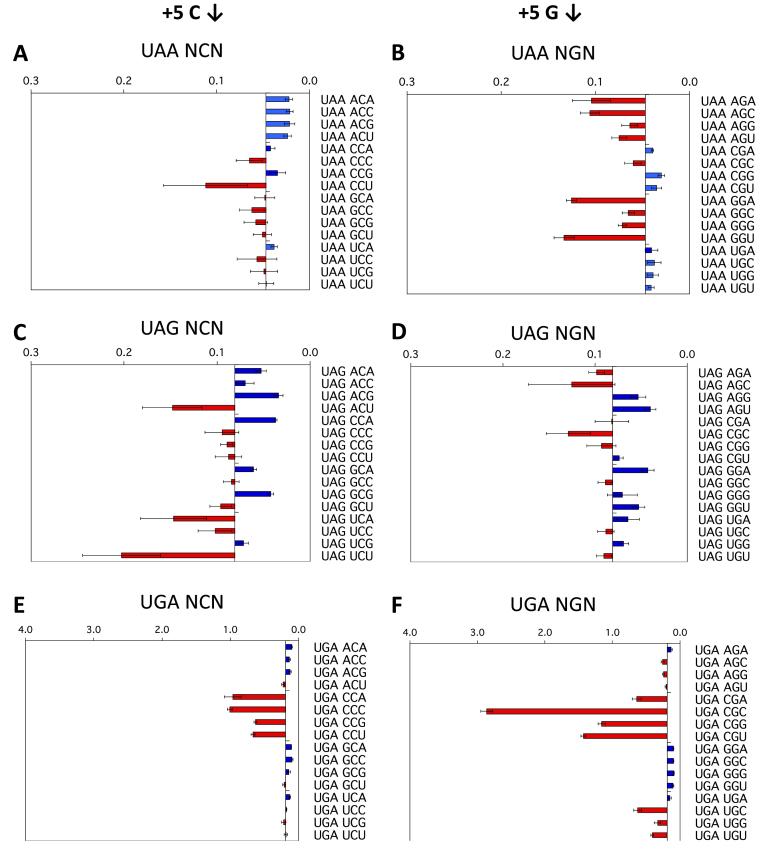
Termination efficiencies of the +1UAAN(C/G)N+6, +1UAGN(C/G)N+6 and +1UGAN(C/G)N+6 signals (+5 and +6 positions). Termination efficiencies of the +1UAAN(C/G)N+6 (A, B), +1UAGN(C/G)N+6 (C, D) and +1UGAN(C/G)N+6 (E, F) sequence contexts measured in COS-7 cultured cells. Readthrough (%) was calculated and results graphed on the x-axis relative to the median termination efficiency for the series as in Figure 2. Termination efficiencies are presented according to the identity of the second base following the termination codon (+5). Presentation format, numbers of replicates and error bars are as in Figure 2.
Figure 4.
Figure 4.
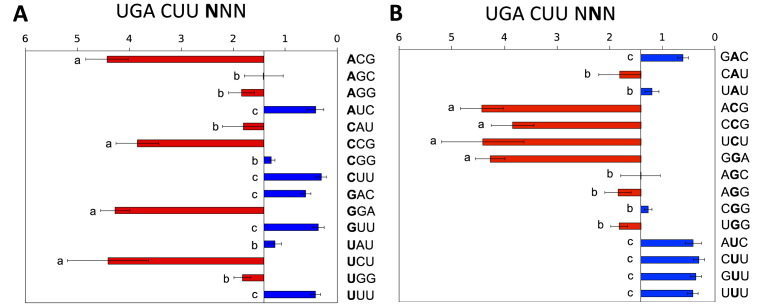
Termination efficiencies of the +1UGACUUNNN+9 signal (+7 to +9 positions). (A) Termination efficiencies of representative high and low efficiency +1UGACUUNNN+9 sequence contexts measured in COS-7 cultured cells. Readthrough (%) was calculated by comparison to a near-cognate control construct (UGG). Termination efficiencies are presented according to the identity of the fourth base following the termination codon (+7). Results are graphed relative to the median termination efficiency for the series (1.41%). Presentation format, numbers of replicates and error bars are as in Figure 2. Means not sharing the same letter are significantly different (Tukey HSD, P < 0.01). (B) The same data as in (A) but ordered according to the identity of the +8 nucleotide.
Figure 5.
Figure 5.
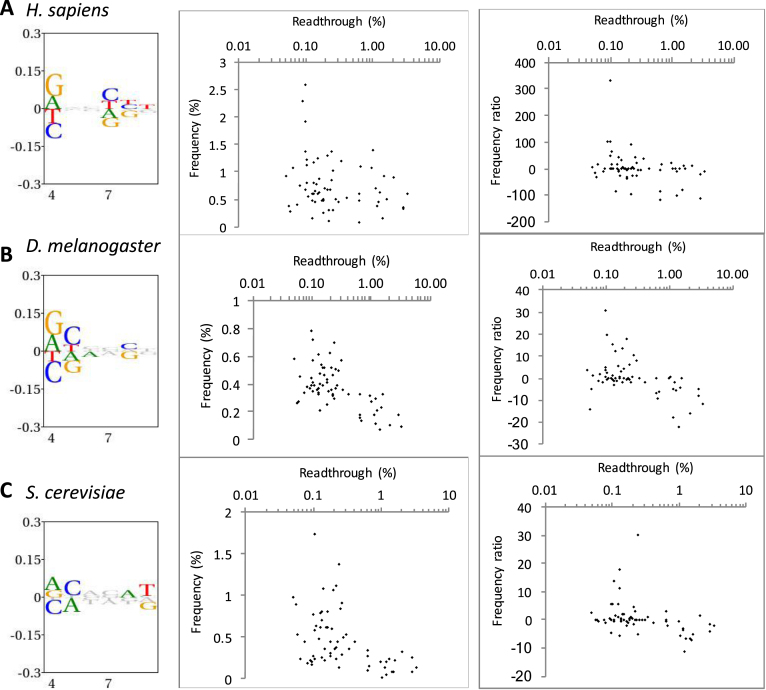
Hexanucleotide bias and stop codon readthrough in the genomes of three eukaryotic species. Left panels show information content and bias through the +4 to +9 positions downstream of all stop codons in each organism. The height of all symbols at any given position specifies the information content, and over-and under-represented nucleotides are assigned positive and negative values, respectively. Middle and right panels show the correlation between measured readthrough and hexanucleotide stop codons beginning with UGA. In the middle panel, frequency among all analysed genes is shown. In the right panels, readthrough is plotted against a frequency ratio, (observed − expected)2/expected (see Methods for details) to adjust for local nucleotide bias. (A) H. sapiens (9482 analysed sequences). (B) D. melanogaster (2280 sequences). (C) S. cerevisiae (1598 sequences).
Figure 6.
Figure 6.
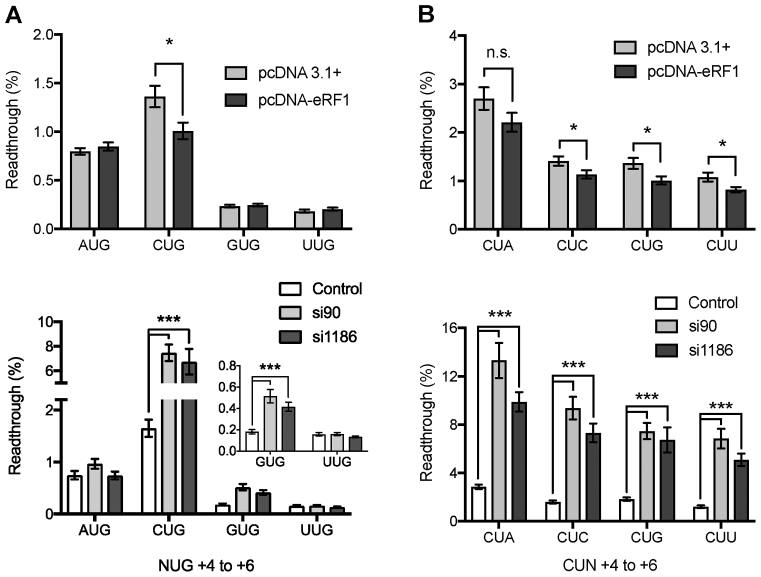
Effect of regulation of eRF1 expression on termination efficiency. Termination efficiencies of +1UGANUG+6 (A) and +1UGACUN+6 (B) sequence contexts in HEK 293T cultured cells co-transfected with either the control plasmid pcDNA or the pcDNA-eRF1 over-expression plasmid (eRF1) (upper panels), or the shRNAs pSilencer negative control (NC), pSilencer-si90 or pSilencer-si1186 (lower panels). Readthrough (%) was calculated by comparison to a near-cognate control construct (UGG). GUG result is expanded in inset in left lower panel. Experiments were performed in triplicate with 12 replicates for each condition, and 24 replicates for pSilencer NC. Mean values are presented. Error bars are SEM. *P < 0.05, ***P < 0.01, n.s., not significant. Data are available in Supplementary Table S3.
Figure 7.
Figure 7.
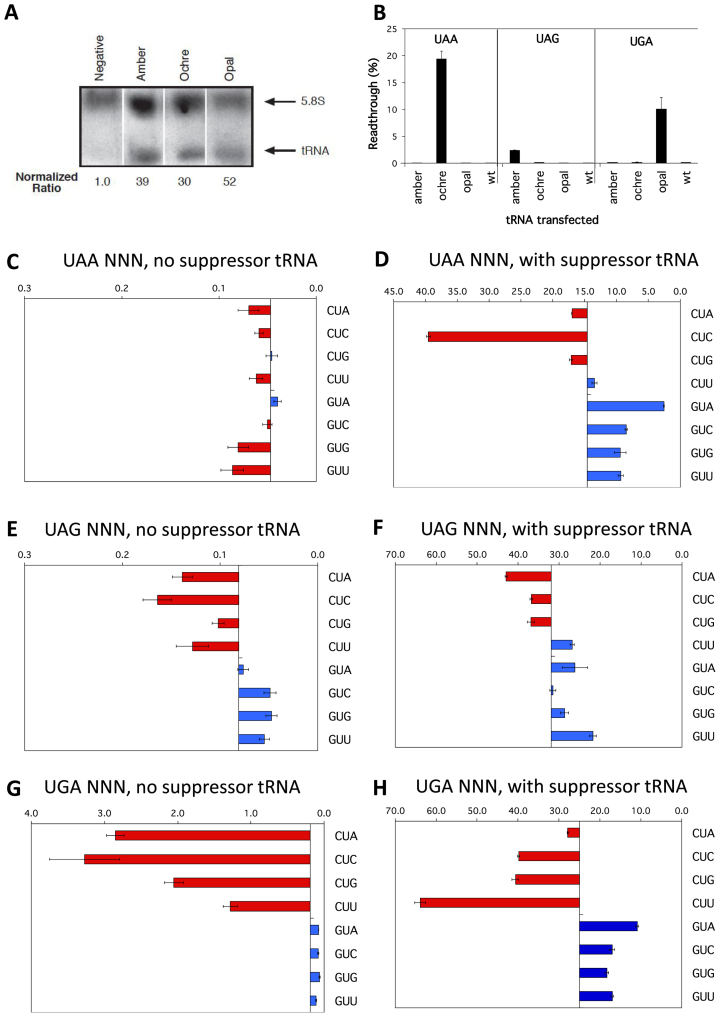
Competition by cognate tRNAs at termination signals. (A) Northern blot probed for sup-tRNA (lower arrow) and 5.8S rRNA (upper arrow) transcripts. Expression levels of sup-tRNA relative to 5.8S rRNA are indicated. The sup-tRNA probe was able to detect ptRNA amber, ptRNA ochre and ptRNA opal as it was complementary to the anticodon loop of the tRNA, but degenerative for the specific anticodon sequence. (B) Termination efficiencies of the +1UAAAGA+6, +1UAGAGA+6 and +1UGAAGA+6 sequence contexts measured in COS-7 cultured cells co-transfected with cognate sup-tRNAs ptRNAoc (ochre UAA), ptRNAam (amber UAG), or ptRNAop (opal UGA); or with the parent control ptRNAser (wild-type tRNAser). Readthrough (%) was calculated by comparison to near-cognate control constructs (CAG/UAA, UAU/UAG, and UGG/UGA) and plotted on the x-axis. Presentation and replicates are as in Figure 2. (C-H) Termination efficiencies of selected UAA (C, D), UAG (E, F) and UGA (G, H) sequence contexts were measured in COS-7 cultured cells co-transfected with cognate suppressor tRNAs (right panels) or without (left panels). UAA sequence contexts were co-transfected with ptRNAoc (ochre UAA), UAG sequence contexts were co-transfected with ptRNAamber (amber UAG), and UGA sequence contexts were co-transfected with ptRNAop (opal UGA). Readthrough (%) was calculated as before. Results are graphed relative to the median termination efficiency for the series (without and with suppressors respectively: 0.047% and 14.61% UAA, 0.081% and 31.94% UAG, 0.190% and 25.0% UGA). Presentation, replicates and error bars were as before.

References

    1. Poole E.S., Young D.J., Askarian-Amiri M.E., Scarlett D.J., Tate W.P.. Accommodating the bacterial decoding release factor as an alien protein among the RNAs at the active site of the ribosome. Cell Res. 2007; 17:591–607. - PubMed
    1. Roy B., Leszyk J.D., Mangus D.A., Jacobson A.. Nonsense suppression by near-cognate tRNAs employs alternative base pairing at codon positions 1 and 3. Proc. Natl. Acad. Sci. U.S.A. 2015; 112:3038–3043. - PMC - PubMed
    1. Blanchet S., Cornu D., Argentini M., Namy O.. New insights into the incorporation of natural suppressor tRNAs at stop codons in Saccharomyces cerevisiae. Nucleic Acids Res. 2014; 42:10061–10072. - PMC - PubMed
    1. Chavatte L., Seit-Nebi A., Dubovaya V., Favre A.. The invariant uridine of stop codons contacts the conserved NIKSR loop of human eRF1 in the ribosome. EMBO J. 2002; 21:5302–5311. - PMC - PubMed
    1. Bulygin K.N., Khairulina Y.S., Kolosov P.M., Ven’yaminova A.G., Graifer D.M., Vorobjev Y.N., Frolova L.Y., Kisselev L.L., Karpova G.G.. Three distinct peptides from the N domain of translation termination factor eRF1 surround stop codon in the ribosome. RNA. 2010; 16:1902–1914. - PMC - PubMed

Publication types

LinkOut - more resources