


Estimating the scale of chronic hepatitis B virus infection among migrants in EU/EEA countries
- PMID: 29325525
- PMCID: PMC5765695
- DOI: 10.1186/s12879-017-2921-8
Estimating the scale of chronic hepatitis B virus infection among migrants in EU/EEA countries
Abstract
Background: Chronic hepatitis B (CHB) related morbidity and mortality can be reduced through risk group screening, linkage to care and anti-viral treatment. This study estimates the number of CHB cases among foreign-born (migrants) in the European Union and European Economic Area (EU/EEA) countries in order to identify the most affected migrant populations.
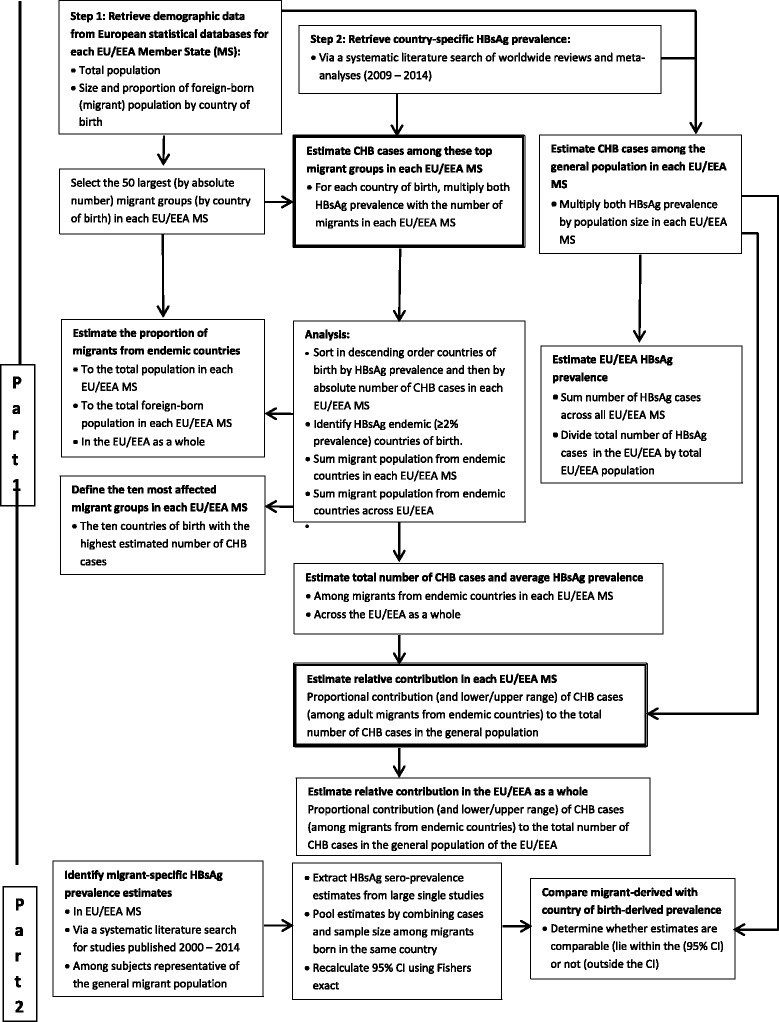
Methods: The CHB burden was estimated by combining: demographic data on migrant population size by country of birth in the EU/EEA, extracted from European statistical databases; and CHB prevalence in migrants’ countries of birth and in EU/EEA countries, derived from a systematic literature search. The relative contribution of migrants from endemic countries to the total CHB burden in each country was also estimated. The reliability of using country of birth prevalence as a proxy for prevalence among migrants was assessed by comparing it to the prevalence found in studies among migrants in Europe.
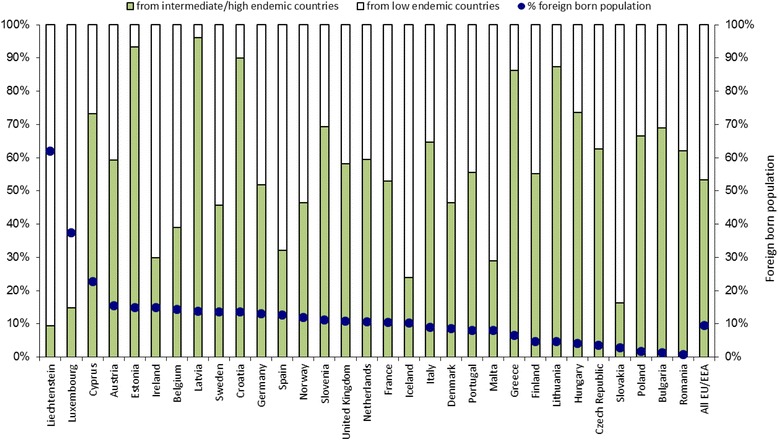
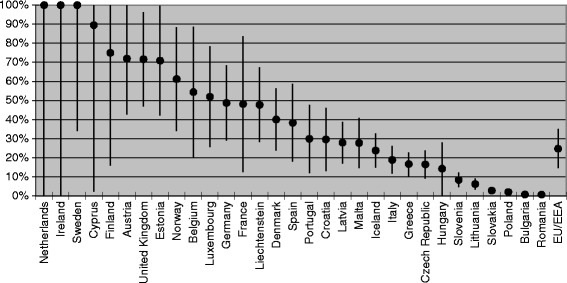
Results: An estimated 1–1.9 million CHB-infected migrants from endemic countries (prevalence ≥2%) reside in the EU/EEA. Migrants from endemic countries comprise 10.3% of the total EU/EEA population but account for 25% (15%–35%) of all CHB cases. Migrants born in China and Romania contribute the largest number of infections, with over 100,000 estimated CHB cases each, followed by migrants from Turkey, Albania and Russia, in descending order, with over 50,000 estimated CHB cases each. The CHB prevalence reported in studies among migrants in EU/EEA countries was lower than the country of birth prevalence in 9 of 14 studies.
Conclusions: Migrants from endemic countries are disproportionately affected by CHB; their contribution however varies between EU/EEA countries. Migrant focused screening strategies would be most effective in countries with a high relative contribution of migrants and a low general population prevalence. In countries with a higher general population prevalence and a lower relative contribution of migrants, screening specific birth cohorts may be a more effective use of scarce resources. Quantifying the number of CHB infections among 50 different migrant groups residing in each of the 31 EU/EEA host countries helps to identify the most affected migrant communities who would benefit from targeted screening and linkage to care.
Keywords: Chronic viral hepatitis; Epidemiology; Europe; Hepatitis B; Migrants.
Conflict of interest statement
Ethics approval and consent to participate
Not applicable.
Consent for publication
Not applicable.
Competing interests
None of the authors have any competing interests to declare.
Publisher’s Note
Springer Nature remains neutral with regard to jurisdictional claims in published maps and institutional affiliations.
Figures
References
-
- Rica S, Glitz A, Ortega F. Immigration in Europe: trends, policies and empirical evidence. 2013.
-
- Sharma S, Carballo M, Feld JJ, Janssen HL. Immigration and viral hepatitis. J Hepatol. 2015; Epub 2015/05/13 - PubMed
-
- European Centre for Disease Prevention and Control . Hepatitis B and C surveillance in Europe. Stockholm: ECDC; 2012. p. 2014.
-
- World Health Organisation . Hepatitis B fact sheet no. 204. 2015.
Publication types
MeSH terms
Substances
Grants and funding
LinkOut - more resources
Full Text Sources
Other Literature Sources
