


An analysis of the global pharmacy workforce capacity trends from 2006 to 2012
- PMID: 29325554
- PMCID: PMC5765699
- DOI: 10.1186/s12960-018-0267-y
An analysis of the global pharmacy workforce capacity trends from 2006 to 2012
Abstract
Background: Human resources for health are at a critical low. The World Health Organization estimates that the current shortage of health workers, including pharmacists, is in excess of 7.2 million worldwide and that, by 2035, the shortage will reach 12.9 million. Pharmacists, in particular, are lacking in the workforce in many countries. The International Pharmaceutical Federation (FIP) and academic partners have conducted periodic global pharmacy workforce surveys in 2006, 2009 and 2012 which have monitored and reported on the status of the pharmacy workforce at the country and territory levels. This current analysis is a synthesis of workforce capacity data from these date points to provide an overview of the global trends and changes to pharmacy workforce capacity over this time period.
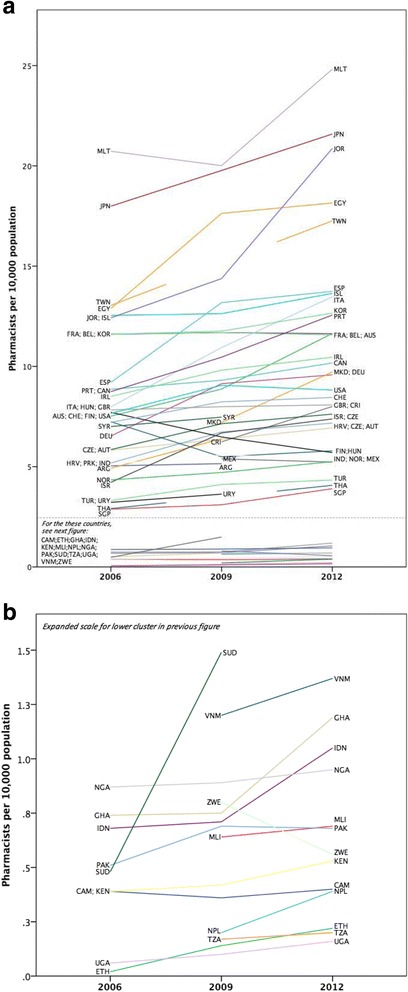
Methods: The methodology proceeded with accessing workforce capacity data collated in 2006, 2009 and 2012 held on file at the FIP Collaborating Centre. This data had previously been validated and made available to WHO Human Resources for Health. The data focused (due to limitations from 2006 databank) on pharmacist workforce capacity. Countries and territories were identified that had data available across at least two of the three time points (2006, 2009 and 2012). Missing time-point data for some countries (data gaps) were subject, where possible, to literature and online data searching to capture possible missing data. Country-level capacity data were plotted against time to identify trends coupled with comparative analysis of the trends.
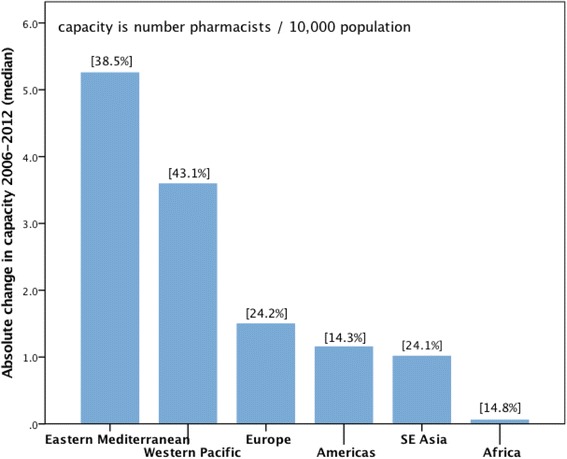
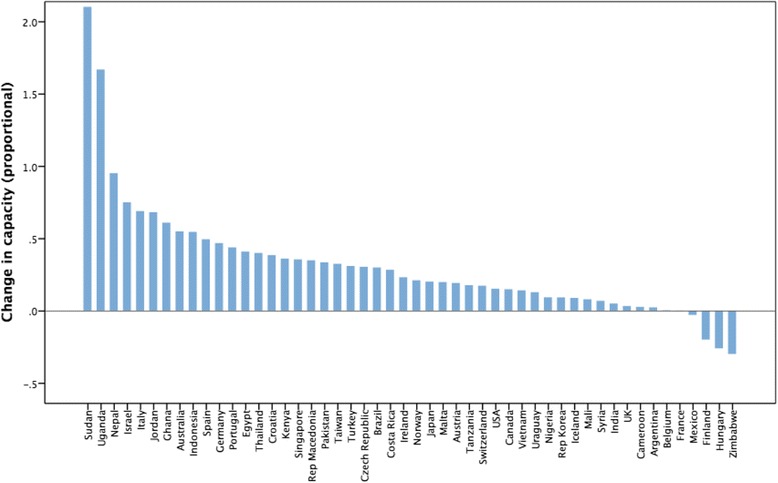
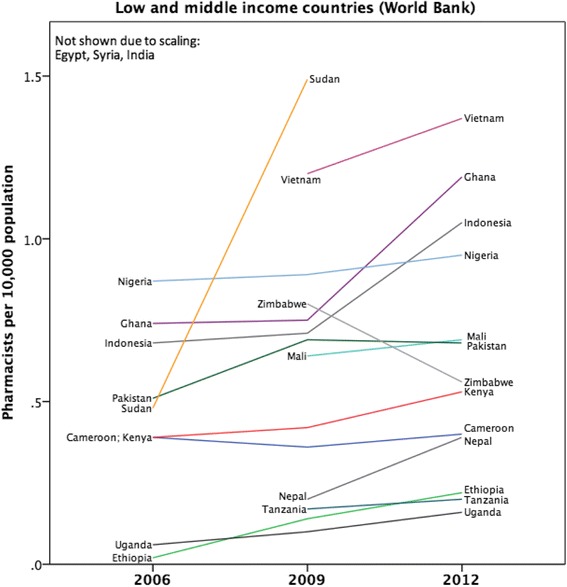
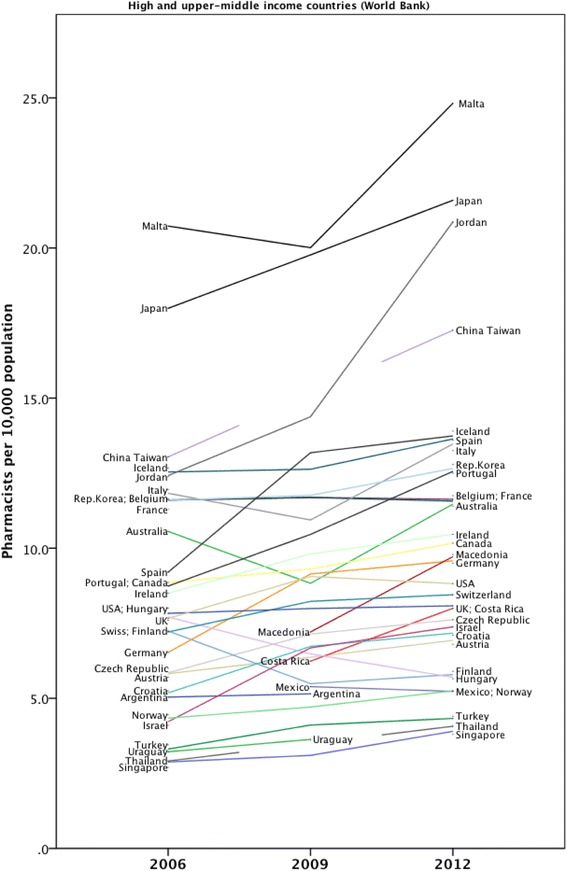
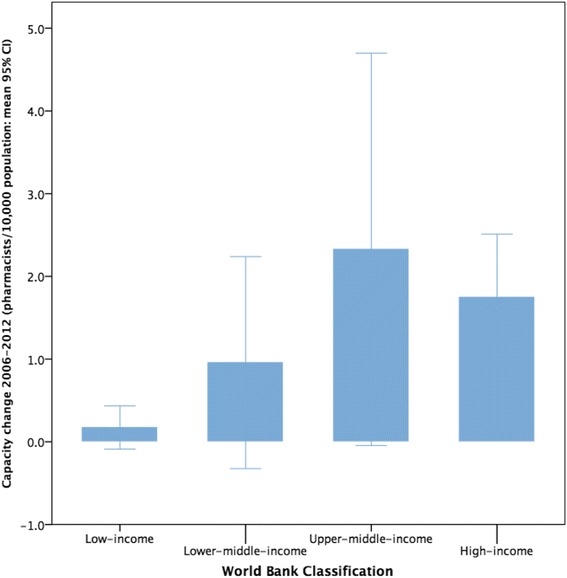
Results: The countries and territories identified as having valid data for each of the time points 2006, 2009 and 2012 were present in all WHO regions, with Europe having the most countries with data available and South East Asia the fewest. All WHO regions have experienced an increase in the density of pharmacists (measured as number of pharmacists per 10 000 population) over the period 2006-2012. However, some countries show a reduction in the density of pharmacists. African countries show large relative increases in acceleration of capacity building but remain significantly behind in terms of absolute capacity per capita. South East Asian and Middle Eastern countries also show large proportional changes in pharmacist workforce.
Conclusion: The global trend is an increase in workforce across all nations and regions, and this is a move in the right direction towards improved access to, and availability of, pharmaceutical expertise. However, there is still much to be done, with some regions and low-income countries still displaying a disproportionately low number of pharmacists on small overall capacity for delivering pharmacy services.
Keywords: Capacity; Global; Healthcare; Pharmacy workforce; Workforce trends.
Conflict of interest statement
Authors’ information
IB is the Director of the Education Development Team at the International Pharmaceutical Federation (FIP) and a Professor of Pharmacy Education at UCL.
CJ is involved in the education and training of the pharmacy workforce employed by National Health Service organisations in London in the United Kingdom. CJ is also workforce development lead at the Royal Pharmaceutical Society (RPS) and project lead for the Global Pharmacy Workforce Observatory (a collaboration between FIP and RPS). PS is an undergraduate intern at the Observatory.
AB is the FIP Education project coordinator and researcher, focussed on projects and reports in the various areas of pharmacy and pharmaceutical science education, continuous education and professional development.
Ethics approval and consent to participate
Not applicable since the study did not involve human participants or human data.
Consent for publication
Not applicable.
Competing interests
The authors declare that they have no competing interests.
Publisher’s Note
Springer Nature remains neutral with regard to jurisdictional claims in published maps and institutional affiliations.
Figures
References
-
- World Health Organization (WHO) and Global Health Workforce Alliance . A universal truth: no health without a workforce. Geneva: World Health Organisation (WHO) and Global Health Workforce Alliance; 2013.
-
- International Pharmaceutical Federation (FIP) Global Pharmacy Workforce Report. The Hague: International Pharmaceutical Federation (FIP); 2012.
-
- International Pharmaceutical Federation (FIP) Global Pharmacy Workforce Report. The Hague: International Pharmaceutical Federation (FIP); 2009.
-
- International Pharmaceutical Federation (FIP) Global pharmacy workforce and migration report. The Hague: International Pharmaceutical Federation (FIP); 2006.
MeSH terms
LinkOut - more resources
Full Text Sources
Other Literature Sources
Medical
