


Cognitive and Behavioral Skills Exercises Completed by Patients with Major Depression During Smartphone Cognitive Behavioral Therapy: Secondary Analysis of a Randomized Controlled Trial
- PMID: 29326098
- PMCID: PMC5785683
- DOI: 10.2196/mental.9092
Cognitive and Behavioral Skills Exercises Completed by Patients with Major Depression During Smartphone Cognitive Behavioral Therapy: Secondary Analysis of a Randomized Controlled Trial
Abstract
Background: A strong and growing body of evidence has demonstrated the effectiveness of cognitive behavioral therapy (CBT), either face-to-face, in person, or as self-help via the Internet, for depression. However, CBT is a complex intervention consisting of several putatively effective components, and how each component may or may not contribute to the overall effectiveness of CBT is poorly understood.
Objective: The aim of this study was to investigate how the users of smartphone CBT use and benefit from various components of the program.
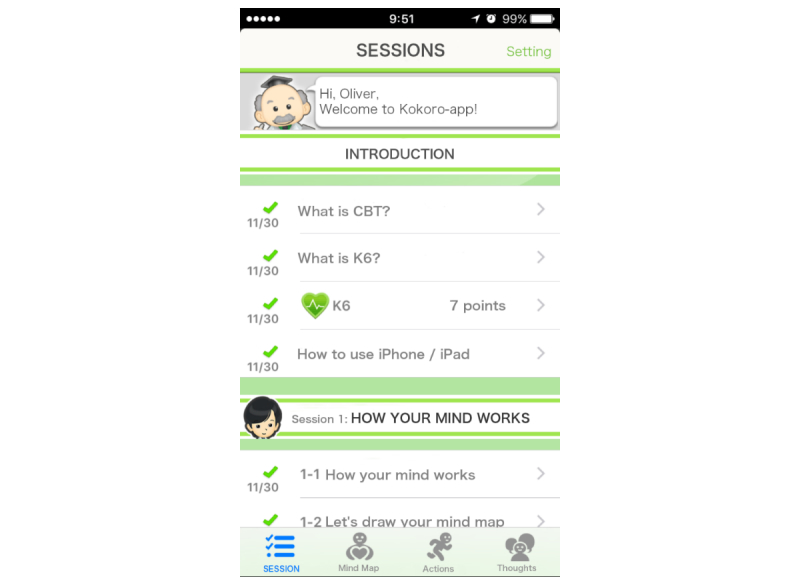
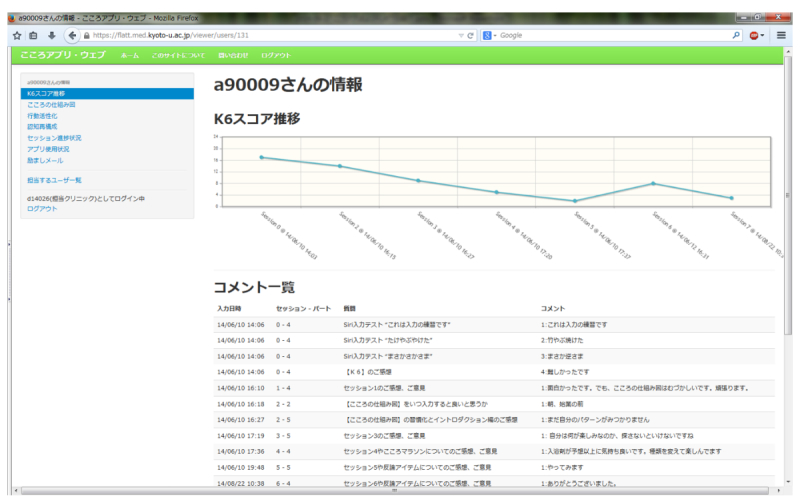
Methods: This is a secondary analysis from a 9-week, single-blind, randomized controlled trial that has demonstrated the effectiveness of adjunctive use of smartphone CBT (Kokoro-App) over antidepressant pharmacotherapy alone among patients with drug-resistant major depressive disorder (total n=164, standardized mean difference in depression severity at week 9=0.40, J Med Internet Res). Kokoro-App consists of three cognitive behavioral skills of self-monitoring, behavioral activation, and cognitive restructuring, with corresponding worksheets to fill in. All activities of the participants learning each session of the program and completing each worksheet were uploaded onto Kokoro-Web, which each patient could use for self-check. We examined what use characteristics differentiated the more successful users of the CBT app from the less successful ones, split at the median of change in depression severity.
Results: A total of 81 patients with major depression were allocated to the smartphone CBT. On average, they completed 7.0 (standard deviation [SD] 1.4) out of 8 sessions of the program; it took them 10.8 (SD 4.2) days to complete one session, during which they spent 62 min (SD 96) on the app. There were no statistically significant differences in the number of sessions completed, time spent for the program, or the number of completed self-monitoring worksheets between the beneficiaries and the nonbeneficiaries. However, the former completed more behavioral activation tasks, engaged in different types of activities, and also filled in more cognitive restructuring worksheets than the latter. Activities such as "test-drive a new car," "go to a coffee shop after lunch," or "call up an old friend" were found to be particularly rewarding. All cognitive restructuring strategies were found to significantly decrease the distress level, with "What would be your advice to a friend who has a similar problem?" found more helpful than some other strategies.
Conclusions: The CBT program offered via smartphone and connected to the remote server is not only effective in alleviating depression but also opens a new avenue in gathering information of what and how each participant may utilize the program. The activities and strategies found useful in this analysis will provide valuable information in brush-ups of the program itself and of mobile health (mHealth) in general.
Trial registration: Japanese Clinical Trials Registry UMIN CTR 000013693; https://upload.umin.ac.jp/cgi-open-bin/ctr_e/ ctr_view.cgi?recptno=R000015984 (Archived by WebCite at http://www.webcitation.org/6u6pxVwik).
Keywords: cognitive therapy; major depressive disorder; smartphone; telemedicine.
©Toshi A Furukawa, Masaru Horikoshi, Hirokazu Fujita, Naohisa Tsujino, Ran Jinnin, Yuki Kako, Sei Ogawa, Hirotoshi Sato, Nobuki Kitagawa, Yoshihiro Shinagawa, Yoshio Ikeda, Hissei Imai, Aran Tajika, Yusuke Ogawa, Tatsuo Akechi, Mitsuhiko Yamada, Shinji Shimodera, Norio Watanabe, Masatoshi Inagaki, Akio Hasegawa. Originally published in JMIR Mental Health (http://mental.jmir.org), 11.01.2018.
Conflict of interest statement
Conflicts of Interest: TAF has received lecture fees from Eli Lilly, Janssen, Meiji, MSD, Otsuka, Pfizer, and Tanabe-Mitsubishi and consultancy fees from Takeda Science Foundation. He has received royalties from Igaku-Shoin and Nihon Bunka Kagaku-sha publishers. He has received research support from Mochida and Tanabe-Mitsubishi. He is diplomate of the Academy of Cognitive Therapy. MH has received royalties from Igaku Shoin, Shogakukan Shuei-sha Production, Shindan-to-Chiryo-sha, Sogen-sha, Kango-Kyokai, Kitaoji-Shobo, and Kongo-Shuppan publishers. HF has received lecture fees from Meiji and Mochida. NT has received speaking fees from Astellas, Shionogi, Novartis, FUJIFILM RI Pharma, Meiji, Mochida, Janssen, Eli Lilly, and Dainippon-Sumitomo. He has received royalties from Igaku-Shoin, Nanzando, Medical View, and Kanehara publishers. YK has received speaking fee from Otsuka, Yoshitomi, Tanabe-Mitsubishi, Dainippon-Sumitomo, and Eli Lilly. SO has received speaking fee from Eli Lilly and Mochida. He has received royalties from Igaku-Shoin and Nihon-Hyoron-sha publishers. NK has received lecture fees from Eli Lilly, Janssen, Dainippon-Sumitomo, and Otsuka and consultancy fees from Meiji and Otsuka. He has received royalties from Igaku-Shoin, Nakayama-Shoten, Seronjihou-sha, and Iwasakigakujutu-Shuppan publishers. He has received research funds from Shionogi, Pfizer, and Meiji-Seika. YO has received honoraria for speaking at meetings sponsored by Eli Lilly. NT has received lecture fees from Otsuka and Meiji. AT has received honoraria for speaking at a meeting sponsored by Eli Lilly and Tanabe-Mitsubishi. He has received royalties from Kagaku-Hyoron-sha. TA has received speaking fees or research funds from Daiichi-Sankyo, Eizai, Hisamitsu, Lilly, MSD, Meiji, Mochida, Otsuka, Pfizer, Novartis, and Terumo. He has received royalties from Igaku-Shoin, Nanzando, and Nankodo publishers. MY has received speaking fees from Meiji and has contracted research with Nippon Chemiphar. MI has received lecture fees from Pfizer, Mochida, Shionogi, Daiichi-Sankyo, Meiji, Takeda, and Sumitomo Dainippon Pharma. He has received royalties from Nippon-Hyoron-Sha, Nanzando, Seiwa-Shoten, Igaku-Shoin, and Technomics. SS has received lecture fees from Otsuka, MSD, Meiji, Eli Lilly, Mochida, Pfizer, and Tanabe-Mitsubishi. He has received royalties from Seiwa-Shoten. He has received royalties from Sentan-Igaku-sha, Chuohoki, and Medical Review publishers. NW has received royalties from Sogen-sha, Paquet and Akatsuki publishers.
Figures
References
-
- Barth J, Munder T, Gerger H, Nüesch E, Trelle S, Znoj H, Jüni P, Cuijpers P. Comparative efficacy of seven psychotherapeutic interventions for patients with depression: a network meta-analysis. PLoS Med. 2013;10(5):e1001454. doi: 10.1371/journal.pmed.1001454. http://dx.plos.org/10.1371/journal.pmed.1001454 - DOI - PMC - PubMed
-
- Furukawa TA, Weitz ES, Tanaka S, Hollon SD, Hofmann SG, Andersson G, Twisk J, DeRubeis RJ, Dimidjian S, Hegerl U, Mergl R, Jarrett RB, Vittengl JR, Watanabe N, Cuijpers P. Initial severity of depression and efficacy of cognitive-behavioural therapy: individual-participant data meta-analysis of pill-placebo-controlled trials. Br J Psychiatry. 2017 Mar;210(3):190–196. doi: 10.1192/bjp.bp.116.187773. - DOI - PMC - PubMed
-
- Weitz ES, Hollon SD, Twisk J, van Straten A, Huibers MJH, David D, DeRubeis RJ, Dimidjian S, Dunlop BW, Cristea IA, Faramarzi M, Hegerl U, Jarrett RB, Kheirkhah F, Kennedy SH, Mergl R, Miranda J, Mohr DC, Rush AJ, Segal ZV, Siddique J, Simons AD, Vittengl JR, Cuijpers P. Baseline depression severity as moderator of depression outcomes between cognitive behavioral therapy vs pharmacotherapy: an individual patient data meta-analysis. JAMA Psychiatry. 2015 Nov;72(11):1102–9. doi: 10.1001/jamapsychiatry.2015.1516. - DOI - PubMed
LinkOut - more resources
Full Text Sources
Other Literature Sources
Molecular Biology Databases
Miscellaneous
