


Intrathecal baclofen therapy versus conventional medical management for severe poststroke spasticity: results from a multicentre, randomised, controlled, open-label trial (SISTERS)
- PMID: 29326296
- PMCID: PMC6031277
- DOI: 10.1136/jnnp-2017-317021
Intrathecal baclofen therapy versus conventional medical management for severe poststroke spasticity: results from a multicentre, randomised, controlled, open-label trial (SISTERS)
Abstract
Background: Intrathecal baclofen (ITB) is a treatment option for patients with severe poststroke spasticity (PSS) who have not reached their therapy goal with other interventions.
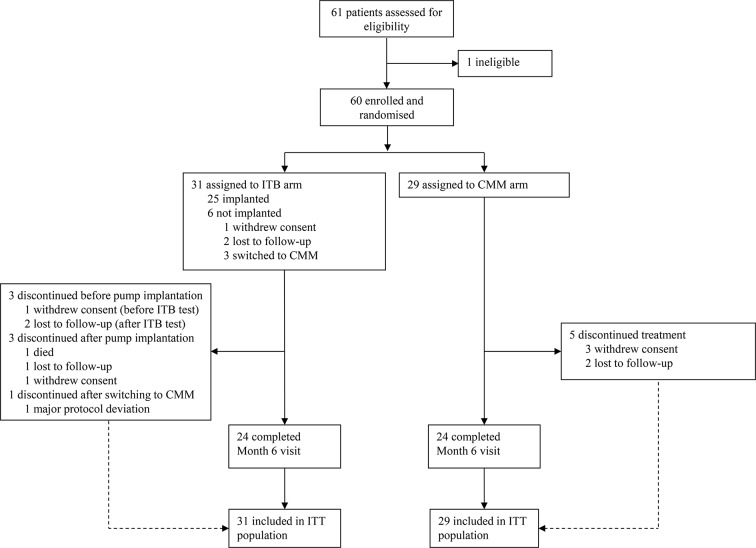
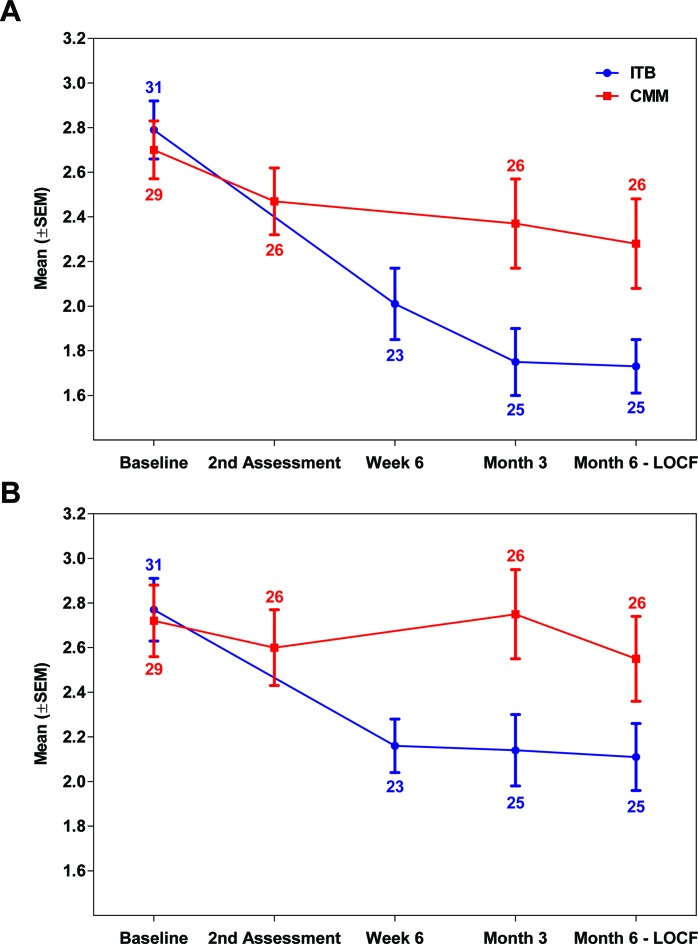
Methods: 'Spasticity In Stroke-Randomised Study' (SISTERS) was a randomised, controlled, open-label, multicentre phase IV study to evaluate the efficacy and safety of ITB therapy versus conventional medical management (CMM) with oral antispastic medications for treatment of PSS. Patients with chronic stroke with spasticity in ≥2 extremities and an Ashworth Scale (AS) score ≥3 in at least two affected muscle groups in the lower extremities (LE) were randomised (1:1) to ITB or CMM. Both treatment arms received physiotherapy throughout. The primary outcome was the change in the average AS score in the LE of the affected body side from baseline to month 6. Analyses were performed for all patients as randomised (primary analysis) and all randomised patients as treated (safety analysis).
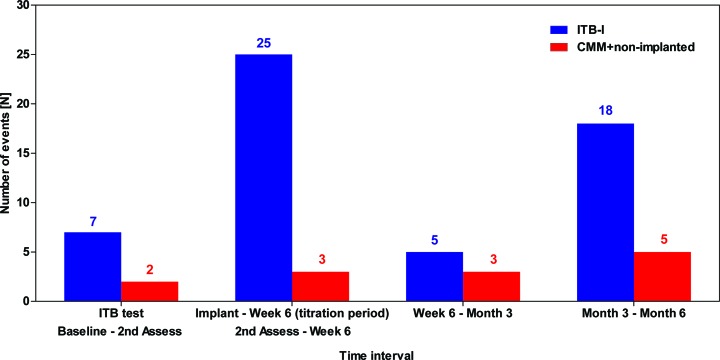
Results: Of 60 patients randomised to ITB (n=31) or CMM (n=29), 48 patients (24 per arm) completed the study. The primary analysis showed a significant effect of ITB therapy over CMM (mean AS score reduction, -0.99 (ITB) vs -0.43 (CMM); Hodges-Lehmann estimate, -0.667(95.1%CI -1.0000 to -0.1667); P=0.0140). More patients reported adverse events while receiving ITB (24/25 patients, 96%; 149 events) compared with CMM (22/35, 63%; 77 events), although events were generally consistent with the known safety profile of ITB therapy.
Conclusions: These data support the use of ITB therapy as an alternative to CMM for treatment of generalised PSS in adults.
Trial registration number: NCT01032239; Results.
© Article author(s) (or their employer(s) unless otherwise stated in the text of the article) 2018. All rights reserved. No commercial use is permitted unless otherwise expressly granted.
Conflict of interest statement
Competing interests: MC, MZ and LS report personal fees from Medtronic during the conduct of the study. GF reports grants from Allergan, Ipsen, Merz and Mallinckrodt during the conduct of the study. JW reports personal fees from Medtronic during the conduct of the study, and personal fees from Allergan, Merz, Ipsen, and Medtronic outside the submitted work. AA, NB, AC and ML are all employees of Medtronic and report personal fees from Medtronic during the conduct of the study. All other authors declare no competing interests.
Figures
References
Publication types
MeSH terms
Substances
Associated data
LinkOut - more resources
Full Text Sources
Other Literature Sources
Medical
Research Materials
