. 2017 Dec 13:4:217.
doi: 10.3389/fvets.2017.00217. eCollection 2017.

Identification of Atypical Enteropathogenic Escherichia coli O98 from Golden Snub-Nosed Monkeys with Diarrhea in China

Affiliations

Identification of Atypical Enteropathogenic Escherichia coli O98 from Golden Snub-Nosed Monkeys with Diarrhea in China

Mingpu Qi et al. Front Vet Sci. .

Abstract

Fecal samples (n = 76) were collected from 38 snub-nosed monkeys (Rhinopithecus roxellana) in Shennongjia National Nature Reserve (China) and examined for the presence of enteropathogenic Escherichia coli (EPEC). The 56 samples originated from 30 free-ranging monkeys on the reserve and 20 samples from 8 captive monkeys that were previously rescued and kept at the research center. Eight diarrhea samples were collected from four of the eight captive monkeys (two samples from each monkey), and two EPEC strains (2.6%) (95% confidence interval 0.3-9.2%) were isolated from two fecal samples from two diarrheic monkeys. Both strains belonged to serotype O98 and phylogenetic group D (TspE4C2+, ChuA+). The virulence gene detection identified these strains as an atypical EPEC (aEPEC) (bfpB - , stx1 - , and stx2-) with the subtype eae+, escV+, and intiminβ+. These strains were highly sensitive to all the antibiotics tested. The lethal dose 50% of the two isolates in Kunming mice was 7.40 × 10⁸ CFU/0.2 mL and 2.40 × 10⁸ CFU/0.2 mL, respectively, indicating low virulence. Based on the report that this serotype had been isolated from some other non-human animals and humans with diarrhea, the first identification of aEPEC O98 strains and their drug resistance profile in R. roxellana is of ecological significance for disease control in this endangered species.

Keywords: Rhinopithecus roxellana; diarrhea; enteropathogenic Escherichia coli; non-human primates; virulence.


Figures
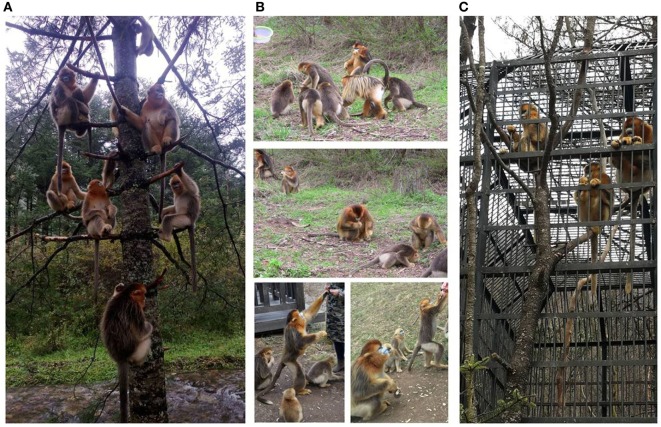
Figure 1
Figure 1
Monkeys sampled in this study. (A) The monkeys from a one-male and multi-female unit waiting for food in the tree before feeding time; (B) monkeys fed with different food, which varies with the seasons; (C) the monkeys kept in the cage which is located in an open area.
Figure 2
Figure 2
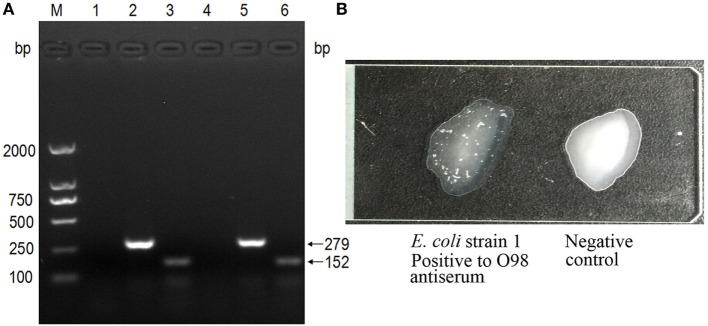
Genotyping and serotyping of Escherichia coli isolates. (A) The triplex PCR specific for E. coli phylogenetic groups. (M) DNA ladder (DL2000); lanes 1–3: PCR products with primers specific to the genes yjaA, ChuA, and TspEC2, using the template of strain 1; lanes 4–6: PCR products with primers specific to the genes yjaA, ChuA, and TspEC2, using the template of strain 2. (B) The strains were typed by the slide agglutination test with standard antisera against all antigens of enteropathogenic E. coli (EPEC), enterotoxigenic E. coli (ETEC), enterohemorrhagic E. coli (EHEC), enteroinvasive E. coli (EIEC), enteroaggregative E. coli (EAEC), and diffuse-adhering E. coli (DAEC) of O1–O163. The left was O98 positive, shown by the apparent white agglutinating clusters, while the right was negative.
Figure 3
Figure 3
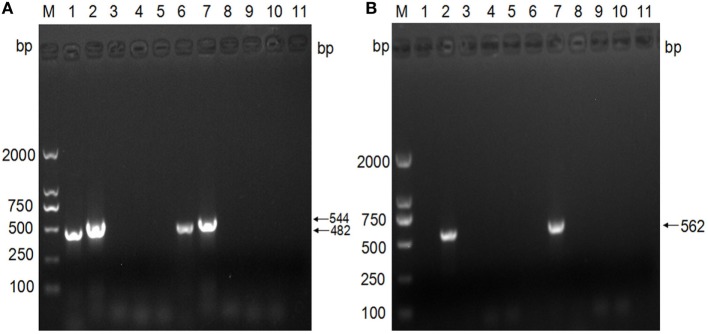
Subgenotyping of Escherichia coli isolates based on the virulence genes. (A) PCR analyses of virulence factors. M: DNA ladder (DL2000); lanes 1–5: PCR products with primers specific to the genes eae, escV, bfpB, stx1, and stx2, using the template of strain 1; lanes 6–10: PCR products with primers specific to the genes eae, escV, bfpB, stx1, and stx2, using the template of strain 2; lane 11: negative. (B) PCR analysis of intimin subtypes. M: DNA ladder (DL2000); lanes 1–5: PCR products with primers specific to intimin α, intimin β, intimin γ, intimin δ, and intimin ε, using the template of strain 1; lanes 6–10: PCR products with primers specific to intimin α, intimin β, intimin γ, intimin δ, and intimin ε, using the template of strain 2; lane 11: negative control.

References

    1. Xiang Z, Yu Y, Yang M, Yang J, Niao M, Li M. Does flagship species tourism benefit conservation? A case study of the golden snub-nosed monkey in Shennongjia National Nature Reserve. Chin Sci Bull (2011) 56(24):2553–8.10.1007/s11434-011-4613-x - DOI
    1. Zhou X, Wang B, Pan Q, Zhang J, Kumar S, Sun X, et al. Whole-genome sequencing of the snub-nosed monkey provides insights into folivory and evolutionary history. Nat Genet (2014) 46(12):1303–10.10.1038/ng.3137 - DOI - PubMed
    1. He W, Lu H, Zhao K, Song D, Gai X, Gao F. Complete genome sequence of a coxsackievirus B3 isolated from a Sichuan snub-nosed monkey. J Virol (2012) 86(23):13134–5.10.1128/JVI.02365-12 - DOI - PMC - PubMed
    1. Zhao GH, Cong MM, Bian QQ, Cheng WY, Wang RJ, Qi M, et al. Molecular characterization of Cyclospora-like organisms from golden snub-nosed monkeys in Qinling Mountain in Shaanxi province, northwestern China. PLoS One (2013) 8(2):e58216.10.1371/journal.pone.0058216 - DOI - PMC - PubMed
    1. Karim MR, Wang R, Dong H, Zhang L, Li J, Zhang S, et al. Genetic polymorphism and zoonotic potential of Enterocytozoon bieneusi from nonhuman primates in China. Appl Environ Microbiol (2014) 80(6):1893–8.10.1128/AEM.03845-13 - DOI - PMC - PubMed

LinkOut - more resources