Association of the Lung Immune Prognostic Index With Immune Checkpoint Inhibitor Outcomes in Patients With Advanced Non-Small Cell Lung Cancer
- PMID: 29327044
- PMCID: PMC5885829
- DOI: 10.1001/jamaoncol.2017.4771
Association of the Lung Immune Prognostic Index With Immune Checkpoint Inhibitor Outcomes in Patients With Advanced Non-Small Cell Lung Cancer
Abstract
Importance: Derived neutrophils/(leukocytes minus neutrophils) ratio (dNLR) and lactate dehydrogenase (LDH) level have been correlated with immune checkpoint inhibitor (ICI) outcomes in patients with melanoma.
Objective: To determine whether pretreatment dNLR and LDH are associated with resistance to ICIs in patients with advanced non-small cell lung cancer (NSCLC).
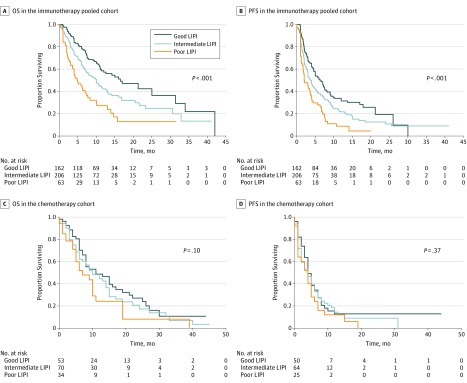
Design, setting, and participants: Multicenter retrospective study with a test (n = 161) and a validation set (n = 305) treated with programmed death 1/programmed death ligand 1 (PD-1/PD-L1) inhibitors in 8 European centers, and a control cohort (n = 162) treated with chemotherapy only. Complete blood cell counts, LDH, and albumin levels were measured before ICI treatment. A lung immune prognostic index (LIPI) based on dNLR greater than 3 and LDH greater than upper limit of normal (ULN) was developed, characterizing 3 groups (good, 0 factors; intermediate, 1 factor; poor, 2 factors).
Main outcomes and measures: The primary end point was overall survival (OS). Secondary end points were progression-free survival (PFS) and disease control rate (DCR).
Results: In the pooled ICI cohort (N = 466), 301 patients (65%) were male, 422 (90%) were current or former smokers, and 401 (87%) had performance status of 1 or less; median age at diagnosis was 62 (range, 29-86) years; 270 (58%) had adenocarcinoma and 159 (34%) had squamous histologic subtype. Among 129 patients with PD-L1 data, 96 (74%) had PD-L1 of at least 1% by immunohistochemical analysis, and 33 (26%) had negative results. In the test cohort, median PFS and OS were 3 (95% CI, 2-4) and 10 (95% CI, 8-13) months, respectively. A dNLR greater than 3 and LDH greater than ULN were independently associated with OS (hazard ratio [HR] 2.22; 95% CI, 1.23-4.01 and HR, 2.51; 95% CI, 1.32-4.76, respectively). Median OS for poor, intermediate, and good LIPI was 3 months (95% CI, 1 month to not reached [NR]), 10 months (95% CI, 8 months to NR), and 34 months (95% CI, 17 months to NR), respectively, and median PFS was 2.0 (95% CI, 1.7-4.0), 3.7 (95% CI, 3.0-4.8), and 6.3 (95% CI, 5.0-8.0) months (both P < .001). Disease control rate was also correlated with dNLR greater than 3 and LDH greater than ULN. Results were reproducible in the ICI validation cohort for OS, PFS, and DCR, but were nonsignificant in the chemotherapy cohort.
Conclusions and relevance: Pretreatment LIPI, combining dNLR greater than 3 and LDH greater than ULN, was correlated with worse outcomes for ICI, but not for chemotherapy, suggesting that LIPI can serve as a potentially useful tool when selecting ICI treatment, raising the hypothesis that the LIPI might be useful for identifying patients unlikely to benefit from treatment with an ICI.
Conflict of interest statement
Figures
Comment in
-
Personalized medicine in immuno-oncology: a novel prognostic index in non-small cell lung cancer.J Thorac Dis. 2018 Apr;10(Suppl 9):S995-S998. doi: 10.21037/jtd.2018.03.153. J Thorac Dis. 2018. PMID: 29849197 Free PMC article. No abstract available.
References
-
- Herbst RS, Baas P, Kim D-W, et al. . Pembrolizumab versus docetaxel for previously treated, PD-L1-positive, advanced non-small-cell lung cancer (KEYNOTE-010): a randomised controlled trial. Lancet. 2016;387(10027):1540-1550. - PubMed
-
- Reck M, Rodríguez-Abreu D, Robinson AG, et al. ; KEYNOTE-024 Investigators . Pembrolizumab versus chemotherapy for PD-L1-positive non-small-cell lung cancer. N Engl J Med. 2016;375(19):1823-1833. - PubMed
Publication types
MeSH terms
Substances
LinkOut - more resources
Full Text Sources
Other Literature Sources
Medical
Research Materials