Review
. 2019 Jan;44(1):247-257.
doi: 10.1007/s11064-017-2460-0. Epub 2018 Jan 11.

Methionine in Proteins: It's Not Just for Protein Initiation Anymore

Affiliations
Review

Methionine in Proteins: It's Not Just for Protein Initiation Anymore

Jung Mi Lim et al. Neurochem Res. 2019 Jan.

Abstract

Methionine in proteins is often thought to be a generic hydrophobic residue, functionally replaceable with another hydrophobic residue such as valine or leucine. This is not the case, and the reason is that methionine contains sulfur that confers special properties on methionine. The sulfur can be oxidized, converting methionine to methionine sulfoxide, and ubiquitous methionine sulfoxide reductases can reduce the sulfoxide back to methionine. This redox cycle enables methionine residues to provide a catalytically efficient antioxidant defense by reacting with oxidizing species. The cycle also constitutes a reversible post-translational covalent modification analogous to phosphorylation. As with phosphorylation, enzymatically-mediated oxidation and reduction of specific methionine residues functions as a regulatory process in the cell. Methionine residues also form bonds with aromatic residues that contribute significantly to protein stability. Given these important functions, alteration of the methionine-methionine sulfoxide balance in proteins has been correlated with disease processes, including cardiovascular and neurodegenerative diseases. Methionine isn't just for protein initiation.

Keywords: Cellular regulation; Methionine; Methionine sulfoxide; Methionine sulfoxide reductase; Oxidative defenses; Protein structure.


Figures
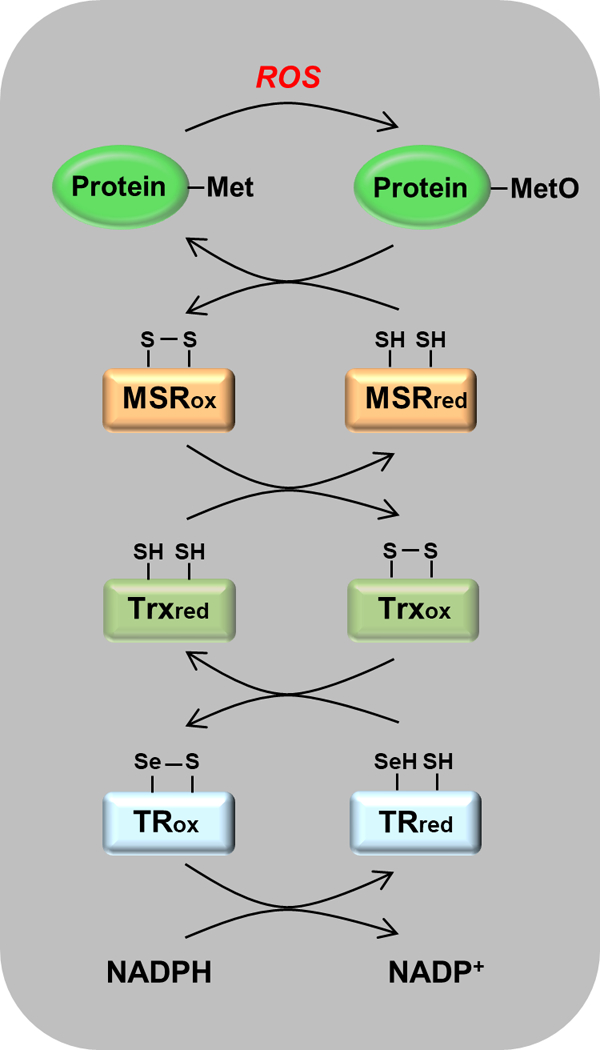
Fig. 1
Fig. 1
Scavenging of reactive oxygen species (ROS) by the msr-dependent catalytic cascade. Reduced forms of the proteins carry the subscript “red” and oxidized forms carry “ox”. Reading from top to bottom, an ROS is intercepted by a Met residue that is oxidized to MetO. MetO is reduced back to Met by msr, with the formation of a disulfide bond. The oxidized msr is reduced by thioredoxin (Trx), which now carries the disulfide bond. It is reduced by thioredoxin reductase (TR), which in mammals contains a selenocysteine residue that is oxidized, forming a selenocysteine-cysteine bond. This disulfide analogue is then reduced by NADPH. The net result is that ROS is reduced at the expense of NADPH.
Fig. 2
Fig. 2
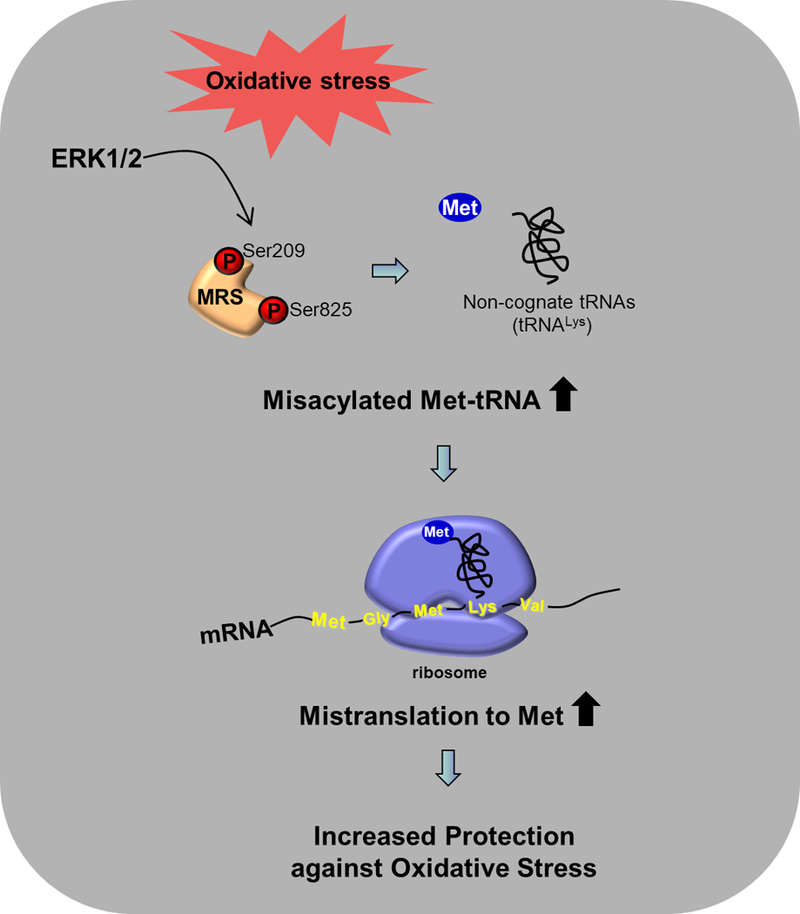
The mechanism by which oxidative stress increases the methionine content of proteins [8]. In response to oxidative stress, ERK1/2 phosphorylates methionyl tRNA synthetase (MRS). This renders the synthetase promiscuous so that it charges non-cognate tRNAs with Met, as shown here for tRNALys. In this example, the Lys codon leads to insertion of Met, thus increasing the total methionine content of the protein to provide additional protection against oxidative stress.
Fig. 3
Fig. 3
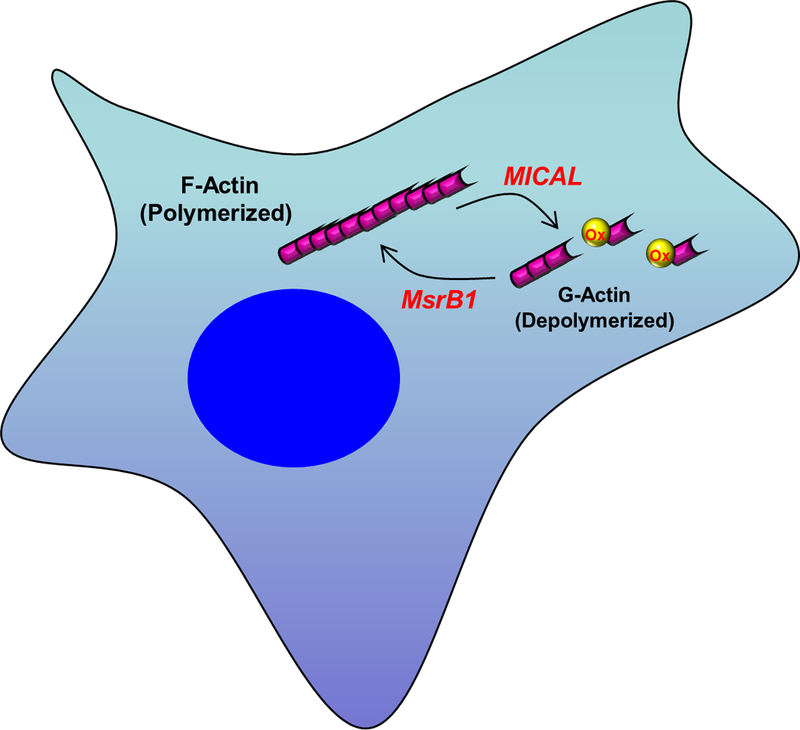
Redox regulation of actin polymerization by oxidation and reduction of methionine. Met44 of actin is oxidized by the monooxygenase MICAL causing depolymerization. Reduction of MetO44 by MsrB1 restores the ability to polymerize.

References

    1. Levine RL, Mosoni L, Berlett BS, Stadtman ER (1996) Methionine residues as endogenous antioxidants in proteins. Proc Natl Acad Sci USA 93:15036–15040 - PMC - PubMed
    1. Bender A, Hajieva P, Moosmann B (2008) Adaptive antioxidant methionine accumulation in respiratory chain complexes explains the use of a deviant genetic code in mitochondria. Proc Natl Acad Sci USA 105:16496–16501 - PMC - PubMed
    1. Valley CC, Cembran A, Perlmutter JD, Lewis AK, Labello NP, Gao J, Sachs JN (2012) The Methionine-aromatic Motif Plays a Unique Role in Stabilizing Protein Structure. J Biol Chem 287:34979–34991 - PMC - PubMed
    1. Lee BC, Peterfi Z, Hoffmann FW, Moore RE, Kaya A, Avanesov A, Tarrago L, Zhou Y, Weerapana E, Fomenko DE, Hoffmann PR, Gladyshev VN (2013) MsrB1 and MICALs regulate actin assembly and macrophage function via reversible stereoselective methionine oxidation. Mol Cell 51:397–404 - PMC - PubMed
    1. Hung RJ, Spaeth CS, Yesilyurt HG, Terman JR (2013) SelR reverses Mical-mediated oxidation of actin to regulate F-actin dynamics. Nat Cell Biol 15:1445–1454 - PMC - PubMed

MeSH terms