. 2018 Mar;41(3):1584-1594.
doi: 10.3892/ijmm.2018.3370. Epub 2018 Jan 9.

Differential microRNA expression profiles and bioinformatics analysis between young and aging spontaneously hypertensive rats

Affiliations

Differential microRNA expression profiles and bioinformatics analysis between young and aging spontaneously hypertensive rats

Jingfeng Wang et al. Int J Mol Med. 2018 Mar.

Abstract

MicroRNAs (miRNAs/miRs) serve a role as important regulators in cardiac hypertrophy. The present study aimed to reveal the differential expression profile of miRNAs between young and aging spontaneously hypertensive rats (SHRs) and studied the functional annotation of predicted targets. Briefly, 3‑month‑old and 12‑month‑old SHRs (n=3/group) were subjected to echocardiography, histopathological analysis and dihydroethidium staining. Subsequently, small RNA sequencing and data processing was conducted to identify the differentially expressed miRNAs between these two groups. Eight significantly upregulated miRNAs were validated by reverse transcription‑quantitative polymerase chain reaction (RT‑qPCR), followed by in silico target gene prediction. Functional annotation analysis of the predicted targets was performed using Gene Ontology (GO) and Kyoto Encyclopedia of Genes and Genomes (KEGG) databases. As a result, significantly impaired left ventricular diastolic function was detected in the 12‑month‑old SHRs, alongside increased myocyte cross‑sectional area and percentage area of fibrosis, elevated reactive oxygen species production and reduced microvessel density (P<0.05). Compared with the 3‑month‑old SHRs, 21 miRNAs were significantly upregulated and five miRNAs were downregulated in 12‑month‑old rats (P<0.05). Eight upregulated, remodeling‑associated miRNAs, including rno‑miR‑132‑3p, rno‑miR‑182, rno‑miR‑208b‑3p, rno‑miR‑212‑3p, rno‑miR‑214‑3p, rno‑miR‑218a‑5p, rno‑miR‑221‑3p and rno‑miR‑222‑3p, underwent bioinformatics analysis. The target genes were significantly enriched in 688 GO terms and 39 KEGG pathways, including regulation of peptidyl‑tyrosine phosphorylation, regulation of protein serine/threonine kinase activity, adrenergic signaling in cardiomyocytes, ErbB signaling pathway, mTOR signaling pathway, FoxO signaling pathway, Ras signaling pathway, insulin secretion, adipocytokine signaling pathway, HIF‑1 signaling pathway, Rap1 signaling pathway, VEGF signaling pathway and TNF signaling pathway. Collectively, the present study identified a dysregulated miRNA profile in aging SHRs, which targeted numerous signaling pathways associated with cardiac hypertrophy, autophagy, insulin metabolism, angiogenesis and inflammatory response.


Conflict of interest statement

Competing interests

The authors declare that they have no competing interests.

Figures
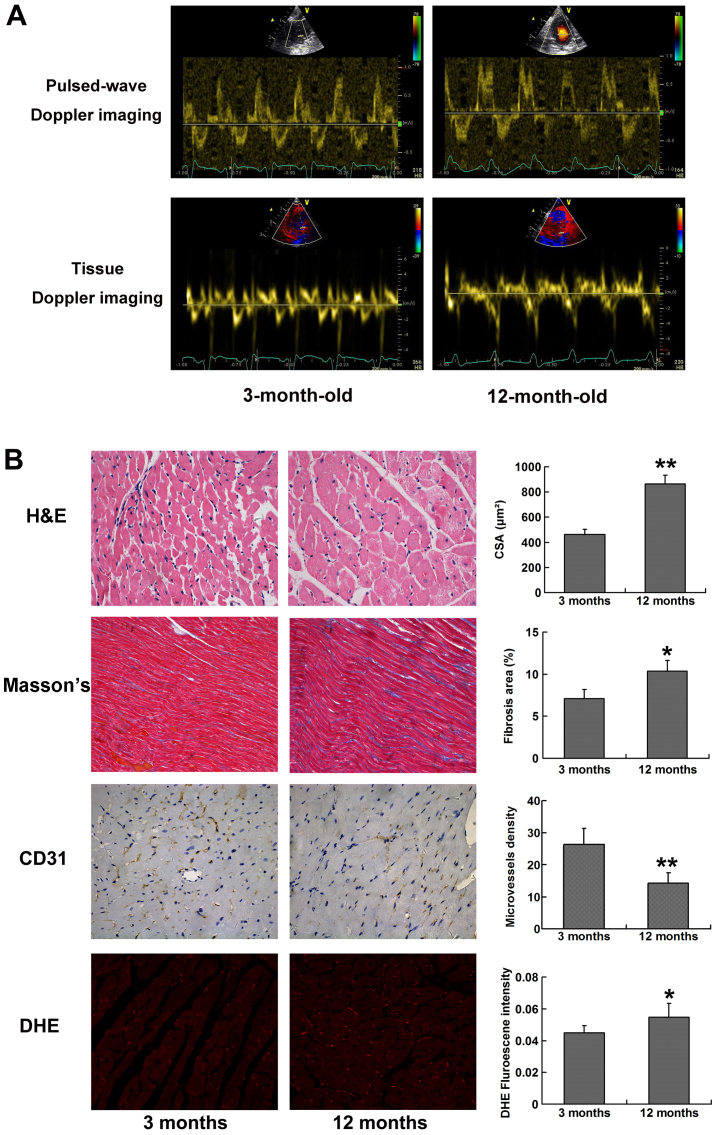
Figure 1
Figure 1
Typical images for echocardiography and histological analysis. (A) Transmitral pulsed-wave Doppler imaging and tissue Doppler imaging at the level of lateral mitral annulus obtained from apical four-chamber view. Peak flow velocity of the E/A waves and peak tissue velocity of E′/A′ diastolic waves were assessed. A decreased E/A ratio and E′/A′ ratio could be observed in 12-month-old SHRs compared with in 3-month-old SHRs. (B) H&E staining (magnification, ×400), Masson's trichrome staining (magnification, ×200), CD31 staining (magnification, ×400) and DHE staining (magnification, ×200), for the calculation of cardiomyocyte CSA, relative fibrosis area (%), microvessel density and reactive oxygen species production, respectively. Five randomly selected fields from each left ventricular section were measured. *P<0.05 and **P<0.01 vs. 3-months-old SHRs. A, late; CD31, cluster of differentiation 31; CSA, cross-sectional area; DHE, dihydroethidium; E, early; H&E, hematoxylin and eosin; SHRs, spontaneously hypertensive rats.
Figure 2
Figure 2
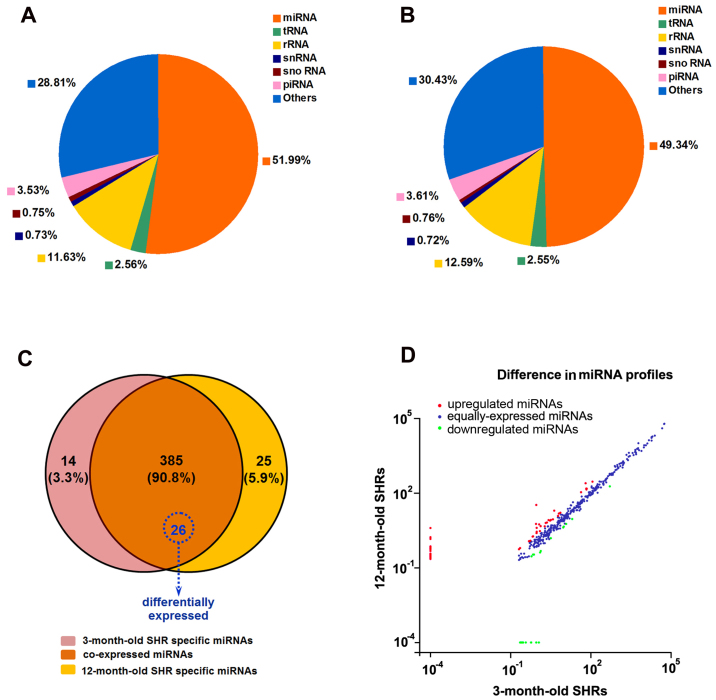
High-throughput small RNA sequencing analysis in 3- and 12-month-old SHRs. Pie-charts representing the distribution of different classes of small RNA reads in (A) 3- and (B) 12-month-old SHR groups, in which miRNAs constituted 51.99 and 49.34% of all small RNA reads. Data were averaged from three samples from each group. (C) Venn diagram indicating the distribution of 424 unique miRNAs between 3- and 12-month-old SHRs. The overlapping section contains 385 coexpressed miRNAs, among which 26 miRNAs were significantly differentially expressed (P<0.05). (D) Differences in the miRNA profiles from 3- and 12-month old SHRs, presented as a scatter plot with normalized values (number of reads per million clean tags). A total of 57 miRNAs were upregulated (red) and 25 miRNAs were downregulated (green) with a fold-change >2 irrespective of P-value. The remaining 303 miRNAs were equally expressed (blue) with a fold-change <2. miRNA, microRNA; piRNA, piwi-interacting RNA; rRNA, ribosomal RNA; SHRs, spontaneously hypertensive rats; snRNA, small nuclear RNA; snoRNA, small nucleolar RNA; tRNA, transfer RNA.
Figure 3
Figure 3
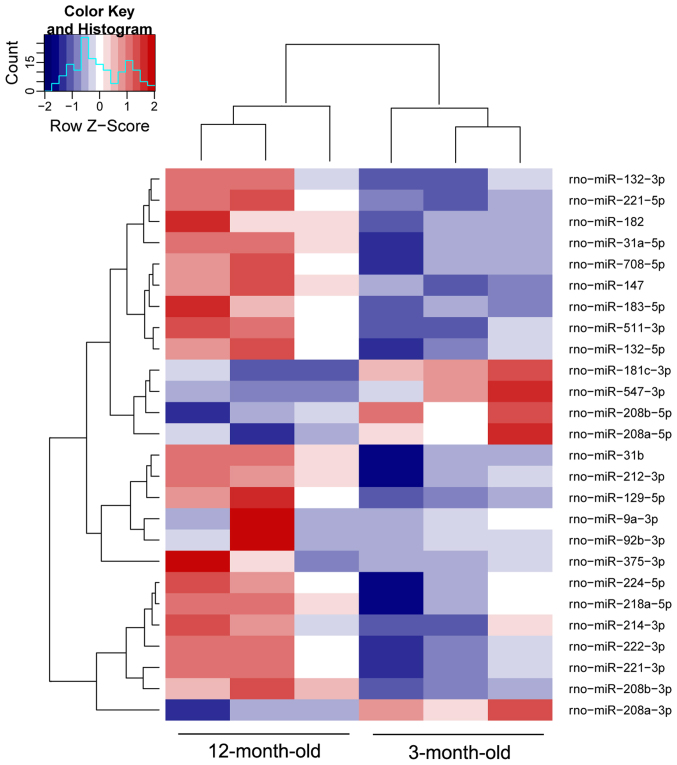
Hierarchical cluster analysis of the 26 significantly differentially expressed miRs in 3-month-old and 12-month-old spontaneously hypertensive rats (including those expressed from the 5′-arm and 3′-arm). Red represents increased expression and blue represents reduced expression. miR, microRNA.
Figure 4
Figure 4
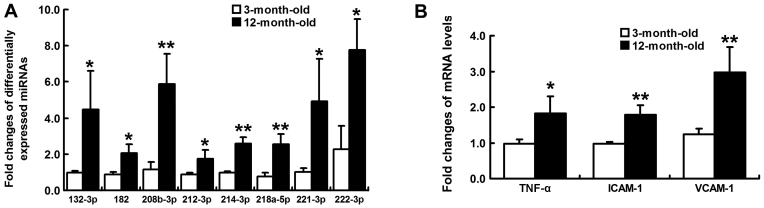
(A) Validation of eight upregulated miRNAs, according to reverse transcription-quantitative PCR. RNU6 served as a housekeeping control. PCR results were consistent with sequencing data. (B) Quantification of TNF-α, ICAM-1 and VCAM-1 mRNA levels normalized to β-actin. *P<0.05 and **P<0.01 vs. 3-month-old spontaneously hypertensive rats. ICAM-1, intercellular cell adhesion molecule-1; miRNA, microRNA; PCR, polymerase chain reaction; TNF-α, tumor necrosis factor-α; VCAM-1, vascular cell adhesion molecule-1.
Figure 5
Figure 5
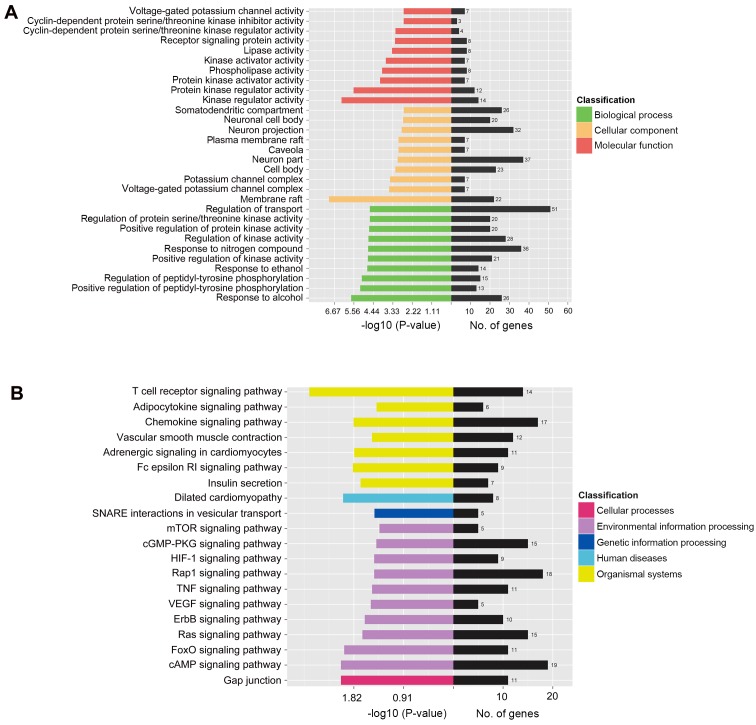
GO annotation and KEGG pathway enrichment analysis of predicted miRNA targets. (A) GO enrichment for predicted target genes of the eight upregulated miRNAs. No. of genes enriched and −log10 (P-value) for each term are displayed for the top 10 GO terms in biological process, cellular component and molecular function. (B) Top 20 enriched KEGG pathways of miRNA target genes, as demonstrated by no. of genes and −log10 (P-value). GO, Gene Ontology; KEGG, Kyoto Encyclopedia of Genes and Genomes; miRNA, microRNA.

References

    1. Owan TE, Hodge DO, Herges RM, Jacobsen SJ, Roger VL, Redfield MM. Trends in prevalence and outcome of heart failure with preserved ejection fraction. N Engl J Med. 2006;355:251–259. doi: 10.1056/NEJMoa052256. - DOI - PubMed
    1. Cingolani OH, Yang XP, Cavasin MA, Carretero OA. Increased systolic performance with diastolic dysfunction in adult spontaneously hypertensive rats. Hypertension. 2003;41:249–254. doi: 10.1161/01.HYP.0000052832.96564.0B. - DOI - PubMed
    1. Messerli FH, Rimoldi SF, Bangalore S. The transition from hypertension to heart failure: Contemporary update. JACC Heart Fail. 2017;5:543–551. doi: 10.1016/j.jchf.2017.04.012. - DOI - PubMed
    1. Gu H, Li Y, Fok H, Simpson J, Kentish JC, Shah AM, Chowienczyk PJ. Reduced first-phase ejection fraction and sustained myocardial wall stress in hyptensive patients with diastolic dysfunction: A manifestation of impaired shortening deactivation that links systolic to diastolic dysfunction and preserves systolic ejection fraction. Hypertesion. 2017;69:633–640. doi: 10.1161/HYPERTENSIONAHA.116.08545. - DOI - PMC - PubMed
    1. Slama M, Ahn J, Varagic J, Susic D, Frohlich ED. Long-term left ventricular echocardiographic follow-up of SHR and WKY rats: Effects of hypertension and age. Am J Physiol Heart Circ Physiol. 2004;286:H181–H185. doi: 10.1152/ajpheart.00642.2003. - DOI - PubMed

MeSH terms