


Response time scores on a reflexive attention task predict a child's inattention score from a parent report
- PMID: 29329307
- PMCID: PMC5766099
- DOI: 10.1371/journal.pone.0190724
Response time scores on a reflexive attention task predict a child's inattention score from a parent report
Abstract
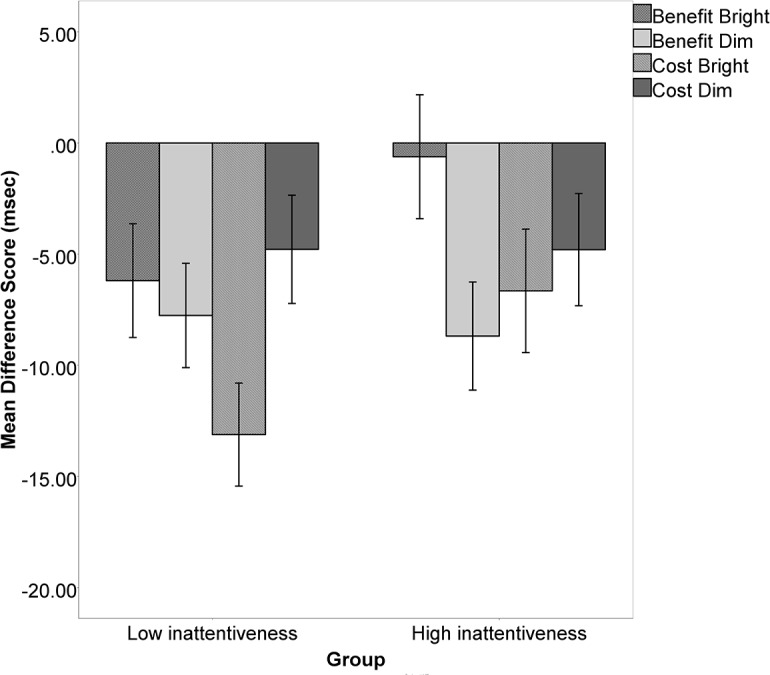
Compared to sustained attention, only a small proportion of studies examine reflexive attention as a component of everyday attention. Understanding the significance of reflexive attention to everyday attention may inform better treatments for attentional disorders. Children from a general population (recruited when they were from 9-16 years old) completed an exogenously-cued task measuring the extent to which attention is captured by peripheral cue-target conditions. Parents completed a questionnaire reporting their child's day-to-day attention. A general linear model indicated that parent-rated inattention predicted the increase in response time over baseline when a bright cue preceded the target (whether it was valid or invalid) but not when a dim cue preceded the target. More attentive children had more pronounced response time increases from baseline. Our findings suggest a link between a basic measure of cognition (response time difference scores) and parent observations. The findings have implications for increased understanding of the role of reflexive attention in the everyday attention of children.
Conflict of interest statement
Figures

References
-
- Hupp JM. Word learning and attention allocation based on word class and category knowledge. Infant Child Dev. 2015; 24(1): 44–61.
-
- Niv Y, Daniel R, Geana A, Gersham SJ, Leong YC, Radulsecu, et al. Reinforcement learning in multidimensional environments relies on attention mechanisms. J Neurosci. 2015; 35(21): 8145–8157. doi: 10.1523/JNEUROSCI.2978-14.2015 - DOI - PMC - PubMed
-
- Dogru SS. Efficacy of Montessori education in attention gathering skill of children. Educational Research and Reviews. 2015; 10(6): 733–738.
-
- Krause B, Kadosh RC. Can transcranial electrical stimulation improve learning difficulties in atypical brain development? A future possibility for cognitive training. Dev Cogn Neurosci. 2013; 6: 176–194. doi: 10.1016/j.dcn.2013.04.001 - DOI - PMC - PubMed
Publication types
MeSH terms
Grants and funding
LinkOut - more resources
Full Text Sources
Other Literature Sources
