


Exercise during and after neoadjuvant rectal cancer treatment (the EXERT trial): study protocol for a randomized controlled trial
- PMID: 29329555
- PMCID: PMC5767015
- DOI: 10.1186/s13063-017-2398-1
Exercise during and after neoadjuvant rectal cancer treatment (the EXERT trial): study protocol for a randomized controlled trial
Abstract
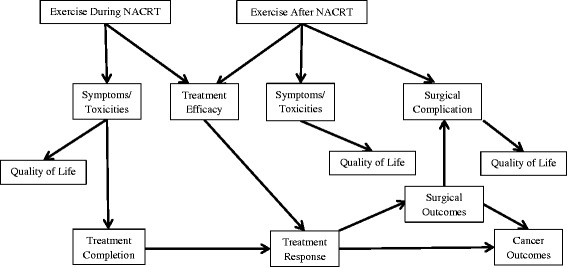
Background: Standard treatment for locally advanced rectal cancer includes 5-6 weeks of neoadjuvant chemoradiotherapy (NACRT) followed by total mesorectal excision 6-8 weeks later. NACRT improves local disease control and surgical outcomes but also causes side effects including fatigue, diarrhea, hand-foot syndrome, and physical deconditioning that may impede quality of life (QoL), treatment completion, treatment response, and long-term prognosis. Interventions to improve treatment outcomes and manage side effects that are safe, tolerable and low-cost are highly desirable. Exercise has been shown to improve some of these outcomes in other cancer patient groups but no study to date has examined the potential benefits (and harms) of exercise training during and after NACRT for rectal cancer.
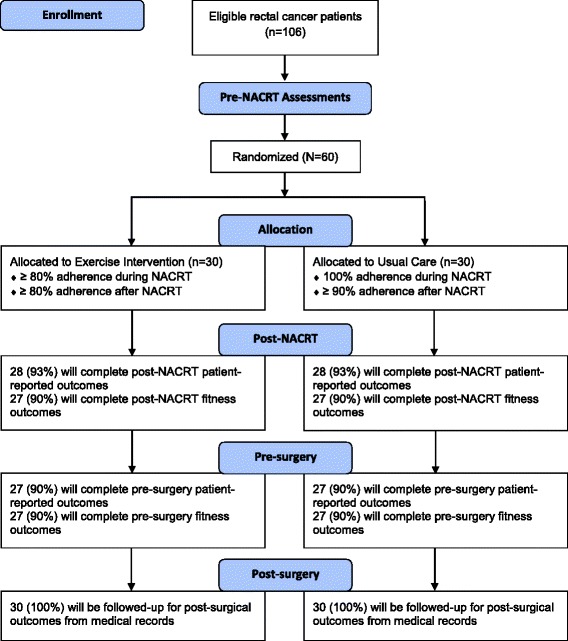
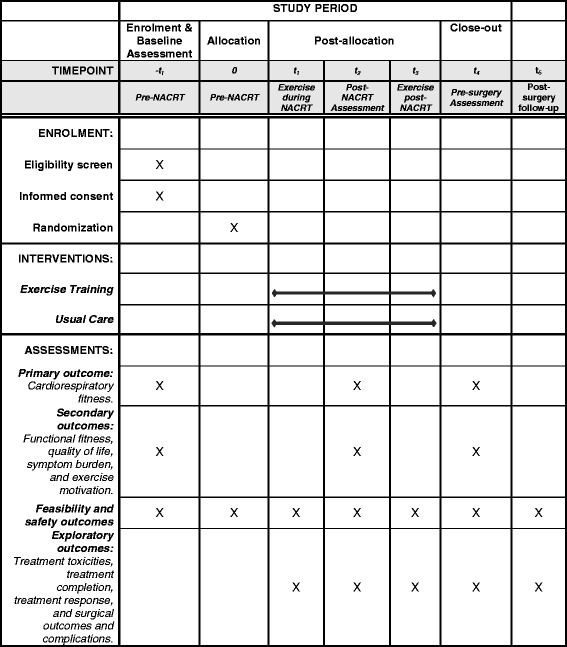
Methods/design: The Exercise During and After Neoadjuvant Rectal Cancer Treatment (EXERT) trial is a single-center, prospective, two-armed, phase II randomized controlled trial designed to test the preliminary efficacy of exercise training in this clinical setting and to further evaluate its feasibility and safety. Participants will be 60 rectal cancer patients scheduled to receive long-course NACRT followed by total mesorectal excision. Participants will be randomly assigned to exercise training or usual care. Participants in the exercise training group will be asked to complete three supervised, high-intensity interval training sessions/week during NACRT and ≥ 150 min/week of unsupervised, moderate-to-vigorous-intensity, continuous exercise training after NACRT prior to surgery. Participants in the usual care group will be asked not to increase their exercise from baseline. Assessments will be completed pre NACRT, post NACRT, and pre surgery. The primary endpoint will be cardiorespiratory fitness (VO2 peak) at the post-NACRT time point assessed by a graded exercise test. Secondary endpoints will include functional fitness assessed by the Senior's Fitness Test, QoL assessed by the European Organisation of Research and Treatment of Cancer, and symptom management assessed by the M.D. Anderson Symptom Inventory. Exploratory clinical endpoints will include treatment toxicities, treatment completion, treatment response, and surgical complications.
Discussion: If the preliminary findings of EXERT are positive, additional research will be warranted to confirm whether exercise is an innovative treatment to maintain QoL, manage side effects, and/or improve treatment outcomes in rectal cancer patients.
Trial registration: ClinicalTrials.gov, ID: NCT03082495 . Registered on 9 February, 2017.
Keywords: Cancer; Exercise; Physical activity; Physical fitness; Quality of life; Symptom management.
Conflict of interest statement
Ethics approval and consent to participate
Ethics approval has been granted by the Health Research Ethics Board of Alberta (HREBA)-Cancer Committee (CC) (HREBA.CC-16-0986). All participants are required to provide written informed consent prior to participating in this study.
Consent for publication
Not applicable.
Competing interests
The authors declare that they have no competing interests.
Publisher’s Note
Springer Nature remains neutral with regard to jurisdictional claims in published maps and institutional affiliations.
Figures
References
-
- Sauer R, Liersch T, Merkel S, Fietkau R, Hohenberger W, Hess C, et al. Preoperative versus postoperative chemoradiotherapy for locally advanced rectal cancer: results of the German CAO/ARO/AIO-94 randomized phase III trial after a median follow-up of 11 years. J Clin Oncol. 2012;30(16):1926–33. doi: 10.1200/JCO.2011.40.1836. - DOI - PubMed
Publication types
MeSH terms
Associated data
Grants and funding
LinkOut - more resources
Full Text Sources
Other Literature Sources
Medical
