


Metabolic syndrome, hypertension, and hyperlipidemia in mothers, fathers, sisters, and brothers of women with polycystic ovary syndrome: a systematic review and meta-analysis
- PMID: 29331234
- PMCID: PMC5983376
- DOI: 10.1016/j.fertnstert.2017.10.018
Metabolic syndrome, hypertension, and hyperlipidemia in mothers, fathers, sisters, and brothers of women with polycystic ovary syndrome: a systematic review and meta-analysis
Abstract
Objective: To provide an evidence-based assessment of metabolic syndrome, hypertension, and hyperlipidemia in first-degree relatives of women with polycystic ovary syndrome (PCOS).
Design: Systematic review and meta-analysis.
Setting: Not applicable.
Patient(s): Mothers, fathers, sisters, and brothers of women with and without PCOS.
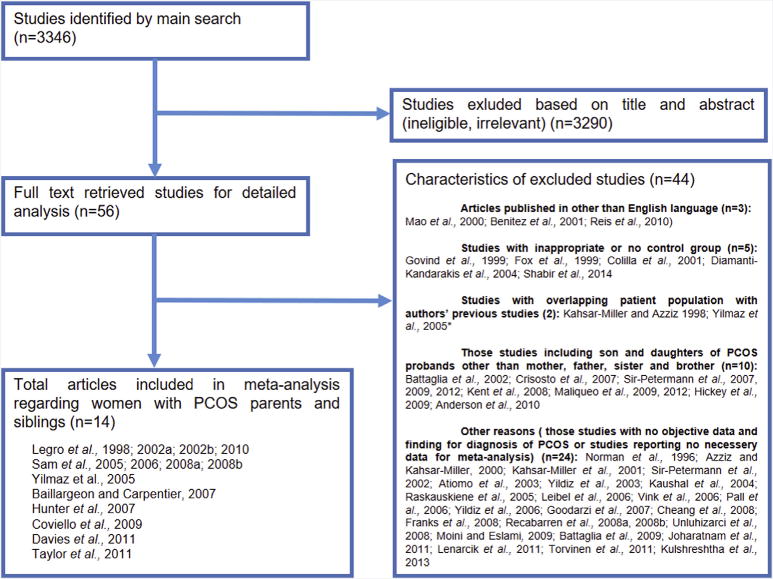
Intervention(s): An electronic-based search with the use of PubMed from 1960 to June 2015 and cross-checked references of relevant articles.
Main outcome measure(s): Metabolic syndrome, hypertension and dyslipidemia, and surrogate markers, including systolic blood pressure (BP), diastolic BP, total cholesterol, low-density lipoprotein cholesterol, high-density lipoprotein cholesterol, and triglycerides.
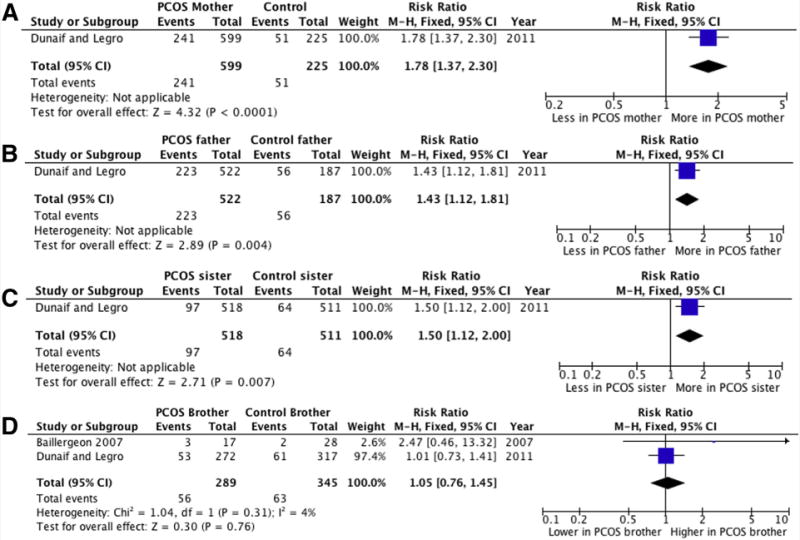
Result(s): Fourteen of 3,346 studies were included in the meta-analysis. Prevalence of the following was significantly increased in relatives of women with PCOS: metabolic syndrome (risk ratio [RR] 1.78 [95% confidence interval 1.37, 2.30] in mothers, 1.43 [1.12, 1.81] in fathers, and 1.50 [1.12, 2.00] in sisters), hypertension (RR 1.93 [1.58, 2.35] in fathers, 2.92 [1.92, 4.45] in sisters), and dyslipidemia (RR 3.86 [2.54, 5.85] in brothers and 1.29 [1.11, 1.50] in fathers). Moreover, systolic BP (mothers, sisters, and brothers), total cholesterol (mothers and sisters), low-density lipoprotein cholesterol (sisters), and triglycerides (mothers and sisters) were significantly higher in first-degree relatives of PCOS probands than in controls.
Conclusion(s): Our results show evidence of clustering for metabolic syndrome, hypertension, and dyslipidemia in mothers, fathers, sisters, and brothers of women with PCOS.
Systematic review registration number: PROSPERO 2016 CRD42016048557.
Keywords: Dyslipidemia; first-degree relatives; hypertension; metabolic syndrome; polycystic ovary syndrome.
Copyright © 2017 American Society for Reproductive Medicine. Published by Elsevier Inc. All rights reserved.
Figures
Comment in
-
Family Ties.Fertil Steril. 2018 Feb;109(2):254-255. doi: 10.1016/j.fertnstert.2017.11.024. Epub 2018 Jan 6. Fertil Steril. 2018. PMID: 29317128 No abstract available.
References
-
- Knochenhauer ES, Key TJ, Kahsar-Miller M, Waggoner W, Boots LR, Azziz R. Prevalence of the polycystic ovary syndrome in unselected black and white women of the southeastern United States: a prospective study. J Clin Endocrinol Metab. 1998;83:3078–82. - PubMed
-
- Azziz R, Woods KS, Reyna R, Key TJ, Knochenhauer ES, Yildiz BO. The prevalence and features of the polycystic ovary syndrome in an unselected population. J Clin Endocrinol Metab. 2004;89:2745–9. - PubMed
-
- Yildiz BO, Bozdag G, Yapici Z, Esinler I, Yarali H. Prevalence, phenotype and cardiometabolic risk of polycystic ovary syndrome under different diagnostic criteria. Hum Reprod. 2012;27:3067–73. - PubMed
-
- Zawadzki J, Dunaif A. Diagnostic criteria for polycystic ovary syndrome: towards a rational approach. In: Dunaif A, Givens JR, Haseltine FP, Merriam GR, editors. Polycystic ovary syndrome (current issues in endocrinology and metabolism) Boston: Blackwell Scientific; 1992. pp. 377–84.
-
- Rotterdam ESHRE/ASRM-Sponsored PCOS Consensus Workshop Group. Revised 2003 consensus on diagnostic criteria and long-term health risks related to polycystic ovary syndrome. Fertil Steril. 2004;81:19–25. - PubMed
Publication types
MeSH terms
Grants and funding
LinkOut - more resources
Full Text Sources
Other Literature Sources
Medical
