Review
. 2018 Jun:43:108-116.
doi: 10.1016/j.mib.2017.12.013. Epub 2018 Jan 12.

Lessons from simple marine models on the bacterial regulation of eukaryotic development

Affiliations
Review

Lessons from simple marine models on the bacterial regulation of eukaryotic development

Arielle Woznica et al. Curr Opin Microbiol. 2018 Jun.

Abstract

Molecular cues from environmental bacteria influence important developmental decisions in diverse marine eukaryotes. Yet, relatively little is understood about the mechanisms underlying these interactions, in part because marine ecosystems are dynamic and complex. With the help of simple model systems, including the choanoflagellate Salpingoeca rosetta, we have begun to uncover the bacterial cues that shape eukaryotic development in the ocean. Here, we review how diverse bacterial cues-from lipids to macromolecules-regulate development in marine eukaryotes. It is becoming clear that there are networks of chemical information circulating in the ocean, with both eukaryotes and bacteria acting as nodes; one eukaryote can precisely respond to cues from several diverse environmental bacteria, and a single environmental bacterium can regulate the development of different eukaryotes.


Figures

Figure 1
Figure 1
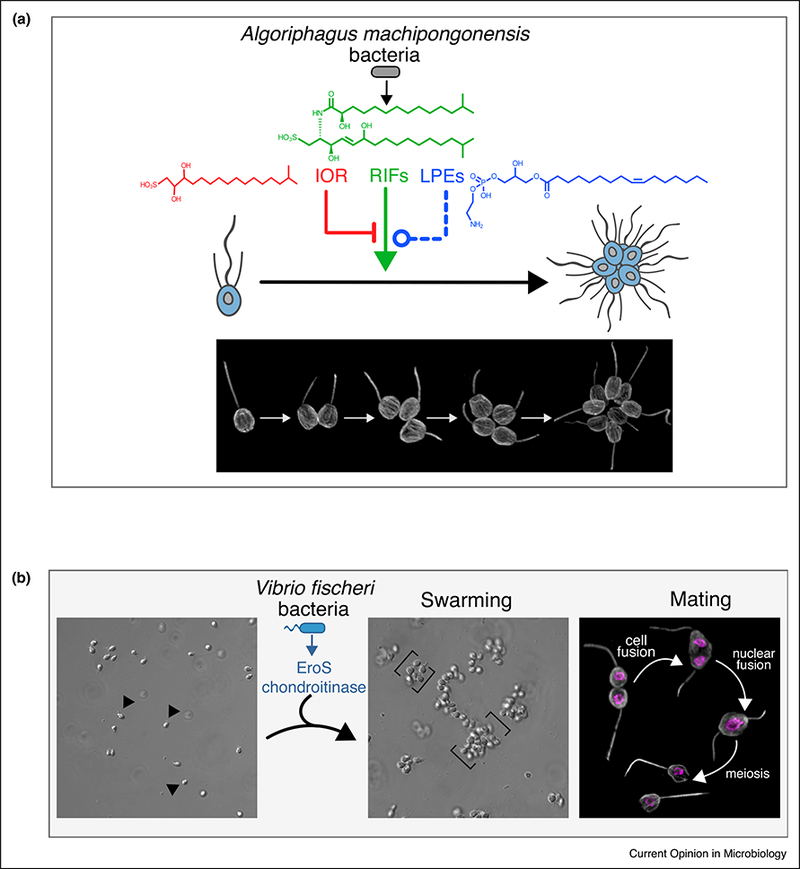
Bacteria regulate rosette development and sexual reproduction in the choanoflagellate, S. rosetta. (a) Algoriphagus machipongonensis bacteria regulate the development of S. rosetta from a solitary cell into a multicellular ‘rosette’ colony through serial rounds of cell division. Algoriphagus produces three classes of lipids — sulfonolipids (RIFs), lysophosphatidylethanolamines (LPEs), and a capnine (IOR-1) — that interact to alternately induce, enhance, or inhibit rosette development. While the sulfonolipid RIFs are sufficient to initiate rosette development in S. rosetta, they require the synergistic enhancing activity of the LPEs for robust rosette development. Algoriphagus also produces the inhibitory IOR-1 that inhibits the RIFs, but cannot overcome the synergistic inducing activity of the RIFs + LPEs. Immunofluorescence images illustrate stages of S. rosetta rosette development; tubulin staining (gray) highlights the cell body and apical flagellum. (b) Vibrio fischeri bacteria induce sexual reproduction in S. rosetta. EroS, a chondroitin lyase secreted by V. fischeri, triggers solitary S. rosetta cells (arrows) to form large swarms (brackets) through cell aggregation. During swarming, S. rosetta cells pair off and mate, a process that involves the cell and nuclear fusion of two haploid cells into one diploid cell, followed by meiosis to generate haploid progeny. Immunofluorescence images depict mating stages in S. rosetta; tubulin staining (gray) highlights the cell body and apical flagellum, and Hoechst staining (magenta) highlights the nucleus.
Figure 2
Figure 2
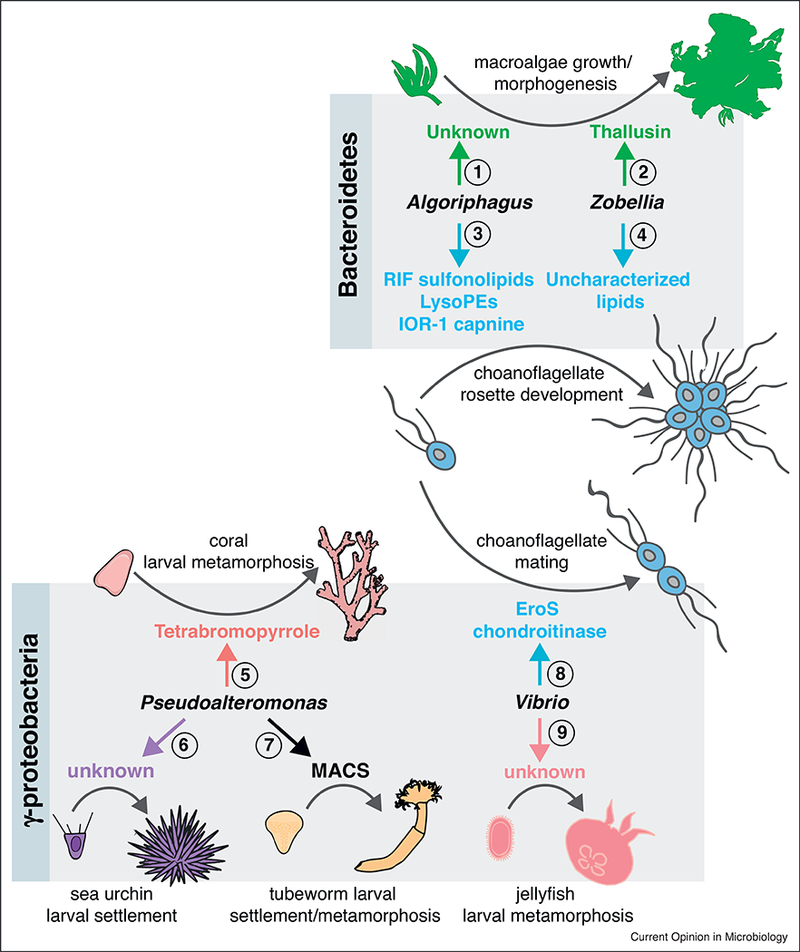
Distinct molecular cues from environmental Bacteroidetes and Gammaproteobacteria regulate developmental transitions in diverse marine eukaryotes. The Bacteroidetes bacteria Algoriphagus and Zobellia uliginosa regulate morphogenesis in organisms as diverse as algae and choanoflagellates. (1) Uncharacterized factors produced by Algoriphagus induce morphogenesis in the macroalgae Ulva mutabilis. (2) Algoriphagus machipongonensis lipids [sulfonolipids, lysophosphatidylethanolamines, and a capnine] regulate rosette development in the choanoflagellate Salpingoeca rosetta. (3) Thallusin, an amino acid derivative produced by Zobellia uliginosa, induces morphogenesis in the macroalgae Monostroma oxyspermum. (4) Uncharacterized molecules from Zobellia uliginosa induce rosette development in the choanoflagellate Salpinogeca rosetta. Gammaproteobacteria can likewise elicit developmental responses in diverse animals and choanoflagellates. (5) Tetrabromopyrrole produced by Pseudoalteromonas spp. induces larval metamorphosis in corals Acropora millepora and Acropora willisae, and larval settlement (attachment and metamorphosis) in the coral Porites astreoides. (6) Uncharacterized cues from Pseudoalteromonas bacteria induce larval settlement in the sea urchin Heliocidaris erythrogramma. (7) Pseudoalteromonas luteoviolacea produces arrays of contractile phage tail-like structures (MACs) that trigger metamorphosis of the tubeworm Hydroides elegans. (8) A chondroitinase (EroS) secreted by Vibrio fischeri induces mating in the choanoflagellate S. rosetta. (9) Unknown cues secreted by Vibrio alginolyticus induce larval metamorphosis in the jellyfish Cassiopea andromeda.

References

    1. Mcfall-Ngai M, Hadfield MG, Bosch TCG, Carey HV, Domazet-Loo T, Douglas AE, Dubilier N, Eberl G, Fukami T, Gilbert SF et al. : Animals in a bacterial world, a new imperative for the life sciences. Proc Natl Acad Sci USA 2013, 110:3229–3236. - PMC - PubMed
    1. Vandenkoornhuyse P, Quaiser A, Duhamel M, Le Van A, Dufresne A: The importance of the microbiome of the plant holobiont. New Phytol 2015, 206:1196–1206. - PubMed
    1. Badri DV, Weir TL, van der Lelie D, Vivanco JM: Rhizosphere chemical dialogues: plant-microbe interactions. Curr Opin Biotechnol 2009, 20:642–650. - PubMed
    1. McFall-Ngai MJ, Ruby EG: Symbiont recognition and subsequent morphogenesis as early events in an animal-bacterial mutualism. Science 1991, 254:1491–1494. - PubMed
    1. Sommer F, Bäckhed F: The gut microbiota — masters of host development and physiology. Nat Rev Microbiol 2013, 11:227–238. - PubMed

Publication types

MeSH terms