


Familial and ethnic risk in inflammatory bowel disease
- PMID: 29333063
- PMCID: PMC5759609
- DOI: 10.20524/aog.2017.0208
Familial and ethnic risk in inflammatory bowel disease
Abstract
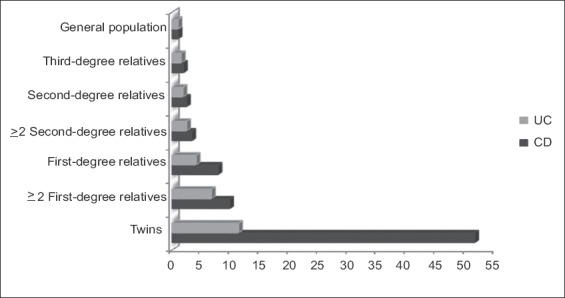
Familial aggregation in inflammatory bowel disease (IBD) has been established for several decades, reflecting shared genetic and environmental susceptibility. A positive family history remains the strongest recognizable risk factor for the development of IBD and is reported in around 8-12% of IBD patients. Crohn's disease shows a more frequent familial pattern than ulcerative colitis. The risk of developing IBD in first-degree relatives of an affected proband is increased 4- to 8-fold. The risk for twins and children born from couples who both have IBD is also substantially higher; a cumulative effect of the number of family members affected has been described, with the highest incidence being described for families with three or more affected members. Herein, we review the available evidence regarding familial IBD, and briefly discuss the variation of IBD across different races and ethnicities, hoping to provide a useful update and a practical guide that can serve clinicians as a guide for counseling.
Keywords: Inflammatory bowel disease; counseling; ethnic risk; familial risk; first-degree relatives; phenotype.
Conflict of interest statement
Conflict of Interest: None
Figures
References
-
- Torres J, Mehandru S, Colombel JF, Peyrin-Biroulet L. Crohn's disease. Lancet. 2017;389:1741–1755. - PubMed
-
- Torres J, Burisch J, Riddle M, Dubinsky M, Colombel JF. Preclinical disease and preventive strategies in IBD: perspectives, challenges and opportunities. Gut. 2016;65:1061–1069. - PubMed
-
- Brant SR. Update on the heritability of inflammatory bowel disease: the importance of twin studies. Inflamm Bowel Dis. 2011;17:1–5. - PubMed
Publication types
LinkOut - more resources
Full Text Sources
Other Literature Sources