


Anti-Inflammatory and Anti-Obesity Properties of Food Bioactive Components: Effects on Adipose Tissue
- PMID: 29333376
- PMCID: PMC5758087
- DOI: 10.3746/pnf.2017.22.4.251
Anti-Inflammatory and Anti-Obesity Properties of Food Bioactive Components: Effects on Adipose Tissue
Abstract
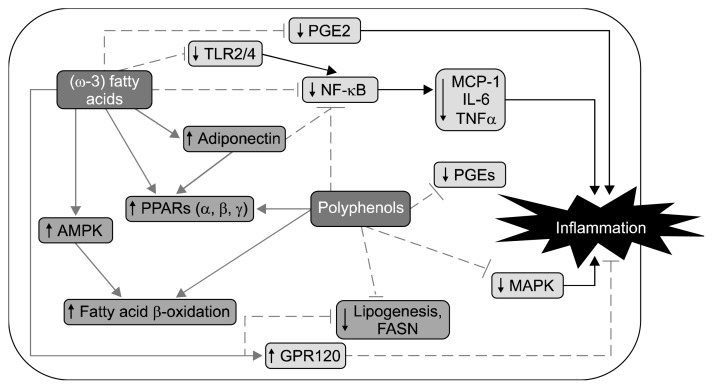
Obesity is an epidemic and costly disease affecting 13% of the adult population worldwide. Obesity is associated with adipose tissue hypertrophy and hyperplasia, as well as pathologic endocrine alterations of adipose tissue including local and chronic systemic low-grade inflammation. Moreover, this inflammation is a risk factor for both metabolic syndrome (MetS) and insulin resistance. Basic and clinical studies demonstrate that foods containing bioactive compounds are capable of preventing both obesity and adipose tissue inflammation, improving obesity-associated MetS in human subjects and animal models of obesity. In this review, we discuss the anti-obesity and anti-inflammatory protective effects of some bioactive polyphenols of plant origin and omega-3 polyunsaturated fatty acids, available for the customers worldwide from commonly used foods and/or as components of commercial food supplements. We review how these bioactive compounds modulate cell signaling including through the nuclear factor-κB, adenosine monophosphate-activated protein kinase, mitogen-activated protein kinase, toll-like receptors, and G-protein coupled receptor 120 intracellular signaling pathways and improve the balance of pro- and anti-inflammatory mediators secreted by adipose tissue and subsequently lower systemic inflammation and risk for metabolic diseases.
Keywords: inflammation; obesity; omega-3 fatty acids; polyphenols.
Conflict of interest statement
AUTHOR DISCLOSURE STATEMENT The authors declare no conflict of interest.
Figures
References
-
- Kalupahana NS, Claycombe K, Newman SJ, Stewart T, Siriwardhana N, Matthan N, Lichtenstein AH, Moustaid-Moussa N. Eicosapentaenoic acid prevents and reverses insulin resistance in high-fat diet-induced obese mice via modulation of adipose tissue inflammation. J Nutr. 2010;140:1915–1922. doi: 10.3945/jn.110.125732. - DOI - PubMed
Publication types
LinkOut - more resources
Full Text Sources
Other Literature Sources