Long-term outcomes after Natural Orifice Specimen Extraction versus conventional laparoscopy-assisted surgery for rectal cancer: a matched case-control study
- PMID: 29333423
- PMCID: PMC5765275
- DOI: 10.4174/astr.2018.94.1.26
Long-term outcomes after Natural Orifice Specimen Extraction versus conventional laparoscopy-assisted surgery for rectal cancer: a matched case-control study
Abstract
Purpose: The aim of this study was to compare the long-term outcomes of total laparoscopic surgery with Natural Orifice Specimen Extraction (NOSE) with those for conventional laparoscopy (CL)-assisted surgery for treating rectal cancers.
Methods: We reviewed the prospectively collected records of 844 patients (163 NOSE and 681 CL) who underwent curative surgery for mid- or upper rectal cancers from January 2006 to November 2012. We applied propensity score analyses and compared oncological outcomes for the NOSE and CL groups in a 1:1 matched cohort.
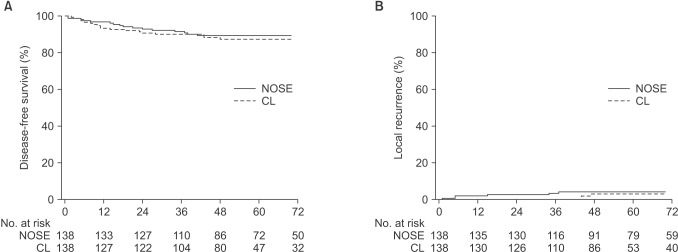
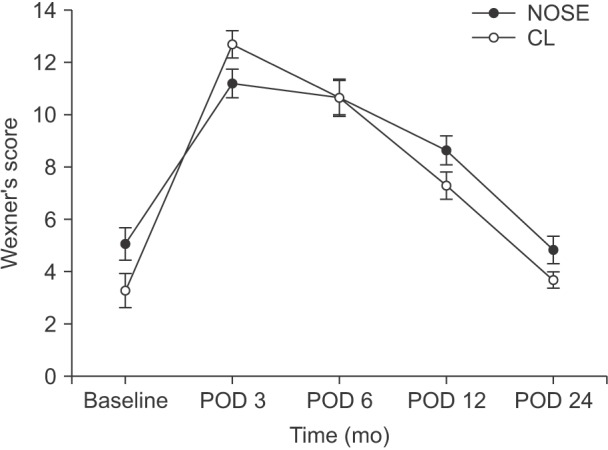
Results: After propensity score matching, each group included 138 patients; the NOSE and CL groups did not differ significantly in terms of baseline clinical characteristics. The median follow-up was 57.7 months (interquartile range, 42.4-82.5 months). The combined 5-year local recurrence rate for all tumor stages was 4.1% (95% confidence interval [CI], 0.9%-7.4%) in the NOSE group and 3.0% (95% CI, 0%-6.3%) in the CL group (P = 0.355). The combined 5-year disease-free survival rates for all stages were 89.3% (95% CI, 84.3%-94.3%) in the NOSE group and 87.3% (95% CI, 81.8%-92.9%) in the CL group (P = 0.639). The postoperative mean fecal incontinence scores at 6, 12, and 24 months were similar between the 2 groups.
Conclusion: In our experience, NOSE for mid- and upper rectal cancer had acceptable long-term oncologic outcomes comparable to those of conventional minimal invasive surgery and seems to be a safe alternative to reduce access trauma.
Keywords: Laparoscopy; Natural Orifice Endoscopic Surgery; Rectal cancer; Survival.
Conflict of interest statement
CONFLICTS OF INTEREST: No potential conflict of interest relevant to this article was reported.
Figures
References
-
- Bonjer HJ, Deijen CL, Abis GA, Cuesta MA, van der Pas MH, de Lange-de Klerk ES, et al. A randomized trial of laparoscopic versus open surgery for rectal cancer. N Engl J Med. 2015;372:1324–1332. - PubMed
-
- Jeong SY, Park JW, Nam BH, Kim S, Kang SB, Lim SB, et al. Open versus laparoscopic surgery for mid-rectal or low-rectal cancer after neoadjuvant chemoradiotherapy (COREAN trial): survival outcomes of an open-label, non-inferiority, randomised controlled trial. Lancet Oncol. 2014;15:767–774. - PubMed
-
- Park JS, Choi GS, Jun SH, Park SY, Kim HJ. Long-term outcomes after laparoscopic surgery versus open surgery for rectal cancer: a propensity score analysis. Ann Surg Oncol. 2013;20:2633–2640. - PubMed
-
- Singh R, Omiccioli A, Hegge S, McKinley C. Does the extraction-site location in laparoscopic colorectal surgery have an impact on incisional hernia rates? Surg Endosc. 2008;22:2596–2600. - PubMed
-
- Winslow ER, Fleshman JW, Birnbaum EH, Brunt LM. Wound complications of laparoscopic vs open colectomy. Surg Endosc. 2002;16:1420–1425. - PubMed
LinkOut - more resources
Full Text Sources
Other Literature Sources
Medical