Black-White Disparities in Breast Cancer Subtype: The Intersection of Socially Patterned Stress and Genetic Expression
- PMID: 29333472
- PMCID: PMC5764177
- DOI: 10.3934/publichealth.2017.5.526
Black-White Disparities in Breast Cancer Subtype: The Intersection of Socially Patterned Stress and Genetic Expression
Abstract
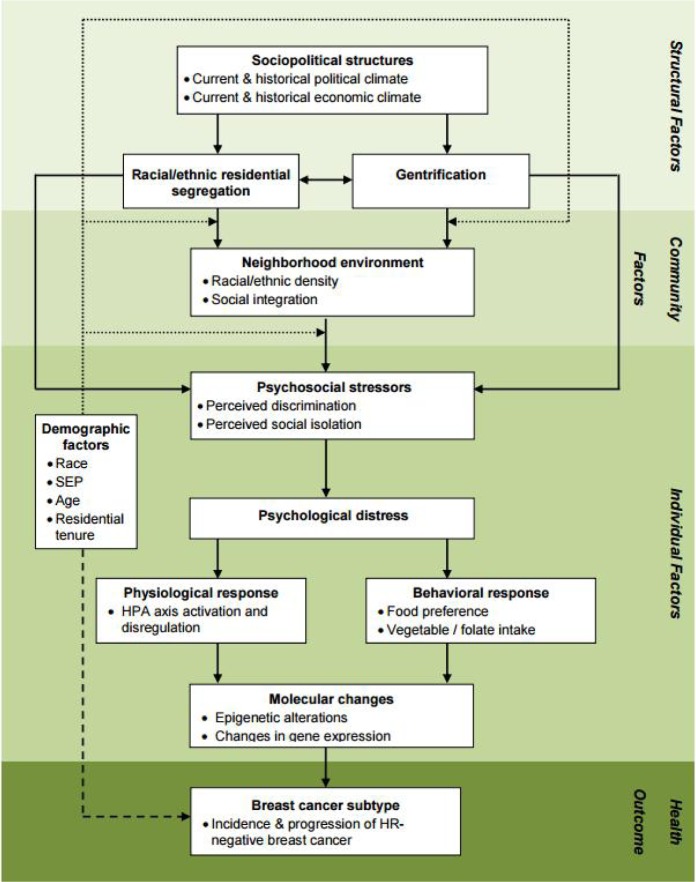
Hormone receptor negative (HR-) breast cancer subtypes are etiologically distinct from the more common, less aggressive, and more treatable form of estrogen receptor positive (ER+) breast cancer. Numerous population-based studies have found that, in the United States, Black women are 2 to 3 times more likely to develop HR- breast cancer than White women. Much of the existing research on racial disparities in breast cancer subtype has focused on identifying predisposing genetic factors associated with African ancestry. This approach fails to acknowledge that racial stratification shapes a wide range of environmental and social exposures over the life course. Human stress genomics considers the role of individual stress perceptions on gene expression. Yet, the role of structurally rooted biopsychosocial processes that may be activated by the social patterning of stressors in an historically unequal society, whether perceived by individual black women or not, could also impact cellular physiology and gene expression patterns relevant to HR- breast cancer etiology. Using the weathering hypothesis as our conceptual framework, we develop a structural perspective for examining racial disparities in breast cancer subtypes, integrating important findings from the stress biology, breast cancer epidemiology, and health disparities literatures. After integrating key findings from these largely independent literatures, we develop a theoretically and empirically guided framework for assessing potential multilevel factors relevant to the development of HR- breast cancer disproportionately among Black women in the US. We hypothesize that a dynamic interplay among socially patterned psychosocial stressors, physiological & behavioral responses, and genomic pathways contribute to the increased risk of HR- breast cancer among Black women. This work provides a basis for exploring potential alternative pathways linking the lived experience of race to the risk of HR- breast cancer, and suggests new avenues for research and public health action.
Keywords: breast cancer; health disparities; social environment; social genomics; weathering.
Conflict of interest statement
Conflict of Interest All authors declare no conflicts of interest in this paper.
Figures
References
-
- Sims AH, Howell A, Howell SJ, et al. Origins of breast cancer subtypes and therapeutic implications. Nat Clin Pract Oncol. 2007;4:516–525. - PubMed
-
- Paquet ER, Hallett MT. Absolute assignment of breast cancer intrinsic molecular subtype. J Natl Cancer Inst. 2014;107:357. - PubMed
-
- Perou CM, Sorlie T, Eisen MB, et al. Molecular portraits of human breast tumours. Nature. 2000;406:747–752. - PubMed
Grants and funding
LinkOut - more resources
Full Text Sources
Other Literature Sources