


Factors associated with recent unsuppressed viral load in HIV-1-infected patients in care on first-line antiretroviral therapy in South Africa
- PMID: 29334886
- PMCID: PMC7053422
- DOI: 10.1177/0956462417748859
Factors associated with recent unsuppressed viral load in HIV-1-infected patients in care on first-line antiretroviral therapy in South Africa
Abstract
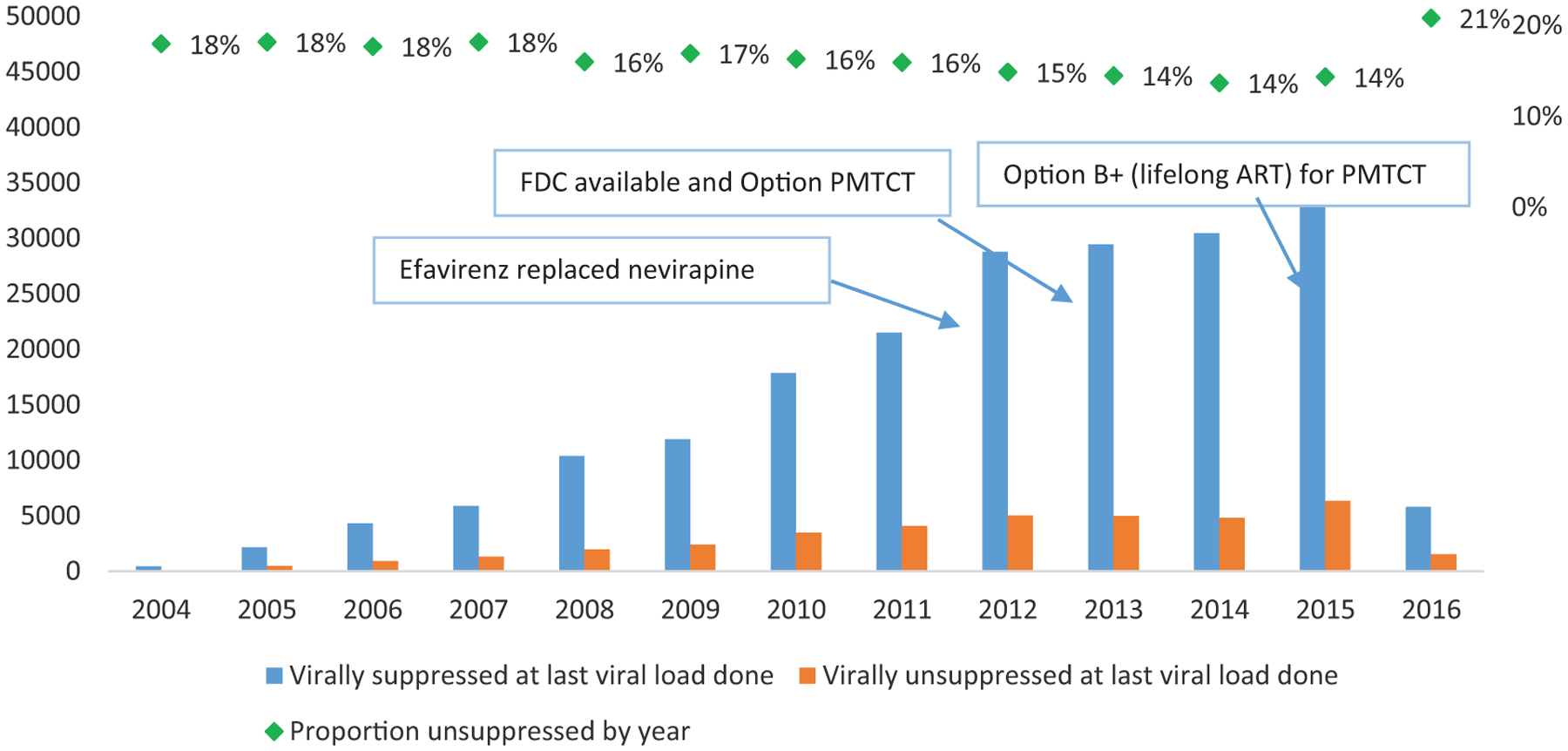
Unsuppressed viral load (VL) in patients on antiretroviral therapy (ART) occurs when treatment fails to suppress a person's VL and is associated with decreased survival and increased HIV transmission. The objective of this study was to evaluate factors associated with unsuppressed VL (VL > 400 copies/ml) in patients currently in care on first-line ART for ≥ 6 months attending South African public healthcare facilities. We analysed electronic medical records of ART patients with a VL result on record who started ART between January 2004 and April 2016 from 271 public health facilities. We present descriptive and multivariable logistic regression for unsuppressed VL at last visit using a priori variables. We included 244,370 patients (69% female) on first-line ART in April 2016 for ≥ 6 months. Median age at ART start was 33 years (7% were < 15 years old). Median duration on ART was 3.7 years. Adjusting for other variables, factors associated with having an unsuppressed VL at the most recent visit among patients in care included: (1) < 15 years old at ART start (adjusted odds ratio [aOR]=2.58; 95% CI = 2.37, 2.81) versus 15-49 years at ART start, (2) male gender (aOR = 1.29; 95% CI = 1.25, 1.35), (3) 6-12 months on ART versus longer (aOR = 1.34; 95% CI = 1.29, 1.40), (4) on tuberculosis (TB) treatment (aOR = 1.78; 95% CI = 1.48, 2.13), and (5) prior ART exposure versus none (aOR = 1.20; 95% CI = 1.08, 1.32). Approximately 85% of the ART cohort who were in care had achieved viral suppression, though men, youth/adolescents, patients with prior ART exposure, those with short duration of ART, and patients on TB treatment had increased odds of not achieving viral suppression. There is a need to develop and evaluate targeted interventions for ART patients in care who are at high risk of unsuppressed VL.
Keywords: 90–90–90; AIDS; HIV; South Africa; antiretroviral therapy; viral load; viral load suppression.
Conflict of interest statement
Declaration of conflicting interests
The authors declared the following potential conflicts of interest with respect to the research, authorship, and/or publication of this article: The contents of this article are the responsibility of BroadReach and do not necessarily reflect the views of USAID or the United States Government.
Figures
References
-
- UNAIDS. AIDS by the Numbers, http://www.unaids.org/sites/default/files/media_asset/AIDS-by-the-number... (2016, accessed 10 January 2017).
-
- Statistics South Africa. Statistical release: mid-year population estimate 2015, https://www.statssa.gov.za/publications/P0302/P03022015.pdf (2015, accessed 10 January 2017).
-
- Shisana O, Rehle T, Simbayi LC, et al. South African national HIV prevalence, incidence and behaviour survey, 2012. Cape Town: HSR Press, 2014.
-
- World Health Organization; Consolidated ARV guidelines, 2013 Chapter 7.3: monitoring response to ART and the diagnosis of treatment failure, http://www.who.int/hiv/pub/guidelines/arv2013/art/artmonitoring/en/index... (2013, accessed 13 January 2017).
Publication types
MeSH terms
Substances
Grants and funding
LinkOut - more resources
Full Text Sources
Other Literature Sources
Medical
Miscellaneous
