


Prevalence of primary aldosteronism in primary care: a cross-sectional study
- PMID: 29335324
- PMCID: PMC5774963
- DOI: 10.3399/bjgp18X694589
Prevalence of primary aldosteronism in primary care: a cross-sectional study
Abstract
Background: Primary aldosteronism (PA) is the most frequent cause of secondary hypertension. Reported prevalences of PA vary considerably because of a large heterogeneity in study methodology.
Aim: To examine the proportion of patients with PA among patients with newly diagnosed, never treated hypertension.
Design and setting: A cross-sectional study set in primary care.
Method: GPs measured aldosterone and renin in adult patients with newly diagnosed, never treated hypertension. Patients with elevated aldosterone-to-renin ratio and increased plasma aldosterone concentration underwent a saline infusion test to confirm or exclude PA. The source population was meticulously assessed to detect possible selection bias.
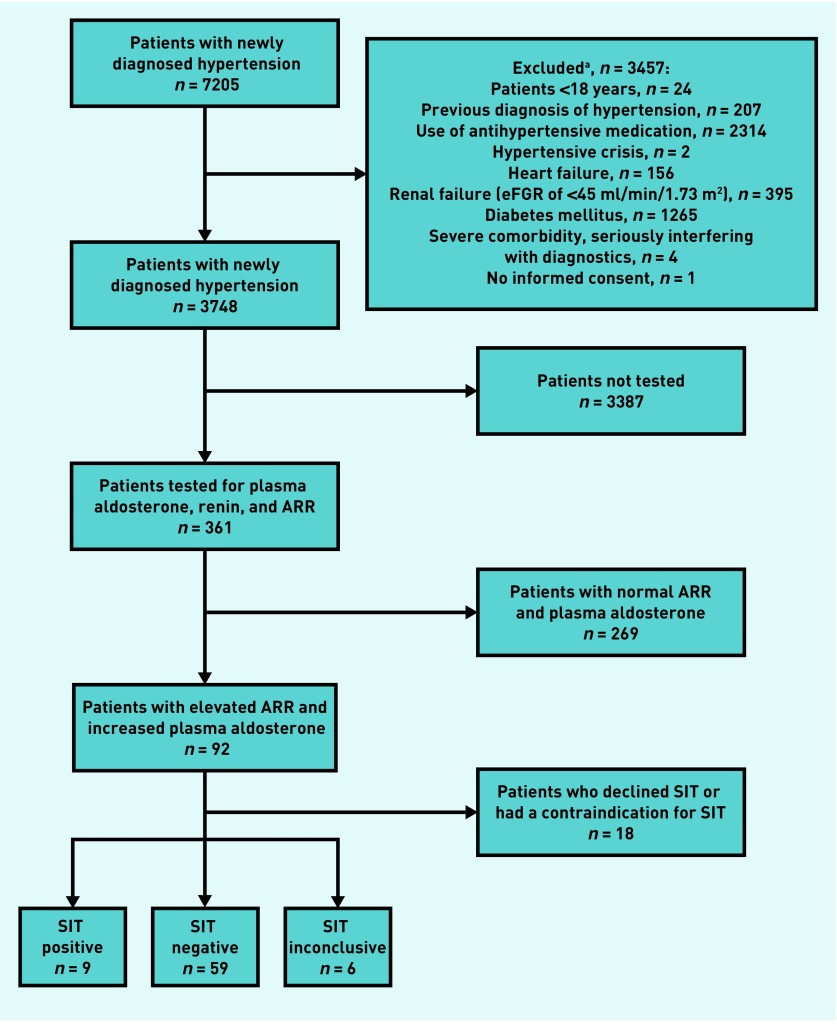
Results: Of 3748 patients with newly diagnosed hypertension, 343 patients were screened for PA. In nine out of 74 patients with an elevated aldosterone-to-renin ratio and increased plasma aldosterone concentration the diagnosis of PA was confirmed by a saline infusion test, resulting in a prevalence of 2.6% (95% confidence interval = 1.4 to 4.9). All patients with PA were normokalaemic and 8 out of 9 patients had sustained blood pressure >150/100 mmHg. Screened patients were younger (P<0.001) or showed higher blood pressure (P<0.001) than non-screened patients.
Conclusion: In this study a prevalence of PA of 2.6% in a primary care setting was established, which is lower than estimates reported from other primary care studies so far. This study supports the screening strategy as recommended by the Endocrine Society Clinical Practice Guideline. The low proportion of screened patients (9.2%), of the large cohort of eligible patients, reflects the difficulty of conducting prevalence studies in primary care clinical practice.
Keywords: general practice; hypertension; prevalence; primary aldosteronism.
© British Journal of General Practice 2018.
Figures
References
-
- Funder JW, Carey RM, Mantero F, et al. The management of primary aldosteronism: case detection, diagnosis, and treatment: an Endocrine Society Clinical Practice Guideline. J Clin Endocrinol Metab. 2016;101(5):1889–1916. - PubMed
-
- Jansen PM, Boomsma F, van den Meiracker AH, Dutch ARRAt investigators Aldosterone-to-renin ratio as a screening test for primary aldosteronism — the Dutch ARRAT study. Neth J Med. 2008;66(5):220–228. - PubMed
-
- Plouin PF, Amar L, Chatellier G. Trends in the prevalence of primary aldosteronism, aldosterone-producing adenomas, and surgically correctable aldosterone-dependent hypertension. Nephrol Dial Transplant. 2004;19(4):774–777. - PubMed
-
- Hannemann A, Wallaschofski H. Prevalence of primary aldosteronism in patient’s cohorts and in population-based studies — a review of the current literature. Horm Metab Res. 2012;44(3):157–162. - PubMed
-
- Calhoun D, Nishizaka M, Zaman A. Low prevalence of white-coat hypertension in subjects with resistant hypertension and hyperaldosteronism. J Hypertens. 2004;22:S206.
MeSH terms
Substances
LinkOut - more resources
Full Text Sources
Other Literature Sources
Medical
