Comparative Efficacy of Tumor Necrosis Factor-α Inhibitors in Ankylosing Spondylitis: A Systematic Review and Bayesian Network Metaanalysis
- PMID: 29335342
- PMCID: PMC11034828
- DOI: 10.3899/jrheum.170224
Comparative Efficacy of Tumor Necrosis Factor-α Inhibitors in Ankylosing Spondylitis: A Systematic Review and Bayesian Network Metaanalysis
Abstract
Objective: To compare the efficacy of 6 tumor necrosis factor-α inhibitors (TNFi) in treatment of ankylosing spondylitis (AS) at 12 weeks and 24 weeks.
Methods: We performed a systematic literature review of randomized controlled trials of TNFi in patients with active AS. We included trials that reported efficacy at 10 to 14 weeks (12-week analysis) and at 24 to 30 weeks (24-week analysis). We used Bayesian network metaanalysis (NMA) to compare their relative efficacy to improve the Bath Ankylosing Spondylitis Disease Activity Index (BASDAI), Bath Ankylosing Spondylitis Functional Index (BASFI), and C-reactive protein (CRP) level.
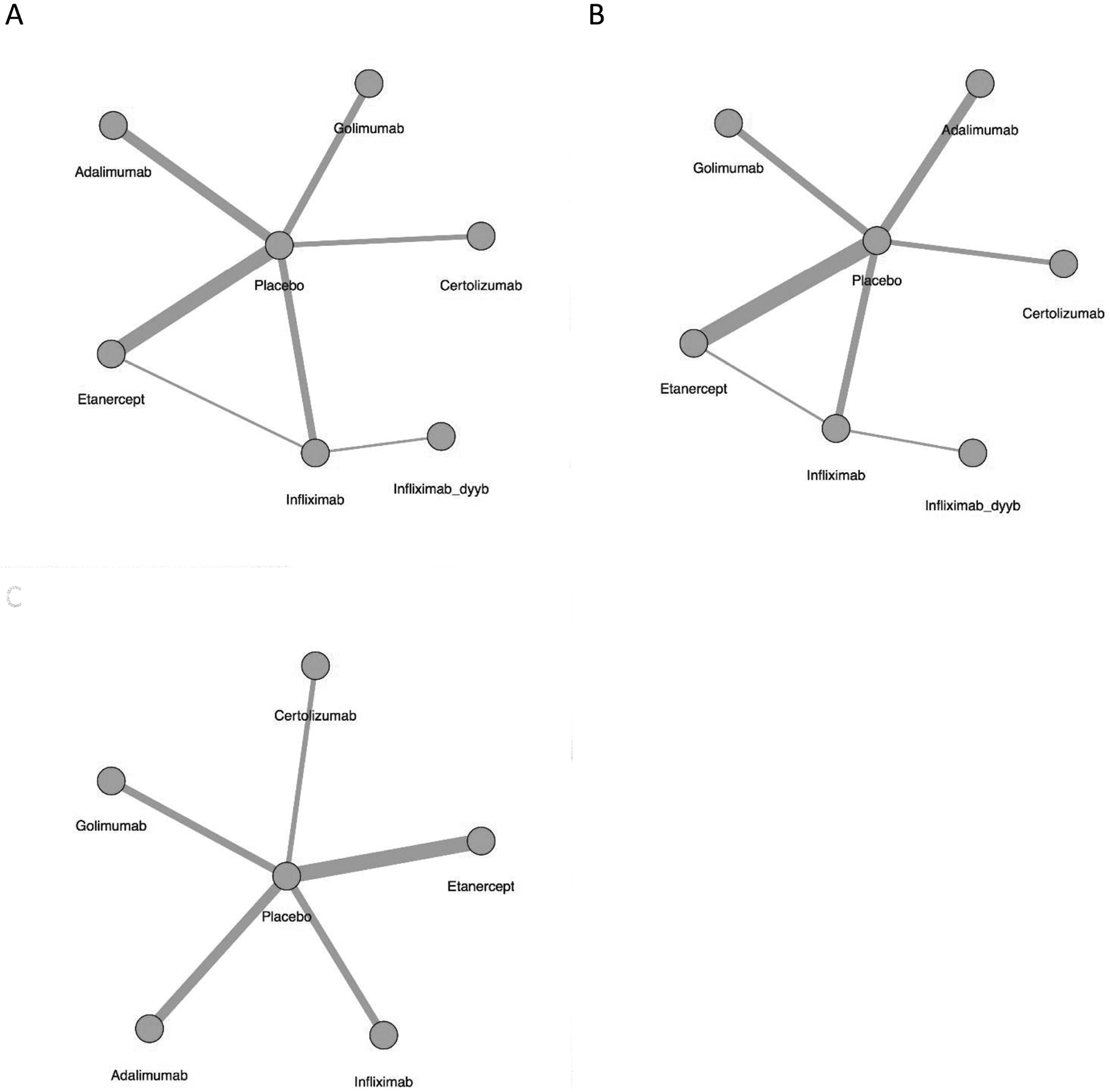
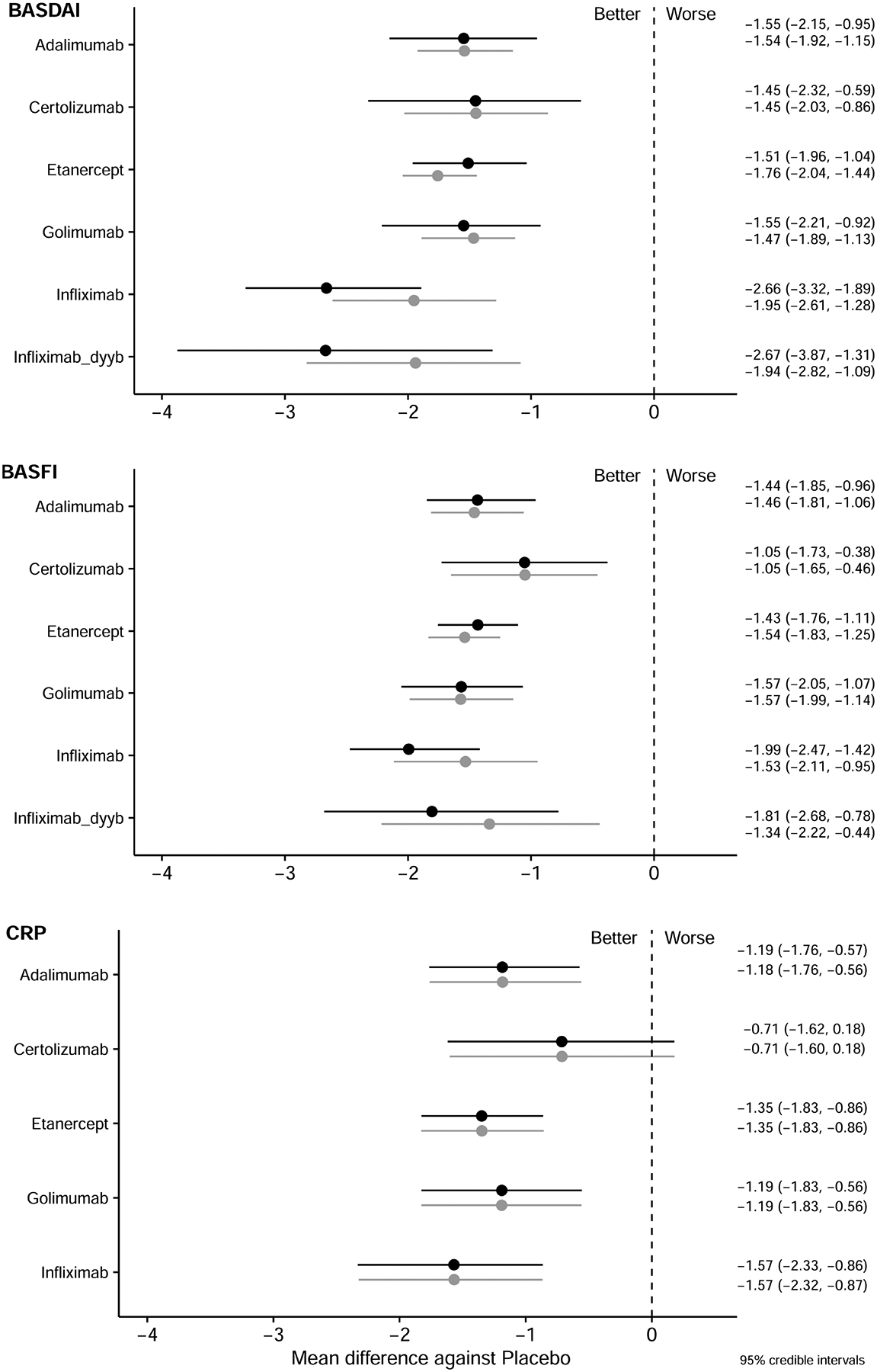
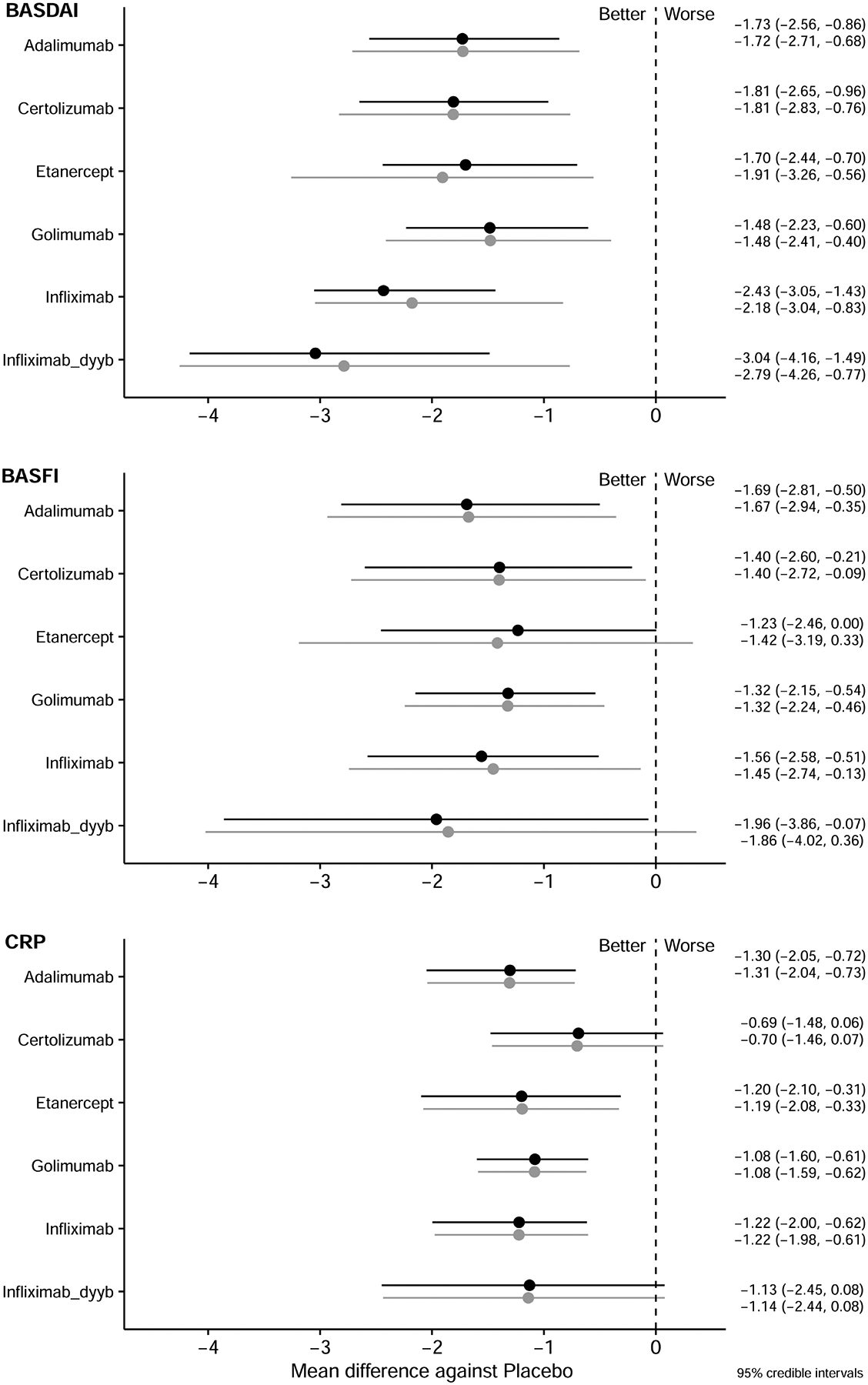
Results: We included 20 trials of 6 TNFi, with 43 treatment arms and 3220 participants. All TNFi were significantly better than placebo in reducing BASDAI and BASFI at 12 weeks and 24 weeks; all but certolizumab pegol (CZP) were statistically better than placebo in reducing CRP at 12 weeks; all but CZP and infliximab-dyyb (IFX biosimilar) were significantly better than placebo in reducing CRP at 24 weeks. IFX was superior to the other TNFi in decreasing BASDAI at 12 weeks, but not at 24 weeks. Excluding 1 open-label trial, there were no differences among TNFi.
Conclusion: Based on this NMA of clinical trials, IFX was superior to other TNFi in reducing BASDAI at 12 weeks, but sensitive to inclusion of an open-label trial, and its efficacy was diminished at 24 weeks. The analysis was limited by few direct comparison trials. Further study of relative safety and longterm effectiveness will help inform the choice of TNFi in treating active AS.
Keywords: ANKYLOSING SPONDYLITIS; COMPARATIVE EFFECTIVENESS RESEARCH; NETWORK METAANALYSIS; TUMOR NECROSIS FACTOR-Α.
Figures
Comment in
-
Mirror, Mirror, on the Wall, Which Is the Most Effective Biologic of All?J Rheumatol. 2018 Apr;45(4):449-450. doi: 10.3899/jrheum.171279. J Rheumatol. 2018. PMID: 29606643 No abstract available.
References
-
- Ward MM, Deodhar A, Akl EA, Lui A, Ermann J, Gensler LS, et al. American College of Rheumatology/Spondylitis Association of America/Spondyloarthritis Research and Treatment Network 2015 Recommendations for the Treatment of Ankylosing Spondylitis and Nonradiographic Axial Spondyloarthritis. Arthritis Rheumatol 2016;68:282–98. - PMC - PubMed
-
- Bell GM, Reynolds G, Isaacs JD. Biologic therapies in non-rheumatic diseases: lessons for rheumatologists? Nat Rev Rheumatol 2011;7:507–16. - PubMed
-
- Giardina AR, Ferrante A, Ciccia F, Impastato R, Miceli MC,Principato A, et al. A 2-year comparative open label randomized study of efficacy and safety of etanercept and infliximab in patients with ankylosing spondylitis. Rheumatol Int 2010;30:1437–40. - PubMed
-
- Park W, Hrycaj P, Jeka S, Kovalenko V, Lysenko G, Miranda P, et al. A randomised, double-blind, multicentre, parallel-group, prospective study comparing the pharmacokinetics, safety, and efficacy of CT-P13 and innovator infliximab in patients with ankylosing spondylitis: the PLANETAS study. Ann Rheum Dis 2013;72:1605–12. - PMC - PubMed
-
- Migliore A, Bizzi E, Bernardi M, Picchianti Diamanti A, Laganà B, Petrella L. Indirect comparison between subcutaneous biologic agents in ankylosing spondylitis. Clin Drug Investig 2015;35:23–9. - PubMed
Publication types
MeSH terms
Substances
Grants and funding
LinkOut - more resources
Full Text Sources
Other Literature Sources
Medical
Research Materials
Miscellaneous