


Review
doi: 10.1038/s41396-017-0028-2.
Epub 2018 Jan 15.
Saving seed microbiomes
Affiliations
- PMID: 29335636
- PMCID: PMC5931960
- DOI: 10.1038/s41396-017-0028-2
Item in Clipboard
Review
Saving seed microbiomes
ISME J.
2018 May.
Abstract
Plant seeds are home to diverse microbial communities whose composition is determined by plant genotype, environment, and management practices. Plant domestication is now recognized as an important driver of plant-associated microbial diversity. To what extent and how domestication affects seed microbiomes is less well studied. Here we propose a 'back-to-the-future' approach to harness seed microbiomes of wild relatives of crop cultivars to save and re-instate missing beneficial seed microbes for improved plant tolerance to biotic and abiotic stress.
Conflict of interest statement
The authors declare that they have no conflict of interest.
Figures
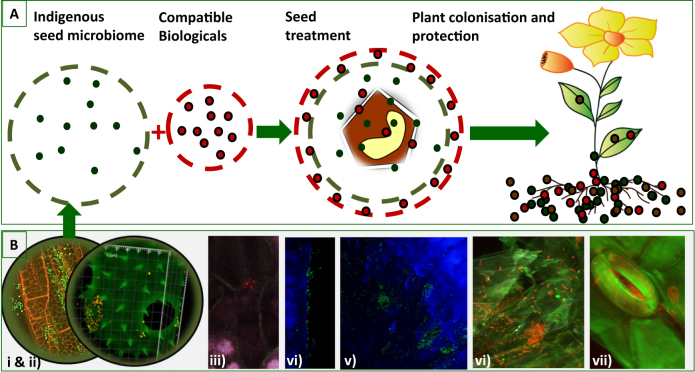
The seed microbiome. a showing the concept of compatible biologicals for crops and, b visualizing endophytes by in situ hybridization and confocal laser scanning microscopy (i) in the endosphere, (ii) on pollen, (iii) naturally occurring in seeds, (iv) after seed treatment within seed on the cotyledon, (v) after seed treatment within seed on the root hypocotyl embryo, (vi) in the rhizosphere and (vii) phyllosphere after seed treatment. Seeds were treated with Serratia plymuthica
References
Publication types
MeSH terms
LinkOut - more resources
Full Text Sources
Other Literature Sources
