


The association between different features of sleep-disordered breathing and blood pressure: A cross-sectional study
- PMID: 29338120
- PMCID: PMC8030859
- DOI: 10.1111/jch.13202
The association between different features of sleep-disordered breathing and blood pressure: A cross-sectional study
Abstract
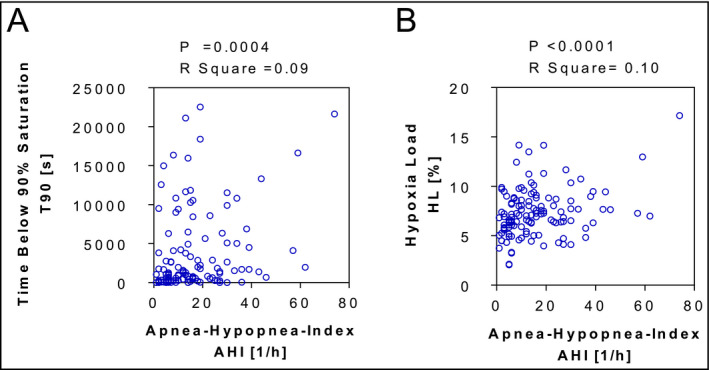
Sleep disordered breathing (SDB) is highly prevalent in patients with high blood pressure (BP). Severity of SDB can be evaluated by the number of apneas and hypopneas per hour (AHI) or by measures of hypoxia. The objective of this study was to assess the association between different measures of SDB and BP. In 134 consecutive patients, polygraphy was performed to determine the AHI. Pulse oximetry was used to determine hypoxemic burden (time below 90% oxygen saturation [T90] and hypoxia load [HL], representing the integrated area above the curve of desaturation). AHI did not correlate with systolic and diastolic BP or pulse pressure. In contrast, HL correlated with pulse pressure during the day (P = .01) and night (P = .0034) before and after adjustment for body mass index. The correlation between systolic BP and HL at night disappeared following adjustment for body mass index. This study generates the hypothesis that nocturnal hypoxemic burden may represent a suitable marker of BP pattern and a potential treatment target in hypertensive patients.
Keywords: blood pressure; hypertension; hypoxia; pulse pressure; sleep apnea.
©2018 Wiley Periodicals, Inc.
Conflict of interest statement
None.
Figures
References
-
- Linz D, Woehrle H, Bitter T, et al. The importance of sleep‐disordered breathing in cardiovascular disease. Clin Res Cardiol. 2015;104:705‐718. - PubMed
-
- Somers VK, White DP, Amin R, et al. Sleep apnea and cardiovascular disease: an American Heart Association/American College of Cardiology Foundation Scientific Statement from the American Heart Association Council for High Blood Pressure Research Professional Education Committee, Council on Clinical Cardiology, Stroke Council, and Council on Cardiovascular Nursing. In collaboration with the National Heart, Lung, and Blood Institute National Center on Sleep Disorders Research (National Institutes of Health). Circulation. 2008;118:1080‐1111. - PubMed
-
- Logan AG, Perlikowski SM, Mente A, et al. High prevalence of unrecognized sleep apnoea in drug‐resistant hypertension. J Hypertens. 2001;19:2271‐2277. - PubMed
-
- Sullivan CE, Issa FG, Berthon‐Jones M, et al. Reversal of obstructive sleep apnoea by continuous positive airway pressure applied through the nares. Lancet. 1981;1:862‐865. - PubMed
-
- Parati G, Lombardi C, Hedner J, et al. Position paper on the management of patients with obstructive sleep apnea and hypertension: joint recommendations by the European Society of Hypertension, by the European Respiratory Society and by the members of European COST (COoperation in Scientific and Technological research) ACTION B26 on obstructive sleep apnea. J Hypertens. 2012;30:633‐646. - PubMed
MeSH terms
LinkOut - more resources
Full Text Sources
Other Literature Sources
Medical
