


Identification of differentially expressed genes and pathways for intramuscular fat metabolism between breast and thigh tissues of chickens
- PMID: 29338766
- PMCID: PMC5771206
- DOI: 10.1186/s12864-017-4292-3
Identification of differentially expressed genes and pathways for intramuscular fat metabolism between breast and thigh tissues of chickens
Abstract
Background: Intramuscular fat (IMF) is one of the important factors influencing meat quality, however, for chickens, the molecular regulatory mechanisms underlying this trait have not yet been clear. In this study, a systematic identification of differentially expressed genes (DEGs) and molecular regulatory mechanism related to IMF metabolism between Beijing-you chicken breast and thigh at 42 and 90 days of age was performed.
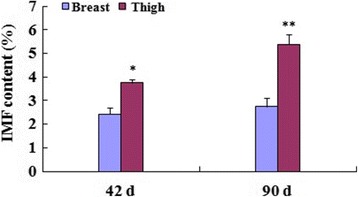
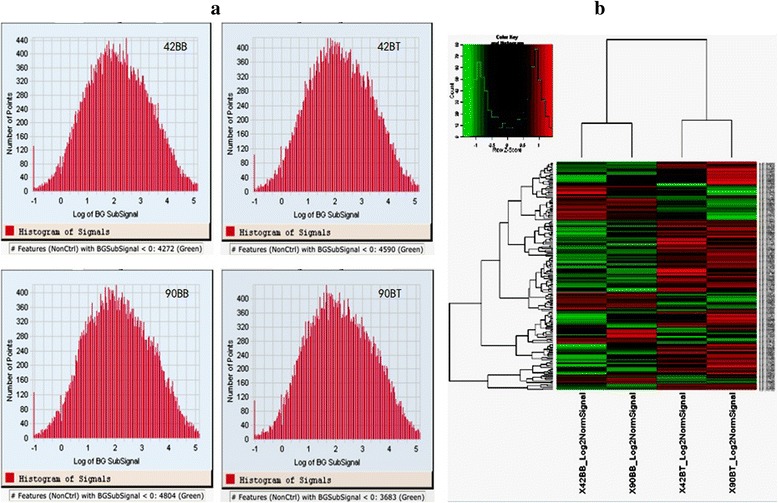
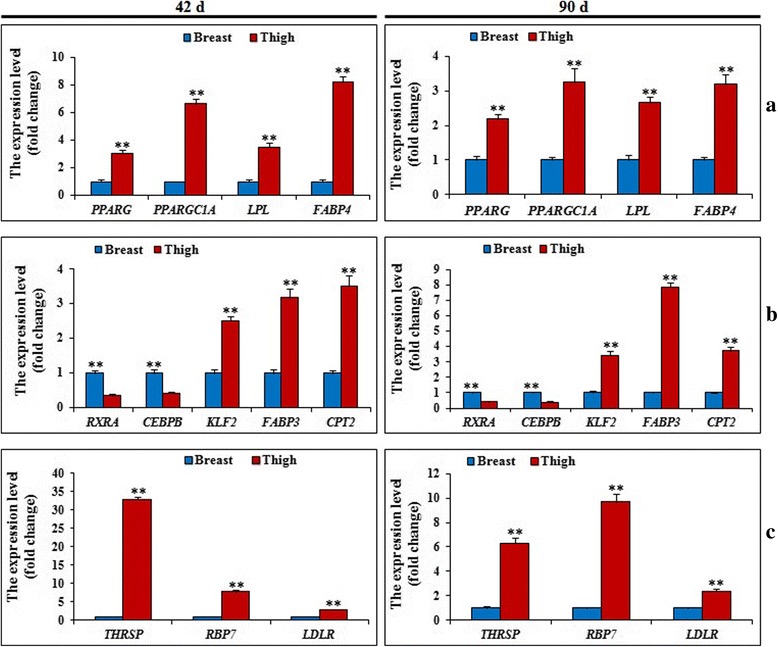
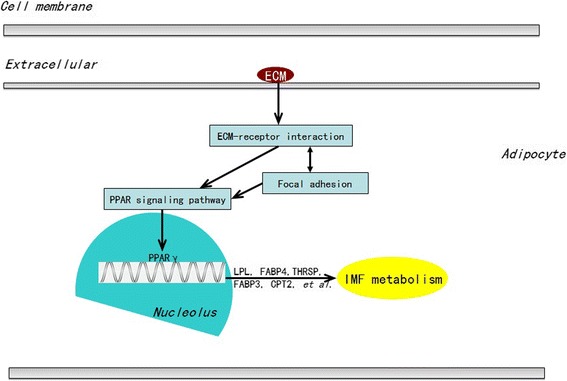
Results: IMF contents, Gene Ontology (GO) terms, and Kyoto Encyclopedia of Genes and Genomes (KEGG) pathways were analyzed, The results showed that both IMF contents in breast at 42 and 90 d were significantly lower (P < 0.05 or P < 0.01) than those in thigh. By microarray, 515 common known DEGs and 36 DEGs related to IMF metabolism were identified between the breast and thigh at 42 and 90 d. Compared to thigh, the expression levels of PPARG had significantly down-regulated (P < 0.01) in breast, but the expression levels of RXRA and CEBPB had significantly up-regulated (P < 0.01). However, the expression levels of LPL, FABP4, THRSP, RBP7, LDLR, FABP3, CPT2 and PPARGC1A had significantly down-regulated in breast (P < 0.01), supporting that PPARG and its down-stream genes had the important regulatory function to IMF deposition. In addition, based on of DEGs, KEGG analysis revealed that PPAR signaling pathway and cell junction-related pathways (focal adhesion and ECM-receptor interaction, which play a prominent role in maintaining the integrity of tissues), might contribute to the IMF metabolism in chicken.
Conclusions: Our data had screened the potential candidate genes associated with chicken IMF metabolism, and imply that IMF metabolism in chicken is regulated and mediated not only by related functional genes and PPAR pathway, but also by others involved in cell junctions. These findings establish the groundwork and provide new clues for deciphering the molecular mechanisms underlying IMF deposition in poultry. Further studies at the translational and posttranslational level are now required to validate the genes and pathways identified here.
Keywords: Breast and thigh; Chicken; Differentially expressed gene; Intramuscular fat; Microarray; Regulatory mechanism.
Conflict of interest statement
Ethics approval and consent to participate
The animal in this study was conducted in accordance with the Guidelines for the Experimental Animals, established by the Ministry of Science and Technology (Beijing, China). Animal experiments were approved by the Science Research Department (in charge of animal welfare issue) of the Institute of Animal Sciences, CAAS (Beijing, China).
Consent for publication
Not applicable.
Competing interests
The authors declare that they have no competing interests.
Publisher’s Note
Springer Nature remains neutral with regard to jurisdictional claims in published maps and institutional affiliations.
Figures
References
-
- Suzuki K, Irie M, Kadowaki H, Shibata T, Kumagai M, Nishida A. Genetic parameter estimates of meat quality traits in Duroc pigs selected for average daily gain, longissimus muscle area, backfat thickness, and intramuscular fat content. J Anim Sci. 2005;83(9):2058–2065. doi: 10.2527/2005.8392058x. - DOI - PubMed
Publication types
MeSH terms
Grants and funding
LinkOut - more resources
Full Text Sources
Other Literature Sources
Research Materials
Miscellaneous
